
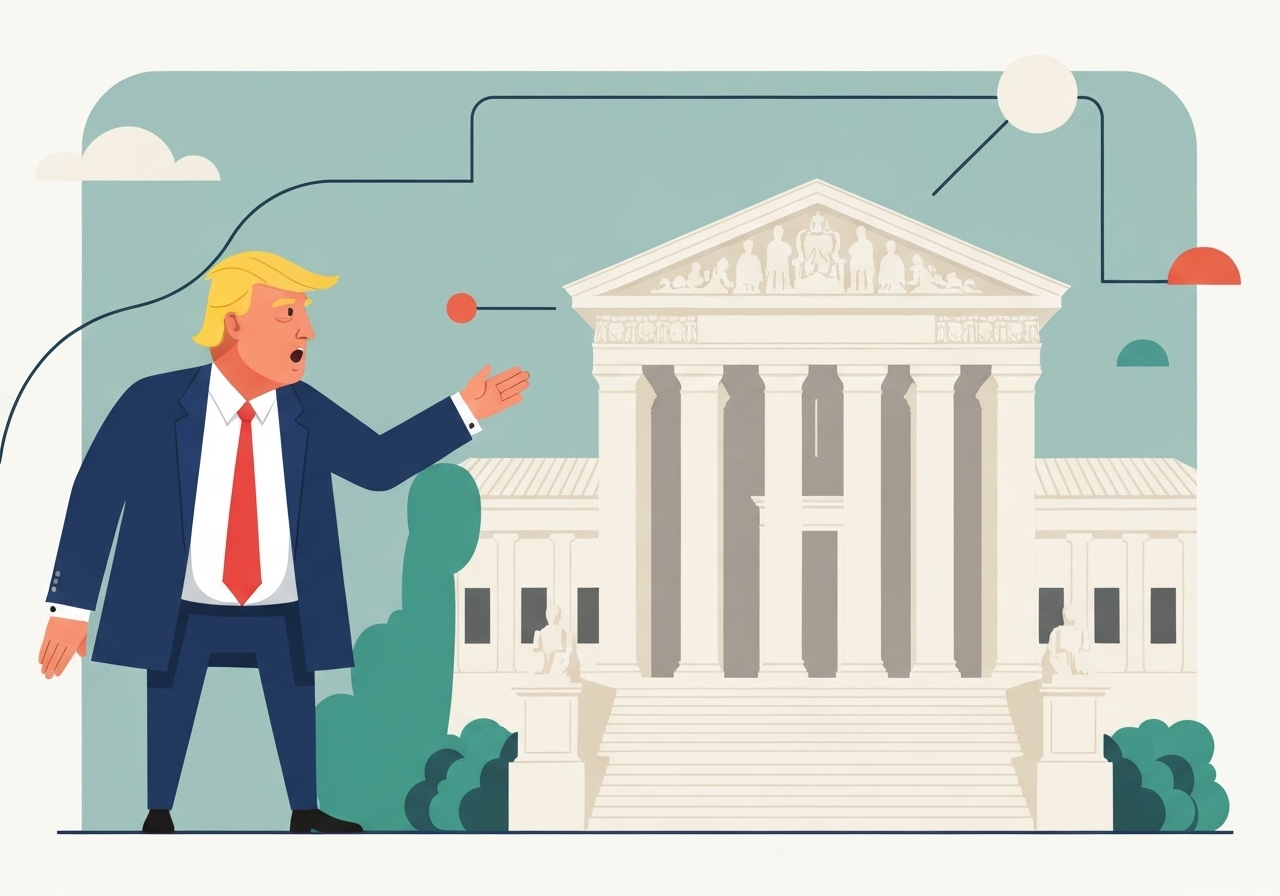
— President Donald Trump asked the U.S. Supreme Court on Wednesday night to quickly take up and rule on an appeal seeking to overturn a 7-4 Federal Circuit decision that found most of his tariffs unlawful.
Key Takeaways
- Trump has asked the Supreme Court to hear arguments in early November and to issue a prompt final decision.
- The U.S. Court of Appeals for the Federal Circuit ruled 7-4 that the president exceeded authority by using IEEPA to impose broad tariffs.
- The appeals court paused its judgment until Oct. 14 to allow for an appeal to the high court.
- Administration filings warn that delaying a resolution until June 2026 could mean $750 billion to $1 trillion in tariffs have already been collected.
- Treasury Secretary Scott Bessent said the appeals court ruling harms diplomatic tools and national-security protections, in a declaration attached to the request.
- Plaintiffs represented by the Liberty Justice Center say the IEEPA-based tariffs are unlawful and have asked the court to resolve the case quickly.
Verified Facts
The U.S. Court of Appeals for the Federal Circuit issued a 7-4 decision finding that President Trump went beyond presidential authority when he relied on the International Emergency Economic Powers Act (IEEPA) to impose sweeping tariffs on imports from nearly every trading partner. The court said tariffs are principally a Congressional power.
Following that ruling, the appeals court stayed its order until Oct. 14, 2025, providing a window for the administration to seek Supreme Court review and for the high court to consider whether to pause the decision while it decides the appeal.
In his petition to the Supreme Court, the president asked the justices to hear oral argument in early November 2025 and to issue a final ruling shortly thereafter. The filings, obtained by plaintiffs’ counsel and cited in related reporting, note that a normal Supreme Court timetable could push a decision into early summer 2026.
Treasury Secretary Scott Bessent filed a declaration attached to the request, saying the appeals court ruling “gravely undermines the President’s ability to conduct real-world diplomacy and his ability to protect the national security and economy of the United States.” The administration cautioned that waiting until June 2026 could result in between $750 billion and $1 trillion in tariff collections that would be difficult to unwind.
The Liberty Justice Center, which represented plaintiffs who successfully challenged the tariffs in lower courts, said both federal courts that considered the case concluded IEEPA does not permit the president to impose broad tariff schemes. Plaintiffs argue the tariffs have harmed small businesses and should be undone.
Context & Impact
If the Supreme Court agrees to hear the case and rules for the administration, the decision would restore a major element of Trump’s trade policy and affect how the executive branch can respond to perceived deficits in trade balances. If the court affirms the appeals court, it would constrain presidential use of IEEPA for sweeping tariff actions.
Economically, an adverse ruling could ease uncertainty for U.S. importers and trading partners but would also raise questions about restitution or unwinding tariff revenues if large sums have already been collected. The administration warns such unwinding could create market and diplomatic disruptions.
Legally, the dispute centers on separation of powers: whether Congress retains exclusive authority over tariffs or whether IEEPA empowers the president to impose broad trade levies in the name of national emergency. The case could set a lasting precedent on executive economic authority.
Potential Near-Term Effects
- Businesses and customs authorities may pause long-term planning until the Supreme Court acts.
- Trading partners could use the legal uncertainty to press for negotiations or retaliatory measures.
- Congressional leaders may face renewed pressure to clarify tariff and emergency authorities.
“Both federal courts that considered the issue agreed that IEEPA does not give the President unchecked tariff authority,”
Jeffrey Schwab, Liberty Justice Center (plaintiffs’ counsel)
“The appeals court ruling undermines the President’s ability to protect national security and the economy,”
Scott Bessent, U.S. Treasury (declaration)
Unconfirmed
- Whether the Supreme Court will accept the case on the expedited timetable requested by the administration remains uncertain.
- The exact amount of tariff revenue that would be collected by any given date is an estimate; the $750 billion–$1 trillion range comes from administration filings and reflects a projection rather than finalized totals.
Bottom Line
The administration has asked the Supreme Court to move quickly to resolve a high-stakes constitutional fight over presidential tariff powers. The court’s decision to expedite, accept, or decline review will shape U.S. trade policy and executive authority for years to come.