
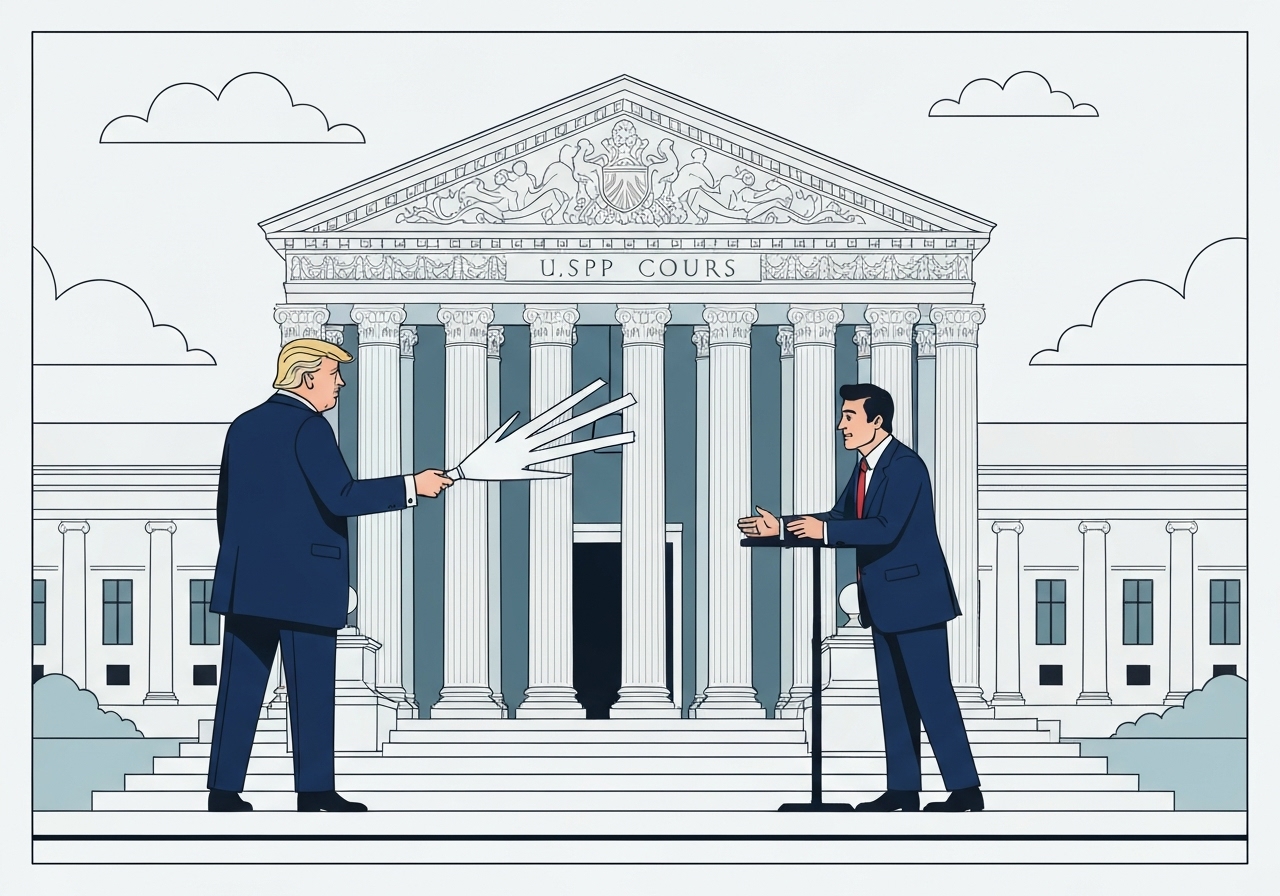
President Donald Trump asked the US Supreme Court on Wednesday to overturn a lower court ruling that found many of his broad import tariffs unlawful, seeking a fast review that could determine whether billions in duties remain in place or must be refunded.
Key takeaways
- The administration filed a petition late Wednesday asking the Supreme Court to review an appeals court decision.
- The US Court of Appeals for the Federal Circuit ruled 7-4 that tariffs imposed under the IEEPA exceed presidential authority.
- Trump invoked the International Emergency Economic Powers Act after declaring an economic emergency in April.
- Baseline 10% and so-called “reciprocal” tariffs on more than 90 countries were contested; levies on Canada, Mexico and China were also struck down by the appeals court.
- If the high court refuses review, the appellate ruling could take effect on 14 October 2025, subject to remaining stays.
- The outcome could force refunds of billions and affect ongoing diplomatic trade negotiations.
Verified facts
Late on Wednesday, the Justice Department filed a petition asking the Supreme Court to reverse the Federal Circuit’s 7-4 ruling that many of the president’s tariffs exceed the authority Congress granted under the International Emergency Economic Powers Act (IEEPA). The administration said the case raises urgent questions about the executive branch’s power over trade.
In April 2025, President Trump declared an economic emergency and issued executive orders that set a baseline 10% tariff and additional “reciprocal” tariffs aimed at correcting trade imbalances across more than 90 countries. Separate duties on steel and aluminum remain outside this dispute because they were imposed under different statutory authority.
Earlier rulings: in May the US Court of International Trade found the tariff program unlawful; that decision was stayed while appeals proceeded. The Federal Circuit then held that setting broad import levies is a “core Congressional power” not authorized by the IEEPA, though it temporarily postponed implementing its mandate to allow appeals.
The administration warned the appeals court decision is already affecting sensitive negotiations and could create long-term legal uncertainty. Solicitor General John Sauer told the justices the stakes are very high and urged rapid review.
Context & impact
Legal: If the Supreme Court takes the case and upholds the Federal Circuit, the government could be required to refund sizable tariff collections to importers and adjust trade policy tools. If the court reverses, the White House would retain broad emergency authority to set targeted tariffs under the IEEPA.
Economic and diplomatic: Businesses say the tariffs have increased costs for small firms and disrupted supply chains; trade partners have protested the measures and some negotiations are reportedly stalled. The dispute could affect US relations with major trading partners including Canada, Mexico and China.
Political: The question also touches on separation of powers. The appeals court described tariff-setting as a function Congress traditionally exercises; the administration argues the president needs flexible tools to respond to economic threats.
Official statements
“The stakes in this case could not be higher,” the Solicitor General wrote in the filing, saying the appeals decision has disrupted ongoing diplomatic and trade efforts. At the same time, challengers representing small businesses say the tariffs are causing real economic harm and seek a prompt resolution.
Solicitor General John Sauer; Jeffrey Schwab, Liberty Justice Center (representing challengers)
Unconfirmed
- Whether the Supreme Court will grant expedited review or schedule the case for its regular term is pending.
- The exact total amount the government would need to refund if the tariffs are invalidated has not been finalized.
- How quickly affected trade negotiations could resume or be renegotiated remains uncertain.
Bottom line
The administration has asked the Supreme Court to resolve a central constitutional and statutory dispute over presidential power to impose broad tariffs. The high court’s decision on whether to hear the case will determine whether current tariffs stay in place, are rescinded, or trigger large refunds—outcomes with major legal, economic and diplomatic consequences.