
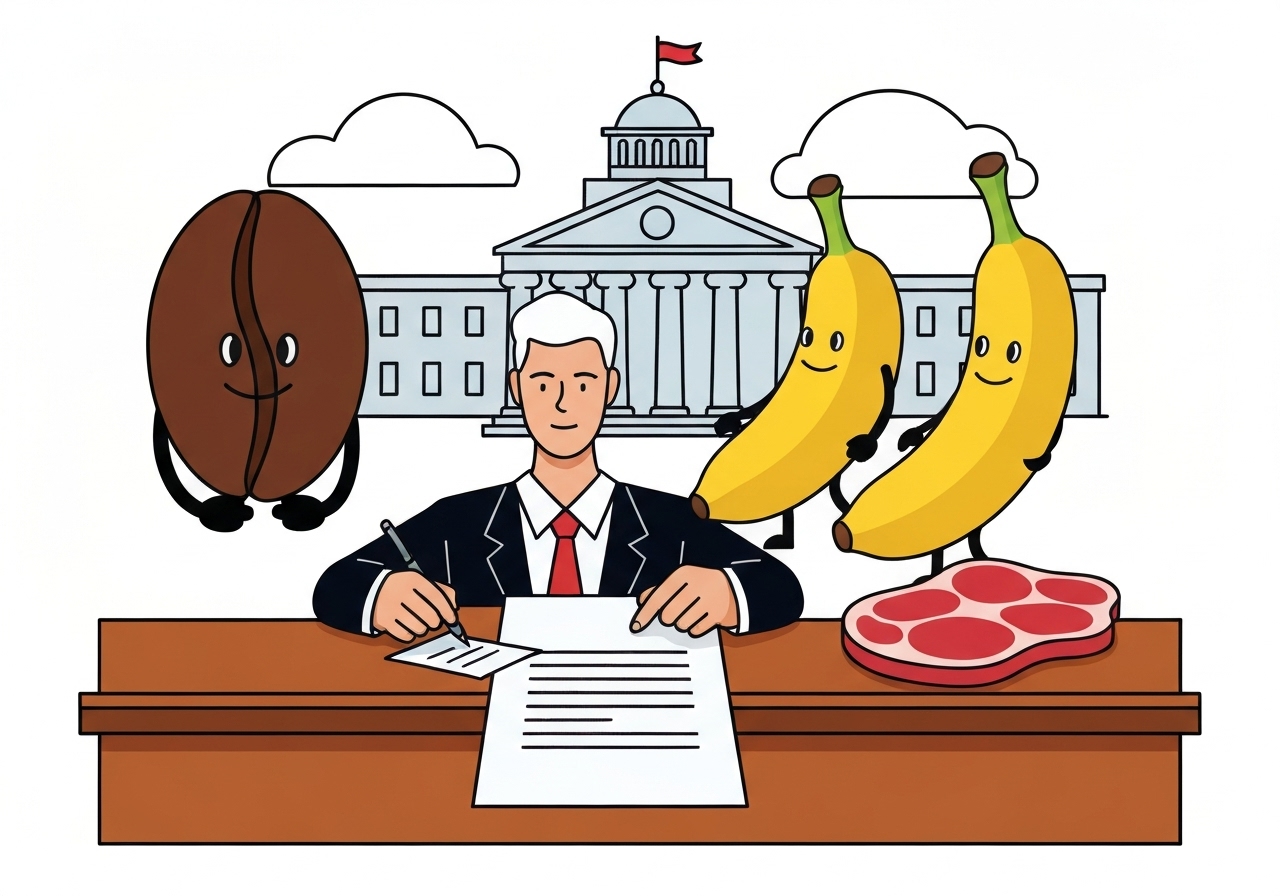
President Donald Trump on Friday, Nov. 14, 2025, announced exemptions from higher tariffs for a set of staple food imports — including coffee, cocoa, bananas and certain beef cuts — aiming to ease rising grocery costs for U.S. households. The step, framed as a consumer-relief measure, reverses portions of an earlier tariff rollout that had driven up input costs for roasters, meat distributors and chocolate makers. Administrators said the change also removes duties on fruits and products with little or no U.S. production, while a related trade framework imposes 10% tariffs on many goods from Argentina, Guatemala and El Salvador and 15% from Ecuador. Economists and producers cautioned that tariff relief could lower some prices but that supply constraints and weather-driven crop shocks remain significant price drivers.
Key takeaways
- On Nov. 14, 2025, the White House exempted coffee, cocoa, bananas, certain beef products and a range of fruits and spices from higher tariffs intended earlier in 2025.
- Brazilian beef faced effective tariff rates exceeding 75% this year, while a 50% tariff on Brazilian coffee was a major factor in rising coffee costs.
- Uncooked beef prices rose roughly 12%–18% year‑over‑year in September 2025, according to the Bureau of Labor Statistics (BLS).
- Ground roast coffee hit $8.41 per pound in July 2025, a 33% increase from the prior year; coffee prices rose nearly 21% year‑over‑year in August 2025.
- Food‑at‑home prices were up about 2.7% year‑over‑year in September 2025; more recent CPI updates were delayed because of a government shutdown.
- The move follows a separate trade framework that set 10% tariffs on most goods from Argentina, Guatemala and El Salvador and 15% from Ecuador.
- Industry groups warn that tariff changes and quota shifts have discouraged long‑term investment in supply chains, keeping supply tight and price volatility elevated.
Background
Tariffs became a central economic tool of the administration in 2025, applied broadly across imports to bolster domestic producers and raise negotiating leverage. For several food categories with little U.S. production—coffee, bananas, some tropical fruits and specific spices—those duties were absorbed by importers and passed through to retailers and consumers. The administration long defended the tariffs as protection for U.S. businesses and workers, arguing consumers would not be the final payers; market price spikes this year have tested that thesis.
Supply constraints predate the tariff decisions in many sectors. Brazil’s cattle herd fell to near a 75‑year low amid drought and higher input costs, while fertilizer and equipment price rises increased ranching costs. Cocoa supplies were hit by several years of weather and pest problems in Ivory Coast and Ghana, and coffee markets faced crop shortages and strong global demand — pushing futures and retail prices to multiyear highs. Those structural factors intersected with trade policy to amplify retail price moves.
Main event
The White House on Nov. 14 announced carved‑out exemptions for a list of agricultural and food products previously subject to higher duties. The exemptions explicitly cover coffee (including beans used by roasters), cocoa, bananas, certain beef cuts, tomatoes, avocados, coconuts, oranges, pineapples, black and green tea, and spices such as cinnamon and nutmeg. Officials said the changes remove duties on items “not grown or produced in the U.S. in sufficient quantities,” a formulation cited to justify the targeted relief.
The announcement followed a separate set of trade framework agreements with four Latin American nations, which included uniform tariff bands: 10% on most goods from Argentina, Guatemala and El Salvador, and 15% on most goods from Ecuador. Administration officials described those bands as part of a broader negotiation posture while noting product‑specific exemptions where domestic supply is limited.
Industry groups and distributors that had reported rapid cost increases welcomed the exemption as likely to reduce input pressures for roasters, meatpackers and chocolate manufacturers. Still, several companies cautioned that the timing of relief and how quickly lower import duties translate into retail price cuts will vary across supply chains and depend on inventory, contracts and global market prices.
Analysis & implications
In the short term, the tariff rollbacks should blunt some of the upward pressure on consumer prices for goods directly affected, especially items with large import shares such as coffee and many tropical fruits. Removing steep duties on products with limited U.S. production reduces an immediate cost layer for importers and processors, which could translate into lower wholesale and retail prices over months rather than days. However, the degree of pass‑through to shoppers depends on retailers’ inventories, forward contracts and competitive dynamics in local markets.
Medium‑term impacts are more ambiguous. Market participants told reporters that tariff volatility itself has discouraged investment — for example, delayed herd rebuilding in the cattle sector and hesitancy by roasters to expand capacity. Policy whiplash, including changing tariffs and quota adjustments (such as the expansion of Argentina’s beef quota), tends to suppress long‑run supply responses, which can keep prices elevated even after duties are eased.
Global supply factors remain decisive in several categories. Coffee and cocoa prices were already elevated because of multi‑year production issues and weather shocks in key growing regions. Even with U.S. tariff relief, producers outside the U.S. face the same production constraints, and global commodity markets will continue to set baseline prices. Moreover, transportation, labor and input cost pressures mean that tariff cuts are only one of several levers affecting final consumer prices.
Comparison & data
| Item | Peak tariff / policy | Recent price change |
|---|---|---|
| Brazilian beef | Effective rates >75% | Uncooked beef +12%–18% YoY (Sep 2025) |
| Coffee (ground roast) | 50% tariff on Brazilian coffee | $8.41/lb July 2025 (+33% YoY); coffee +~21% YoY (Aug 2025) |
| Cocoa | Subject to tariffs, plus crop shocks | Futures ≈ $5,300 (Oct/Nov 2025); retail chocolate ~+30% YoY heading into Halloween |
The table summarizes the interaction between tariff measures and observed retail or futures price moves through mid‑late 2025. It shows that while tariffs added a discrete cost wedge, underlying supply disruptions (herd sizes, crop failures, global demand) contributed heavily to the price paths consumers experienced. Any durable drop in retail prices will likely require both tariff stability and supply recovery.
Reactions & quotes
The White House framed the exemptions as consumer‑oriented relief after earlier tariff measures. Administration spokespeople reiterated a long‑standing line that tariffs defend U.S. industry even as this step narrows duties where domestic supply is limited.
“Tariffs remain a tool to protect American workers, but exemptions are appropriate where U.S. supply is insufficient,”
White House statement
Food manufacturers and grocers offered cautious welcome while warning that inventory and global commodity trends will influence outcomes for shoppers.
“We expect $160 million to $170 million in tariff costs this year, which has strained margins,”
Hershey executive (company disclosure)
Economic analysts noted that while the exemptions could reduce some headline price pressure, they do not erase the structural constraints facing producers and global markets.
“Tariff relief can help, but supply shortages and weather shocks remain primary drivers of recent price spikes,”
Independent commodity analyst
Unconfirmed
- Exactly how quickly and by how much retailers will lower shelf prices remains uncertain; pass‑through schedules vary and are not yet publicly disclosed.
- Whether the exemptions will prompt immediate increases in imports from previously tariffed suppliers is unconfirmed; import flows depend on logistics, contracts and global availability.
Bottom line
The November 14, 2025 tariff exemptions are a tactical move to alleviate political and consumer pressure from elevated grocery bills, and they should reduce some cost pressure for imported coffees, chocolates, certain beef cuts and tropical fruits. That relief is likely to show up unevenly across stores and regions: some outlets may lower prices within weeks, while others will adjust more gradually as inventories turn over and contracts renew.
However, these changes do not eliminate the deeper drivers of price increases—global crop shortfalls, weather impacts, and structural supply constraints in livestock and commodity markets. For a sustained easing of food-price inflation, tariff stability must be paired with recovery in supply chains and investment in production capacity.