
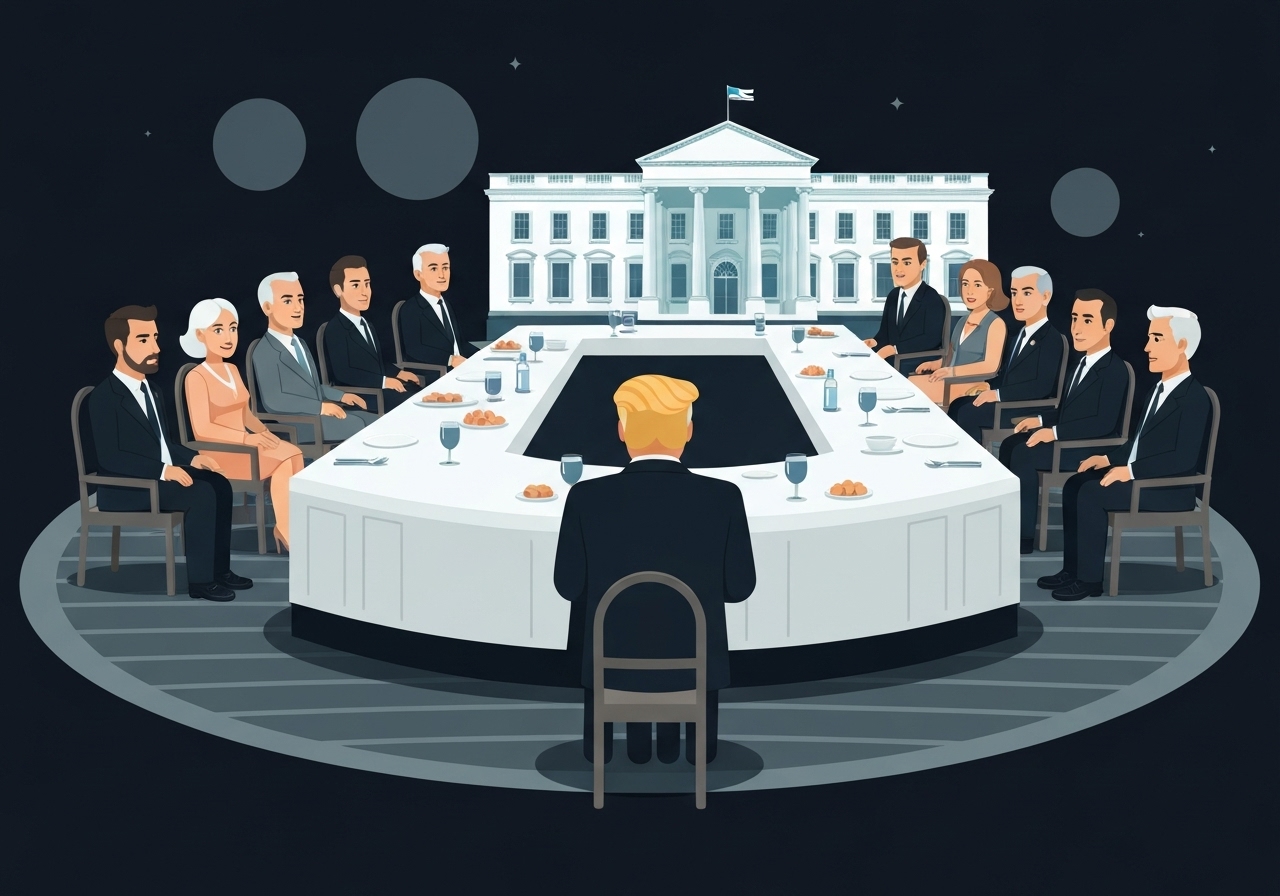
On Sept. 5, 2025, President Donald Trump invited a group of leading technology executives to a White House dinner; the seating choices and guest list highlighted notable pairings, absences and undercurrents among industry leaders.
Key Takeaways
- Tim Cook and Sam Altman were seated next to each other, a placement that drew attention given their differing recent public stances.
- Elon Musk did not attend; Nvidia CEO Jensen Huang was also notably absent while AMD CEO Lisa Su attended.
- Several less familiar names joined the table, including Jason Chang (CSBio), Jamie Siminoff (Ring) and Jared Isaacman.
- Oracle CEO Safra Catz sat beside Bill Gates near the Trumps, signaling proximity to the president during the event.
- The seating arrangement appeared to reflect both strategic outreach and existing tensions among executives—especially around AI and talent poaching.
- Some expected figures—Palantir CEO Alex Karp and Nvidia’s Jensen Huang—were not present.
Verified Facts
The dinner took place at the White House on Sept. 5, 2025, and brought together a range of corporate leaders from established platforms and newer AI-focused firms. Confirmed attendees included Apple’s Tim Cook, OpenAI’s Sam Altman, AMD’s Lisa Su, Oracle’s Safra Catz, and Jared Isaacman. Several other executives were reported as present: Jason Chang (CSBio), John Hering (Lookout), Jamie Siminoff (Ring), David Limp (Blue Origin), Sunny Madra (Groq), Vivek Ranadivé (Sacramento Kings owner and tech veteran), Dylan Field (Figma), Sanjay Mehrotra (Micron), and Shyam Sankar (Palantir CTO).
The event also featured strategic seating placements. Reports and photographs from the evening show Cook and Altman seated adjacent to each other, while Safra Catz was placed near Bill Gates and the Trumps. Multiple high-profile figures were absent: Elon Musk did not attend, and Nvidia CEO Jensen Huang—who has appeared at other Trump events this year—did not join the dinner.
Sam Altman’s presence drew particular attention because of his prior public criticism of Trump during earlier political cycles and his more recent involvement in high-profile AI negotiations. The dinner underscored how executives who have changed public stances or taken different policy positions still appear in direct conversation with the administration.
Context & Impact
White House dinners are traditionally used to build rapport, convey policy preferences, and open private channels for discussion. For the tech sector, such gatherings can shape regulatory expectations, government contracts, and the informal contours of influence.
At a time when AI policy, export controls, and competition for talent are central industry concerns, the seating chart can be read as a signal of who the administration is prioritizing for direct access and who remains at arm’s length.
- Short-term impact: The dinner may accelerate bilateral discussions on AI regulation, national security reviews, and research partnerships.
- Medium-term impact: Visible pairings (for example, Cook next to Altman) could affect alliances, recruitment, and public narratives about industry cooperation with government.
- Long-term impact: Repeated inclusion or exclusion of certain leaders may influence investment and strategic decisions related to U.S. competitiveness in semiconductors and AI.
Official Statements
“I see my friend is here, Jensen.”
Donald Trump (earlier event)
Unconfirmed
- Definitive reasons for Jensen Huang’s and Elon Musk’s absences were not publicly confirmed; scheduling, strategic choice, or prior disagreements are possible explanations but remain unverified.
- Reports that specific deals or policy commitments were agreed at the dinner have not been substantiated by public documents or statements.
- Personal reactions of individual attendees (who had the “worst time” or who felt most comfortable) are based on observers’ readings of body language and are not independently confirmed.
Bottom Line
The Sept. 5 White House dinner gathered a cross-section of technology leaders and highlighted alliances and absences that speak to current tensions in the industry—especially around AI, talent, and influence with Washington. While the seating chart offers readable signals about proximity and priority, concrete policy outcomes or deals tied to the meeting were not publicly documented as of publication.