
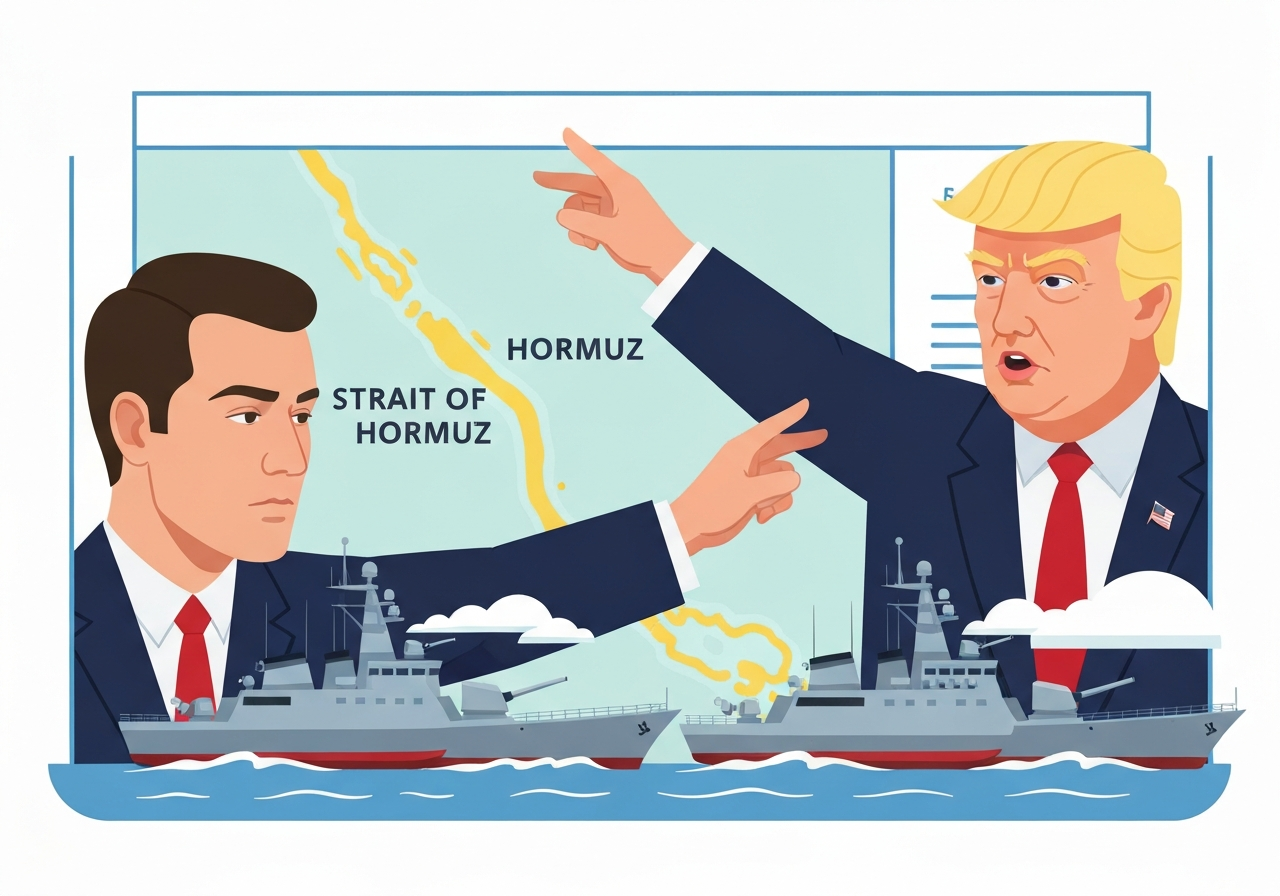
Former US president Donald Trump on Saturday urged the United Kingdom and other nations to deploy naval vessels to the Strait of Hormuz to ensure the waterway remains navigable after a recent escalation with Iran. The appeal, posted on his Truth Social account, followed two weeks of strikes and maritime attacks that officials say have sharply disrupted shipping. The strait links the Persian Gulf and the Gulf of Oman and handles roughly one fifth of global oil flows; around 20 million barrels per day transited it last year. Officials and analysts warn that continued attacks and restricted transit are driving oil prices higher and heightening pressure on the global economy.
Key takeaways
- Donald Trump called on the UK, China, France, Japan, South Korea and other states to send warships to keep the Strait of Hormuz open, urging multinational escorts in coordination with the US.
- The Strait of Hormuz is a critical artery: about 20 million barrels per day passed through it last year, accounting for roughly 20% of global oil flows.
- Maritime strikes and incidents began after US and Israeli strikes on Iran two weeks ago; multiple merchant vessels have been attacked, and some insurers and shipping firms have curtailed transits.
- Trump claimed that US forces have “destroyed 100% of Iran’s military capability,” a statement Tehran rejected as “fabricated lies.”
- The UK Ministry of Defence said it is discussing options with allies; HMS Dragon recently departed for the Mediterranean, and officials say the risk to tankers remains high.
- R Adm Neil Morisetti, who captained British warships in the region in past decades, warned the threat level is currently too great to guarantee safe escort of tankers.
- Prime Minister Keir Starmer has defended the UK decision not to join the initial strikes, saying he must judge what is in Britain’s national interest.
Background
The Strait of Hormuz sits between Oman and Iran and is the chokepoint for much of the world’s oil exports from the Persian Gulf. Historically, the strait has been vulnerable during regional conflicts: during the 1980–88 Iran–Iraq war and in later flare-ups, commercial shipping has faced missiles, mines and harassment by small craft. Those precedents shaped how coastal states and trading partners plan naval escorts and insurance coverage for tankers.
Tensions escalated after coordinated US and Israeli strikes on Iran two weeks ago; those strikes have been described in some reports as killing Iran’s supreme leader, Ayatollah Ali Khamenei. Since then, multiple merchant vessels transiting the strait have reported attacks or near-miss incidents. Governments, shipping companies and insurers are recalibrating risk assessments as some crews avoid the route and some shipowners reroute around Africa, adding time and cost to deliveries.
Main event
On Saturday, Trump used Truth Social to press the UK and other affected states to send warships to the area. He framed the move as a multinational effort to ‘‘keep the Strait open and safe’’ and warned that the United States would continue kinetic actions in coastal areas. His post included a mixture of operational claims and exhortations for allied participation.
Iran responded quickly, dismissing assertions that its military had been neutralised as false. Tehran’s government described claims that its forces were destroyed as “fabricated lies” and reaffirmed its capacity to respond. Meanwhile, the UK Ministry of Defence said it is consulting with partners and considering a range of measures to protect shipping, without committing to a specific naval deployment timetable.
Operationally, the UK has repositioned assets: HMS Dragon has left for the Mediterranean, and officials have flagged carrier movement as under consideration. R Adm Neil Morisetti, who led escorts in the region during the 1980s and 1990s, told the press the current threat picture makes safe tanker escort extremely challenging and may explain why some UK planners are cautious about immediate escort missions.
Analysis & implications
Deploying multinational warships to escort commercial vessels would be a significant step with political, legal and operational ramifications. Politically, such a mission would require clear rules of engagement, consensus among contributing states and a legal basis for interdiction or defensive fire. Without those, naval escorts risk becoming entangled in escalation dynamics they are meant to reduce.
Operationally, the strait’s narrow geography concentrates transits, which complicates protective measures. Iran has the ability to use small boats, mines and drones to harass shipping; even after large-scale strikes, asymmetric attacks can persist and impose outsized disruption on commerce. Escort groups must contend with sea mines, electronic interference and stand-off weapons, and they need persistent surveillance and rapid-clearance capabilities.
Economically, prolonged disruption of the Hormuz route raises shipping costs, adds transit time for rerouted tankers around Africa, and exerts upward pressure on oil prices—effects that filter into inflation and growth forecasts globally. Markets are sensitive to both physical disruptions and the political risk premium attached to military deployments in the Gulf.
Finally, multinational naval deployments would test alliance cohesion. Some states may be reluctant to become direct participants in a theatre where strikes and counterstrikes are ongoing. The UK has so far declined to join the initial strikes; Prime Minister Keir Starmer says his duty is to assess Britain’s national interest, a stance likely to shape whether London supports escort operations beyond surveillance or convoy-support roles.
Comparison & data
| Metric | Value |
|---|---|
| Share of global oil via Hormuz | ~20% |
| Average daily barrels (last year) | ~20 million barrels/day |
| Time since initial strikes | ~2 weeks |
These figures show why the Strait is strategically important: even partial closure translates into large physical and financial disruptions. Re-routing oil tankers around the Cape of Good Hope adds weeks to transit time and raises freight and insurance premiums, amplifying effects on global markets.
Reactions & quotes
“We will soon get the Hormuz Strait OPEN, SAFE, and FREE!”
Donald Trump (Truth Social post)
Trump’s emphatic language framed the situation as one demanding immediate allied action; analysts note the rhetorical tone aimed both at domestic audiences and at potential partners.
“Claims Iran’s military capability has been destroyed are fabricated lies.”
Iranian government statement
Tehran’s terse denial signalled it will continue to contest attribution of maritime attacks and resist narratives that portray it as incapacitated.
“The risks are too great to guarantee the safety of tankers at the moment.”
R Adm Neil Morisetti (former Royal Navy commander in the region)
Morisetti’s assessment underscores operational constraints facing any immediate escort mission and helps explain cautious language from current UK planners.
Unconfirmed
- Trump’s assertion that the United States has “destroyed 100% of Iran’s military capability” is a contested claim and has been explicitly denied by Iranian officials; independent verification is not publicly available.
- Attribution of every reported maritime attack in the strait remains under investigation; some incidents lack conclusive public evidence linking them to Tehran.
Bottom line
The call for allied warships to protect the Strait of Hormuz highlights immediate worries about maritime security, energy markets and coalition politics. While senior figures and former commanders agree the route is at higher risk than usual, deploying an international escort force would require legal, operational and political coordination that is not yet in place.
For businesses and consumers, the near-term consequences are tangible: higher transport costs, insurance premiums and volatile oil prices. For governments, the challenge is to secure shipping lanes without triggering a wider military escalation—an outcome that would exact far greater economic and human costs.
Sources
- The Guardian (news media report)
- UK Ministry of Defence (official government)
- Truth Social (primary social platform)
- The Sunday Times (news media)
- Reuters (news agency)