
Lead
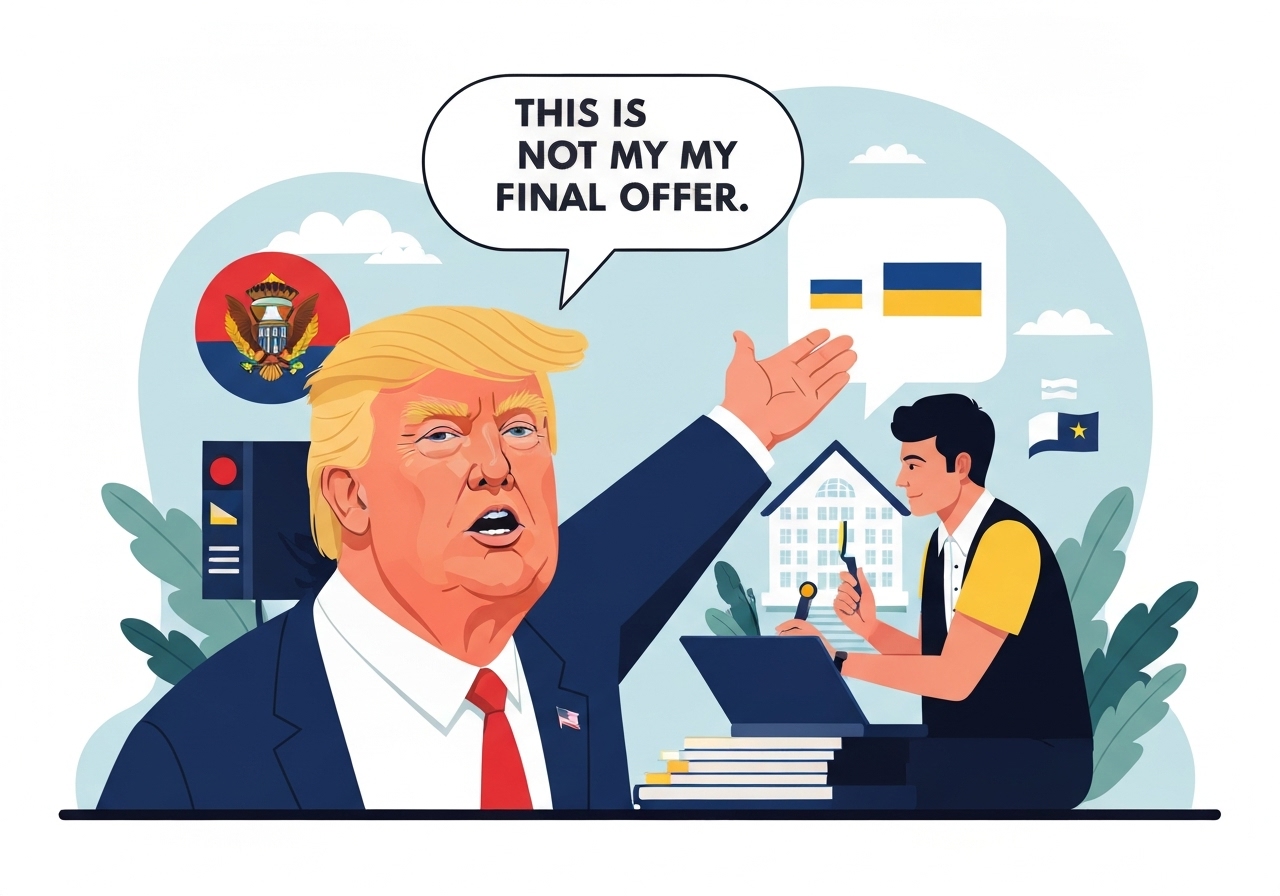
On 23 November 2025, at the White House, President Donald Trump said a Moscow-drafted peace plan for Ukraine was “not my final offer,” after a strong backlash in Kyiv and among European leaders. Officials from Ukraine and the United States were due to meet in Geneva the following day, with security representatives from France, Britain and Germany expected to join. The 28-point document, which Trump set a Thursday deadline for Volodymyr Zelenskyy to sign, would require territorial concessions, limits on Ukraine’s armed forces and rules that bar a European peacekeeping mission and sanctions for Russian war crimes.
Key takeaways
- Trump described his peace blueprint as still negotiable; he made the remark at the White House on 23 November 2025 as officials prepared for Geneva talks.
- The proposal is a 28-point document that asks Kyiv to cede territory, reduce its military and relinquish long‑range systems; Trump has reportedly given Zelenskyy until Thursday to accept.
- Ukrainian leaders and many commentators called the plan unacceptable; critics likened it to historic appeasement and said it includes broad amnesty for Russian actions.
- The US State Department, via deputy spokesman Tommy Piggott, disputed senators’ claims that the plan was merely a Russian “wish list” and said the document had US authorship with input from Russia and Ukraine.
- Geneva talks are to include US and Ukrainian delegations; security officials from France, the UK and Germany are expected to attend as observers or participants.
- G20 and European Council leaders have said the plan needs “additional work” and must be vetted with EU and NATO members because it addresses NATO and EU membership questions.
- Public reaction in Kyiv ranged from strong rejection and vows to continue fighting to a minority urging referendums or compromise to preserve US partnership.
Background
Since Russia’s full‑scale invasion in 2022, Western countries have supplied weapons, intelligence and sanctions in support of Ukraine’s defense of internationally recognised borders. Kyiv’s government insists on restoring sovereignty over Crimea and the eastern regions occupied since 2014 and 2022, while Russia seeks formal recognition of territorial gains. That tug‑of‑war underpins the intense sensitivity around any externally brokered settlement.
The current proposal, described in media reporting as drafted with input from a Moscow delegation and figures linked to the Trump team, arrived amid geopolitical pressure for a rapid ceasefire. European leaders and NATO officials warn that concessions without enforceable guarantees could reward aggression and set precedents affecting security across the continent. The plan’s exclusion of a European peacekeeping force and a blanket amnesty for war crimes are particular flashpoints.
Main event
President Trump told reporters on 23 November that the plan “should’ve happened a long time ago” and that the administration wanted to end the conflict. He qualified the document as negotiable, saying it was “not my final offer.” The White House has framed the talks as an attempt to secure a negotiated settlement, while critics see the text as heavily weighted in Moscow’s favour.
Ukrainian officials dispatched a delegation to Geneva to meet US counterparts, led by Andriy Yermak, the president’s chief of staff, with Rustem Umerov, former defence minister, named among the negotiators. Kyiv has emphasised that any acceptable agreement must preserve sovereignty, security guarantees and justice for victims of atrocities.
The US State Department publicly rebutted claims by senators that secretary of state Marco Rubio had called the proposal “a wish list of the Russians,” with deputy spokesman Tommy Piggott calling those reports “blatantly false” and stating the plan was authored by the United States with input from both Russians and Ukrainians. The authorship dispute has become part of the broader political debate in Washington.
In Kyiv, President Zelenskyy warned in a sombre address that Ukraine faced a painful choice between maintaining national dignity and risking the loss of a major partner in the United States. He reiterated that any genuine peace must rest on guaranteed security and justice for victims and announced a negotiating team by presidential decree to engage in Geneva.
Analysis & implications
If Kyiv accepted terms requiring territorial concessions and military limits, Ukraine’s long‑term security posture and deterrent capacity would be materially weakened. Territorial losses would create de facto border changes that could be difficult to reverse, and a reduced armed force would constrain Ukraine’s ability to resist future aggression.
Strategically, a settlement perceived as imposed by outside powers could fracture Western unity. EU and NATO members have signalled the plan touches on matters—NATO membership and EU accession—that require collective consultation, raising the risk that any bilateral arrangement with the US might isolate European allies or provoke diplomatic friction.
Domestically in the United States, the plan has become politicised. Senators across the aisle raised concerns about the plan’s provenance and content, while the administration’s denial of those claims risks further congressional scrutiny over arms and intelligence cooperation with Kyiv. If cooperation were reduced, Ukrainian forces could lose critical battlefield information.
For Russia, a negotiated settlement that enshrines territorial gains without accountability for alleged war crimes would represent a strategic victory. That outcome could embolden revisionist actors elsewhere and reshape security calculations throughout Eastern Europe, prompting NATO to reassess force posture and deterrence measures.
Comparison & data
| Key provision (reported) | Practical effect on Ukraine |
|---|---|
| Territorial concessions | Recognition or temporary transfer of parts of Donbas/Crimea; loss of sovereign control |
| Reduction of armed forces | Limits on personnel and long‑range systems; reduced deterrence and response capability |
| No European peacekeepers | Restricts third‑party military presence; increases reliance on bilateral guarantees |
| Amnesty clause | Would block prosecution for alleged Russian war crimes in affected areas |
The table summarises reported headline provisions and their immediate consequences. Exact legal language and enforcement mechanisms—if any—were not publicly released in full, leaving critical implementation questions open, such as monitoring, timeline and the role of multilateral institutions.
Reactions & quotes
Shortly after the plan was published, Ukrainian public figures and ordinary citizens expressed strong opposition, while some urged caution about losing a key ally.
“Real, dignified peace is always based on guaranteed security and justice.”
Volodymyr Zelenskyy, President of Ukraine
Zelenskyy framed the debate as one between protecting Ukraine’s sovereignty and accepting arrangements that could sacrifice justice and security guarantees.
“This plan was authored by the United States, with input from both the Russians and Ukrainians.”
Tommy Piggott, US State Department deputy spokesman
Piggott’s statement was issued to counter senators’ reports that the plan was effectively a Russian wish list; the dispute has increased scrutiny in Washington.
“It invites parallels with Munich — the victim is asked to formulate his own defeat so everyone else can live easier.”
Mustafa Nayyem, Ukrainian journalist and former lawmaker
Nayyem and other commentators compared the proposal to historical appeasement, arguing the text would humiliate Ukraine and override victims’ claims for justice.
Unconfirmed
- Claims that Secretary of State Marco Rubio called the proposal “a wish list of the Russians” have been reported by some senators but were labelled “blatantly false” by the US State Department spokesman; authorship and phrasing remain contested.
- The full legal text and implementation mechanisms of the 28 points have not been publicly released in complete form, so specifics about timelines, verification and third‑party enforcement are unconfirmed.
- Reports that the US would cut intelligence cooperation with Ukraine if the deal is rejected are circulating in commentary but lack an official, corroborated announcement from the White House or Congress.
Bottom line
The Geneva talks mark a consequential moment: Washington has presented a 28‑point framework that Kyiv and its European partners view as deeply problematic in its present form. Kyiv’s insistence on sovereignty, security guarantees and accountability for alleged atrocities sets a high bar that the current text appears unlikely to meet without substantial changes.
How this episode unfolds will shape transatlantic cohesion, Ukraine’s immediate battlefield prospects and broader European security for years. Observers should watch whether the US pursues a multilateral approach that secures buy‑in from NATO and EU members, whether Kyiv receives credible guarantees, and how enforcement and justice mechanisms are handled in any agreement.
Sources
- The Guardian (international news outlet) — primary report of the plan, Geneva meetings and reactions.
- The White House (official) — statements and press briefings from the US administration regarding the initiative.
- US Department of State (official) — public remarks and rebuttals from State Department spokespeople.
- Office of the President of Ukraine (official) — presidential statements, team appointments and Kyiv’s position.