
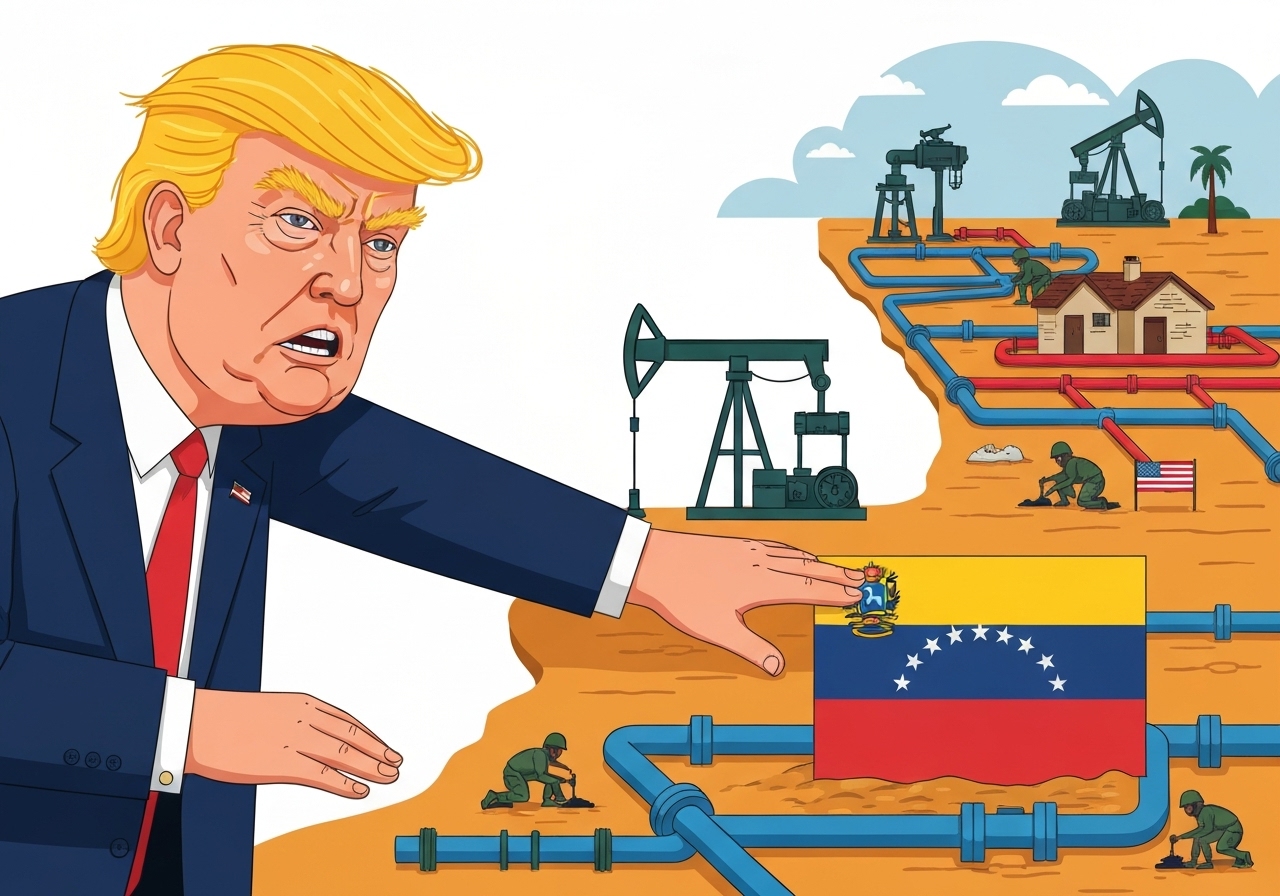
Lead: Hours after U.S. forces detained Venezuelan president Nicolás Maduro, President Donald Trump said the United States would pave the way for major American oil companies to enter Venezuela, repair its failing oil infrastructure and begin producing for profit. The pledge comes as Venezuela—home to the world’s largest proven oil reserves—now produces roughly 1 million barrels per day, down from more than 3 million two decades ago. Market conditions, past legal disputes and the heavy, high‑carbon nature of Venezuelan crude complicate the prospect of a rapid, large‑scale return by U.S. firms. Energy analysts caution political uncertainty and a global oil glut are likely to limit near‑term investment.
Key Takeaways
- President Trump announced U.S. plans hours after Maduro’s capture to open Venezuela to large American oil companies and investment, describing an effort to repair oil infrastructure and generate revenue.
- Venezuela holds the world’s largest proven oil reserves per OPEC, yet current output is about 1 million barrels per day—down from more than 3 million b/d in previous decades.
- U.S. companies have outstanding arbitration awards against Venezuela: ConocoPhillips was awarded over $10 billion and ExxonMobil over $1 billion; only partial payments have been reported.
- Chevron currently produces roughly one quarter of Venezuela’s output and has said it is focused on employee safety and regulatory compliance amid the unfolding events.
- Global oil markets face oversupply and prices under $60 per barrel, reducing the commercial appetite to add new heavy crudes to the market.
- Venezuela’s crude is heavy and carbon‑intensive, making it less attractive to European majors with climate commitments; neighboring Guyana’s lighter, lower‑tax oil is drawing major investor interest instead.
- Analysts note that rebuilding production could be possible with financing and management, but political stability and legal clarity are prerequisites for large capital flows.
Background
Venezuela was once a top global oil producer and a founding member of the Organization of the Petroleum Exporting Countries (OPEC). OPEC statistics list Venezuela among countries with the largest proven reserves, a factor that has long made it strategically important to importing nations and international oil firms. Over decades, the Venezuelan oil sector has shifted from heavy U.S. refinery ties to major commercial relationships with China and other buyers as domestic capacity and contractual terms changed.
In the 2000s, then‑President Hugo Chávez renegotiated terms with international companies, prompting firms such as ExxonMobil and ConocoPhillips to exit and subsequently pursue international arbitration. Venezuela was ordered to pay multi‑billion dollar awards; only portions of those sums have been satisfied, leaving long memories and unsettled claims that affect trust and investment calculations. Chevron, by contrast, maintained a presence and today accounts for a significant share of the country’s remaining output.
Main Event
In the wake of Maduro’s capture, President Trump publicly framed U.S. intervention as not only political but economic, highlighting petroleum as a key objective. He said large American oil companies would invest billions to repair Venezuela’s “badly broken” oil infrastructure and generate returns for the country. That message signals an intention to prioritize energy sector access as part of any new governance arrangement.
Industry reactions were cautious. Chevron stressed employee safety, asset integrity and adherence to applicable laws in a brief company statement. ConocoPhillips said it was monitoring developments and declined to speculate on future investments. ExxonMobil did not provide a comment in response to requests. Firms face legal, safety and sanction‑related constraints that shape immediate choices.
Operationally, Venezuela’s oil fields and refineries suffer from years of underinvestment, mismanagement and maintenance shortfalls. Restoring output to past levels would require capital expenditure, technical crews and reliable governance. Outside consultants such as Wood Mackenzie estimate some production gains are feasible with large, sustained investment, but note timelines can be measured in years rather than weeks.
Analysis & Implications
Short‑term commercial opportunities for U.S. majors are limited by a global oil surplus and prices below $60 per barrel; adding heavy Venezuelan crude would further strain markets. Companies also weigh reputational and regulatory risks: Venezuelan crude is among the more carbon‑intensive sources, which conflicts with many European firms’ emissions and transition commitments, and complicates financing from climate‑sensitive lenders.
Legal entanglements are another barrier. International arbitration awards and unresolved debt claims mean some companies could see a return as a way to recover losses, but enforcing judgments and securing clear titles to assets will be central to any deal. Firms will demand legal protections, enforceable contracts and a stable operating environment before committing capital at scale.
Geopolitically, expanded U.S. presence in Venezuela would shift dynamics in the region. Guyana—now an emergent oil producer with over 10 billion barrels discovered offshore—offers lighter crude, lower tax regimes and fewer legacy complications, attracting firms including ExxonMobil. A reorientation toward Venezuela could therefore encounter competition from friendlier, lower‑cost jurisdictions.
Comparison & Data
| Period / Country | Approx. Crude Output (barrels/day) |
|---|---|
| Venezuela (peak, decades ago) | >3,000,000 b/d |
| Venezuela (current) | ~1,000,000 b/d |
| United States (current) | ~13,000,000 b/d |
The table illustrates the gap between Venezuela’s historical output and its present production, and how the U.S. scale compares. Restoring lost Venezuelan output would require addressing field decline, dilapidated refining capacity, and workforce and supply chain shortfalls. Analysts emphasize that physical reserves do not automatically translate into near‑term flows without sustained investment and governance clarity.
Reactions & Quotes
Government and industry reactions have been swift but measured, reflecting the stakes of any political and commercial transition.
“We’re going to have our very large U.S. oil companies… go in, spend billions of dollars, fix the badly broken infrastructure… and start making money for the country.”
Donald J. Trump — U.S. President (press conference)
This statement framed the operation in economic terms and signaled an administration priority to open Venezuela to American investors. Analysts noted it outlines political intent but offers little detail on legal protections, sanctions relief or timelines.
“Chevron remains focused on the safety and wellbeing of our employees, as well as the integrity of our assets. We continue to operate in full compliance with all relevant laws and regulations.”
Bill Turenne — Chevron spokesperson
Chevron’s response emphasized continuity of operations and regulatory compliance rather than a commitment to expansion. Energy consultancies highlighted that Chevron’s existing footprint gives it a different risk calculus from firms that exited earlier.
“It would be premature to speculate on any future business activities or investments.”
Dennis Nuss — ConocoPhillips spokesperson (email)
ConocoPhillips framed its stance as cautious, reflecting the legal and commercial uncertainty that many international companies face when contemplating a return to Venezuela.
Unconfirmed
- Precise legal framework: It is not yet confirmed what legal guarantees or sanction‑relief mechanisms the U.S. would offer to enable multinational investment in Venezuelan assets.
- Payment of arbitration awards: The full status and enforceability of the multi‑billion dollar arbitration awards against Venezuela remain unresolved in practice.
- Timeline for production recovery: Specific timelines for how quickly U.S. firms could scale Venezuelan output are unconfirmed and depend on funding, security and technical assessments.
Bottom Line
The Trump administration’s stated aim to open Venezuela to U.S. oil companies highlights the country’s enduring strategic value because of its vast reserves. Yet the economic and operational reality is complex: depleted output, heavy crude chemistry, lingering legal disputes and a global supply glut temper the commercial case for an immediate, large‑scale return.
For U.S. firms to invest at scale they will need legal clarity, sanctions relief, assurances on asset titles and a durable political settlement that protects long‑term contracts. Even with abundant reserves, meaningful increases in Venezuelan production are likely to be incremental and will require years of capital, technical work and stable governance.
Sources
- NPR — media report summarizing statements, industry responses and background (journalism).
- OPEC — Organization of the Petroleum Exporting Countries (official data on reserves and production trends).
- U.S. Energy Information Administration (EIA) — national energy statistics and production data (official/analysis).
- Wood Mackenzie — energy consultancy analysis referenced for restoration prospects (industry research).