
Lead
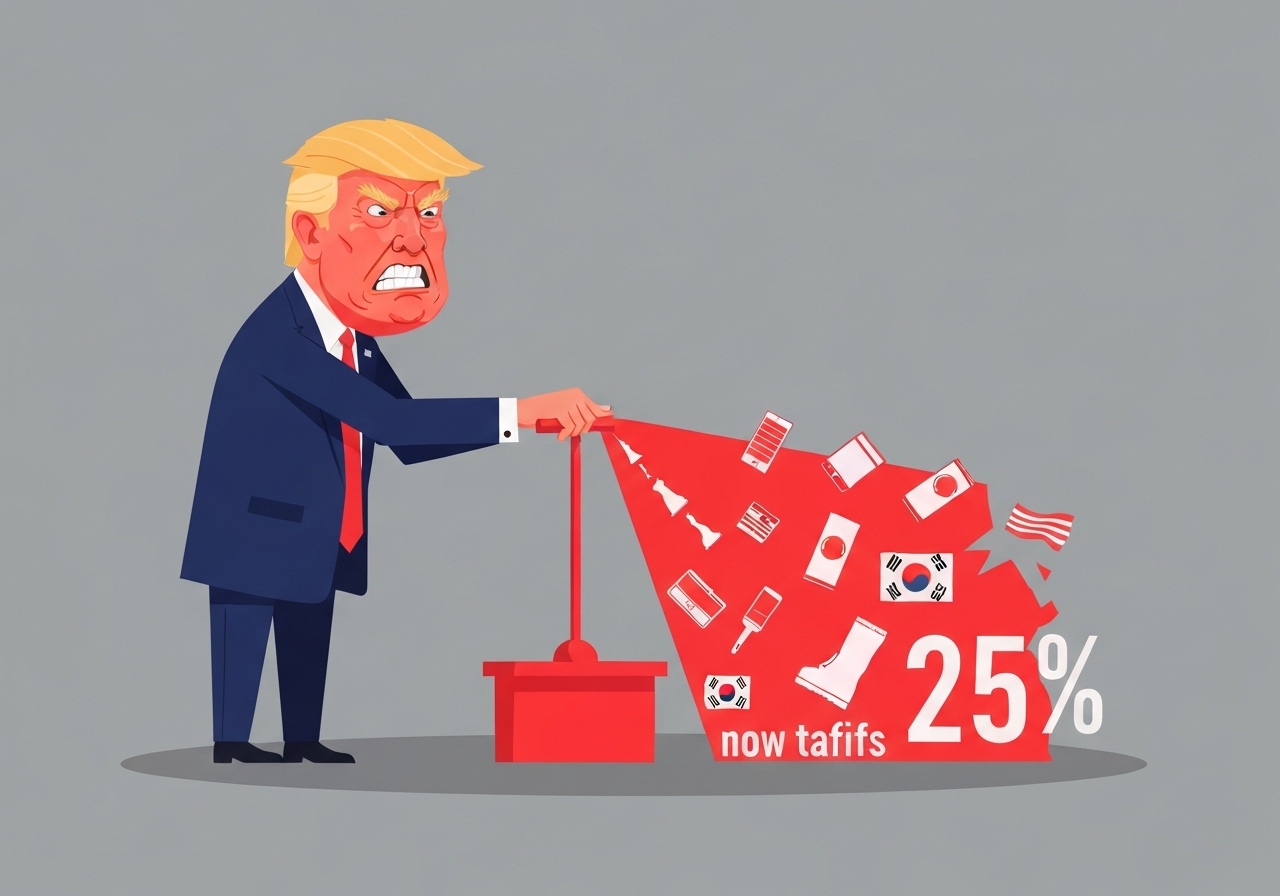
US President Donald Trump announced an increase in tariffs on South Korean imports from 15% to 25%, declaring Seoul had failed to implement a trade deal reached last October. The move, made via a social media post, targets a range of products including automobiles, lumber and pharmaceuticals and says it applies to “all other Reciprocal TARIFFS.” South Korea said it had not received formal notice and sought urgent talks with Washington, while Seoul’s benchmark Kospi index showed an initial fall before recovering later in the day.
Key Takeaways
- President Trump announced tariffs on South Korean imports will rise to 25%, up from 15% across multiple product categories.
- The increase explicitly covers automobiles, lumber, pharmaceuticals and other “Reciprocal TARIFFS” identified in the announcement.
- South Korea stated it had not been given official notice and requested urgent consultations with US officials.
- Seoul’s Industry Minister Kim Jung-kwan, currently in Canada, is reported to plan a visit to Washington to meet US Commerce Secretary Howard Lutnick.
- The US–South Korea trade deal negotiated last October included a South Korean pledge to invest $350bn in the US; tariff reductions were to follow South Korea’s parliamentary process.
- The agreement was submitted to South Korea’s National Assembly on 26 November and local media said passage was likely in February.
- Stock markets reacted: the Kospi fell initially but later traded about 1.8% higher as exporter shares recovered.
- Tariffs are paid by importers; US firms buying affected goods from South Korea will face a 25% levy under the announcement.
Background
The tariff increase arrives against the backdrop of a bilateral deal reached in October that included a commitment by South Korea to invest $350bn in the United States, with portions earmarked for industries such as shipbuilding. Under that pact, Washington agreed to reduce certain US tariffs once Seoul began its domestic approval process.
That agreement was formally submitted to South Korea’s National Assembly on 26 November and has been under review; local media coverage at the time projected likely passage in February. The two governments had linked some US tariff reductions to stages of South Korea’s domestic approval, making timing politically and economically sensitive.
Tariffs have been a recurring tool in President Trump’s second-term foreign-policy playbook, used both to extract concessions and to signal leverage on trade partners. Recent episodes include threats of steep levies against Canada and earlier tensions with NATO allies related to other policy disputes.
Main Event
The announcement came in a social media post in which President Trump said he would increase levies on South Korean imports from 15% to 25%, citing delays by South Korean lawmakers in approving last year’s trade deal. He listed automobiles, lumber and pharmaceuticals among the affected categories and invoked the phrase “all other Reciprocal TARIFFS.”
South Korean officials responded that they had not received formal notification of the tariff increase and requested immediate consultations with US counterparts. Seoul said Industry Minister Kim Jung-kwan, currently in Canada, would travel to Washington as soon as possible to meet US Commerce Secretary Howard Lutnick to seek clarification.
Market reaction was mixed: Seoul’s benchmark Kospi index fell on Tuesday morning after the announcement but later recovered, trading about 1.8% higher as shares of major exporters regained ground. Analysts noted that immediate market moves reflected both uncertainty and the rapid repricing of exporter earnings expectations.
The tariffs, as presented, would be paid by US importers purchasing affected South Korean goods, increasing landed costs for US firms and potentially raising downstream prices for US consumers and businesses that rely on those inputs.
Analysis & Implications
Raising tariffs from 15% to 25% represents a meaningful increase in protection that can shift short-term trade flows and raise costs for US companies that import from South Korea. For manufacturers that depend on Korean auto parts, electronics components or pharmaceutical intermediates, higher input prices could compress margins or raise retail prices.
Diplomatically, the unilateral announcement risks straining the US–South Korea alliance at a time when both countries cooperate on security issues. Seoul’s call for urgent talks and the planned ministerial visit underline the immediate need for high-level engagement to prevent escalation and clarify legal and procedural questions about notification and treaty obligations.
Economically, the measure could prompt South Korea to pursue retaliatory options — from reciprocal tariffs to legal challenges at the World Trade Organization — though Seoul may also calculate that a negotiated resolution preserves broader strategic ties. The $350bn investment pledge embedded in last October’s deal raises stakes for both governments; disruptions to that framework could affect investment timelines and industrial planning.
On the global stage, the episode reinforces concerns among allies and trading partners about volatility in US trade policy. Businesses and investors will be watching whether Washington applies similar measures to other partners and how affected supply chains adapt, including potential reshoring or diversification away from South Korean suppliers.
Comparison & Data
| Item | Previous Rate | New Rate (announced) |
|---|---|---|
| General tariffs cited | 15% | 25% |
| Key sectors named | Automobiles, lumber, pharmaceuticals | Automobiles, lumber, pharmaceuticals |
| South Korea investment pledge (deal) | $350bn | |
The simple comparison above highlights the headline change in headline tariff percentages and the continuity of sectors named by the announcement. While the percentage shift is clear, the detailed product-level scope, exemptions and duration were not published in the social media post and will determine economic outcomes.
Reactions & Quotes
“We will increase levies on South Korea from 15% to 25% across a range of products including automobiles, lumber, pharmaceuticals and ‘all other Reciprocal TARIFFS’.”
Donald Trump, US President (social media post)
Context: The president framed the move as enforcement of the bilateral agreement’s reciprocal terms, attributing the step to delays in South Korea’s parliamentary approval.
“South Korea has not been given official notice of the decision to raise tariffs on some of its goods and wants urgent talks with Washington.”
South Korean government statement
Context: Seoul formally requested immediate consultations and indicated its industry minister would travel to Washington to seek clarification and resolution.
“The agreement was submitted to South Korea’s National Assembly on 26 November and is currently being reviewed; it is likely to be passed in February.”
Local media reporting (parliamentary timeline)
Context: Local reporting has linked tariff reductions to Seoul’s legislative timetable, a central element in the US claim about delayed implementation.
Unconfirmed
- Whether the US provided formal written notice to South Korea before the public social media announcement remains unclear from available statements.
- The precise product-level list, legal basis and duration of the tariff increase were not detailed in the public post and require official documentation to confirm.
- Details of the planned meeting between Industry Minister Kim Jung-kwan and US Commerce Secretary Howard Lutnick — including timing and agenda — were described as forthcoming and unverified at the time of reporting.
Bottom Line
The announced tariff increase is a significant near-term escalation in trade measures between the United States and a key ally, affecting multiple sectors and introducing uncertainty for importers, exporters and investors. Because the announcement was made via social media and Seoul says it lacked formal notice, urgent diplomatic engagement will be decisive in preventing further economic and political fallout.
Markets and businesses should watch for the detailed tariff schedule, any exemptions, and the outcome of immediate talks in Washington. Longer-term consequences will depend on whether the two governments resolve procedural disagreements quickly or whether the dispute catalyzes broader shifts in supply chains, investment commitments and alliance dynamics.