
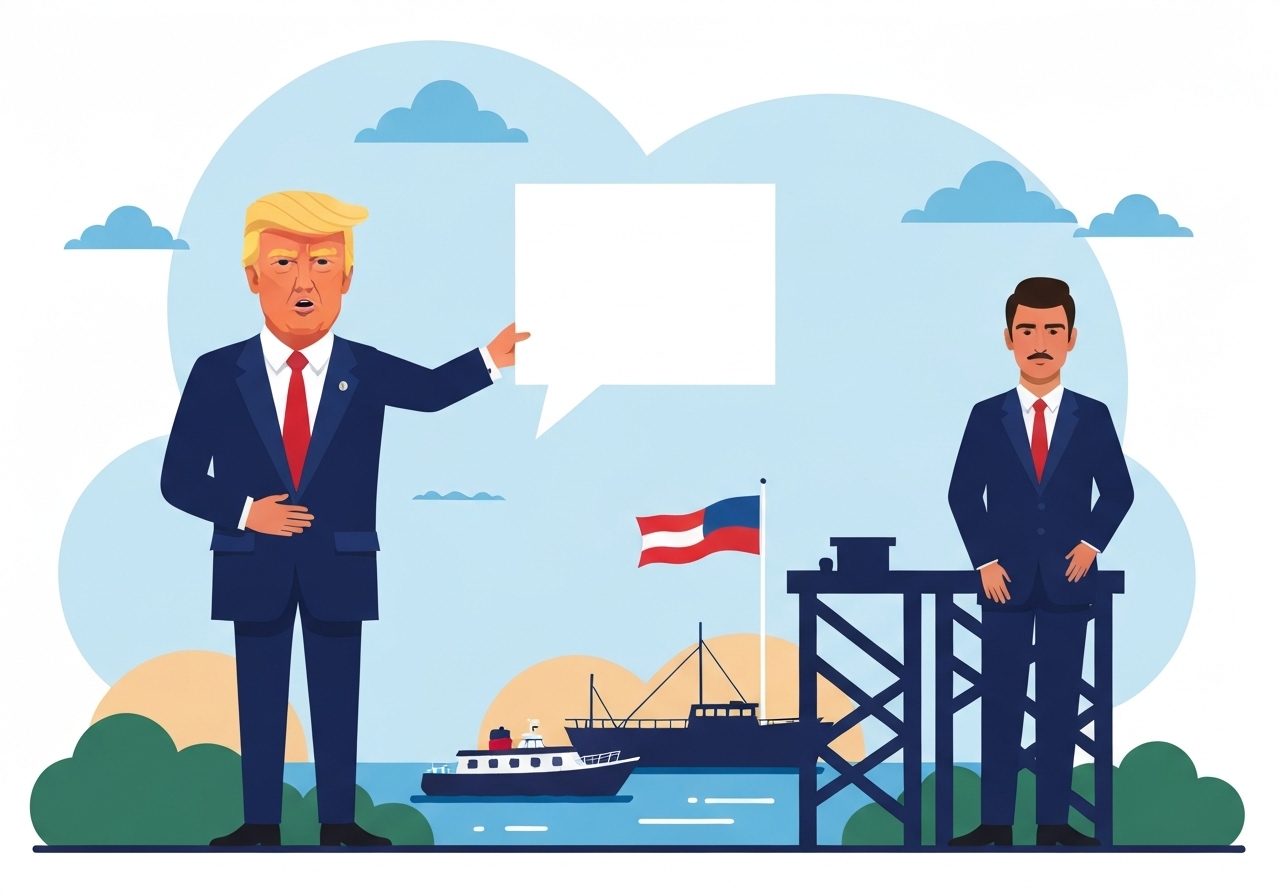
On Dec. 29, 2025, President Donald Trump said the United States “hit” a dock in Venezuela where drugs were reportedly being loaded onto boats, calling it a major explosion in the loading area. He made the claim publicly at Mar-a-Lago after earlier mentioning in a radio interview that U.S. forces had “knocked out” a large facility tied to drug shipments. If accurate, the assertion would represent the first known land-based strike in the administration’s campaign against Venezuela. Administration officials have not provided operational details, and defense and intelligence agencies have offered limited public comment.
Key Takeaways
- President Trump said on Dec. 29, 2025, that a dock in Venezuela where drugs were loaded was “hit,” describing a major explosion in the loading area.
- Trump told WABC last Friday his administration had “knocked out” a “big facility” used to dispatch drug-running boats; he provided no operational specifics.
- The president said it “doesn’t matter” whether U.S. military forces or other agencies carried out the action; earlier he confirmed in October he authorized the CIA to operate in Venezuela.
- The U.S. has positioned roughly 15,000 troops and several warships in the Caribbean region as of December 2025, according to administration reporting.
- Earlier in December 2025, the president ordered what he described as a “complete blockade” on sanctioned oil tankers entering or leaving Venezuela, targeting a primary income source for the Maduro government.
- ABC News reported the Pentagon referred queries to the White House; the CIA declined to comment when approached by ABC News.
Background
Since 2023 the U.S. has escalated pressure on the Nicolás Maduro government, citing ties between state actors, criminal networks and large-scale drug shipments departing Venezuelan shores. Washington’s tools have included sanctions on oil and shipping, targeted maritime interdictions, and diplomatic efforts to isolate Caracas. In October 2025 the White House authorized the Central Intelligence Agency to increase activity inside Venezuela, according to prior administration statements; that authorization was framed as part of counter-narcotics and national-security operations.
The campaign has relied principally on maritime interdiction and sanctions aimed at depriving the Maduro government of revenue. U.S. officials have said they are targeting drug flows and financial networks that sustain Venezuela’s ruling circle. Caracas has denounced U.S. measures as economic warfare and has accused Washington of seeking regime change, raising regional diplomatic tensions with neighboring countries and U.S. partners in Latin America.
Main Event
Trump first referred to the operation during a Friday radio interview, saying the U.S. “knocked out” a large site used to send boats carrying drugs. On Dec. 29, 2025, as he greeted Israeli Prime Minister Benjamin Netanyahu at Mar-a-Lago, reporters pressed him for clarification on whether U.S. military forces directly executed the action. The president replied, “Well, it doesn’t matter,” and added that there had been “a major explosion in the dock area where they load the boats up with drugs.”
Trump also said, “They load the boats up with drugs. So we hit all the boats and now we hit the area. It’s the implementation area. That’s where they implement. And that is no longer around.” He did not specify the precise location, the timing beyond “two nights ago” in earlier remarks, or which U.S. entity carried out the strike. ABC News contacted the Pentagon and the White House for comment; the Pentagon directed ABC News to the White House, and the CIA declined to comment.
Administration officials have publicly emphasized disruption of drug trafficking and financial networks as the goal, while stopping short of describing kinetic actions in detail. Venezuelan officials had not issued a verified public account of the incident as of publication, and local reporting has been limited by access constraints in parts of the country where security operations and government responses are tightly controlled.
Analysis & Implications
If verified as a U.S.-linked strike on Venezuelan soil, the action would mark a notable escalation from maritime interdictions to strikes on land infrastructure tied to trafficking. Such a move raises legal and diplomatic questions, including the authority for cross-border operations, potential violations of Venezuelan sovereignty, and the threshold for congressional notification under U.S. law. Washington’s rationale centers on counter-narcotics objectives, but opponents and international observers may view land strikes as stepping toward direct confrontation with the Maduro regime.
Domestically, the incident could intensify partisan debate over executive war powers and oversight. Members of Congress may demand briefings or formal notifications if U.S. forces or U.S.-authorized agencies conducted the action. Internationally, the strike (or alleged strike) risks inflaming relations with regional governments that have expressed concern about U.S. military activities in Latin America; it could also complicate cooperation with partners needed to interdict drug shipments and track illicit finance.
On the operational side, hitting a loading dock could disrupt short-term flows of narcotics and degrade logistics hubs, but traffickers often adapt by shifting routes, changing transshipment points, or using smaller, harder-to-detect vessels. Long-term reduction in trafficking usually requires sustained interdiction combined with financial sanctions, regional law enforcement cooperation, and seizure of upstream production and distribution networks.
Comparison & Data
| Action | Location | Date (reported) | Notes |
|---|---|---|---|
| Maritime interdictions | Caribbean/Atlantic | Ongoing (2023–2025) | Multiple at-sea seizures and strikes on suspected drug vessels. |
| Alleged land strike | Venezuelan dock (unnamed) | Reported Dec. 29, 2025 | If accurate, first known land-based strike in this campaign; details unconfirmed. |
The U.S. military presence in the region has grown: as of December 2025 the administration has reported approximately 15,000 U.S. troops and several warships in the Caribbean theatre. Past U.S. actions focused on maritime interdiction rather than strikes on sovereign territory, so a verified land action would be a departure from the operational pattern to date.
Reactions & Quotes
“Well, it doesn’t matter, but there was a major explosion in the dock area where they load the boats up with drugs.”
President Donald Trump
“They load the boats up with drugs. So we hit all the boats and now we hit the area. It’s the implementation area.”
President Donald Trump
“The Pentagon referred ABC News to the White House for comment.”
ABC News (reporting)
Those remarks were followed by limited official comment: ABC News said the Pentagon redirected inquiries to the White House, and the CIA declined to comment when approached. Venezuelan government spokespeople had not provided a verified, detailed account of the event in the public record at the time of reporting.
Unconfirmed
- Whether the strike was executed directly by U.S. military forces, U.S. intelligence assets, proxy forces, or another actor remains unconfirmed.
- The precise location and identity of the dock or facility described by the president have not been publicly corroborated by independent sources.
- Casualty figures, material damage assessments, and the operational timeline for the reported explosion have not been verified.
- Venezuelan official confirmation or detailed responses to the reported incident were not publicly available at the time of reporting.
Bottom Line
President Trump’s public claim that the United States “hit” a Venezuelan dock tied to drug shipments on Dec. 29, 2025, if substantiated as a U.S.-linked land strike, would represent a clear escalation from maritime interdictions to actions on foreign soil. The administration frames such steps as part of a broader counter-narcotics and economic pressure campaign that includes a recently announced blockade of sanctioned oil tankers and heightened military presence in the Caribbean.
Key questions remain about who conducted the action, the legal basis for any cross-border operation, and the likely regional fallout. Observers should watch for formal statements from the Pentagon, the White House, and Venezuelan authorities, as well as congressional inquiries and regional diplomatic responses that will shape whether this episode becomes an isolated event or a turning point in U.S.-Venezuela tensions.