
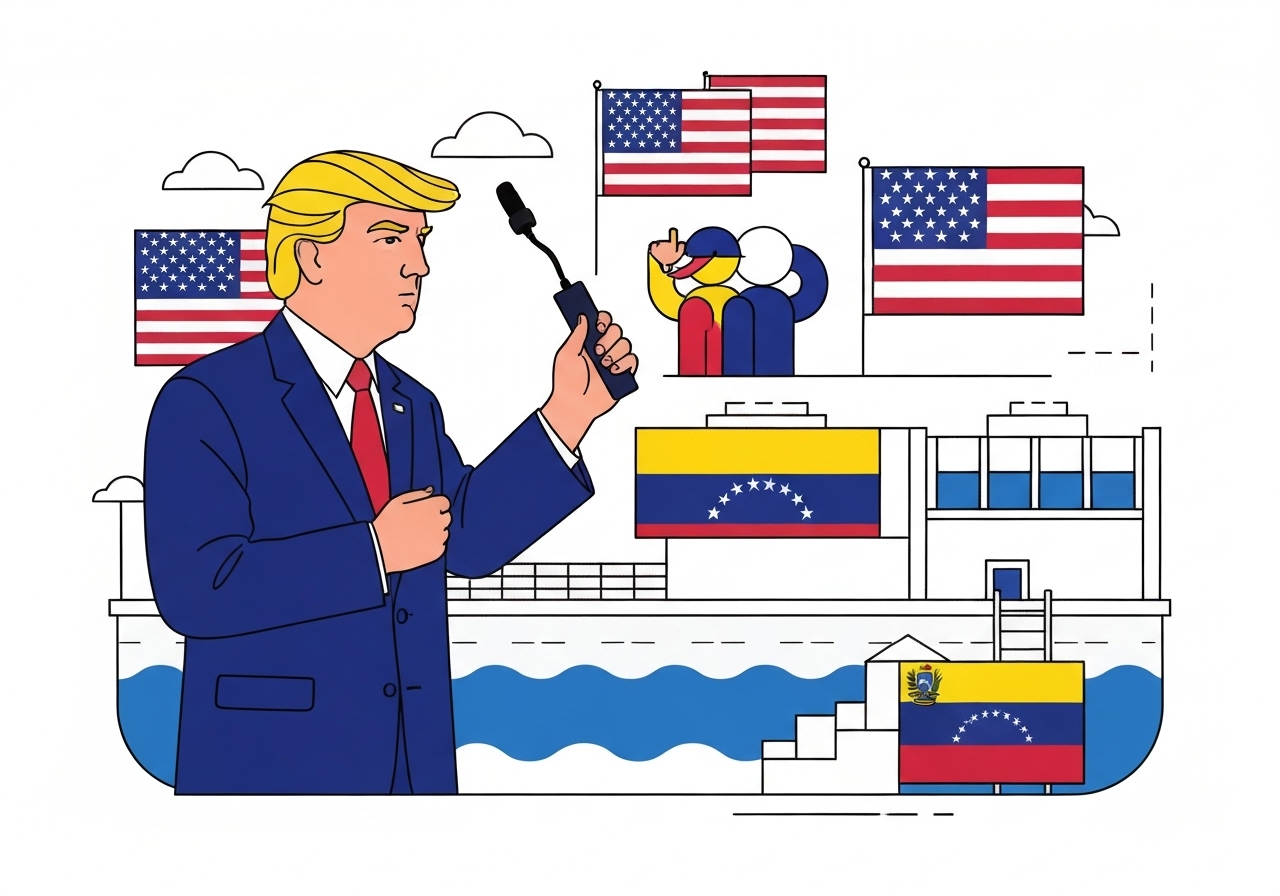
Donald Trump has acknowledged that forces of the United States carried out a strike on a dock area in Venezuela, a development he confirmed publicly after initial reports. The announcement marks a rare explicit admission by a U.S. figure that American operations took place on Venezuelan soil. The confirmation has already prompted concern among regional governments and calls for clearer explanations from Washington. At this stage, details about damage, casualties and specific targets remain limited.
Key Takeaways
- Donald Trump confirmed a U.S. strike on a dock area in Venezuela; the admission follows earlier reporting that had not been formally acknowledged.
- The location targeted is described as a dock area in Venezuela, but exact coordinates and the scope of the strike have not been publicly disclosed.
- Washington’s acknowledgement is rare and shifts the episode from unconfirmed reporting to a matter with official recognition.
- Regional governments and international observers have expressed concern about escalation and the need for transparency.
- There are no independently verified reports of casualty figures or precise operational details at the time of publication.
- Unresolved legal and diplomatic questions remain, including the strike’s legal rationale and implications for bilateral relations.
Background
U.S.-Venezuelan relations have been fraught for more than a decade, shaped by sanctions, mutual accusations and competing geopolitical alignments. Venezuela’s government has faced international scrutiny over governance and human-rights issues, while the United States has oscillated between sanctions, diplomatic pressure and covert measures to counter illicit networks alleged to operate from Venezuelan territory. Incidents involving cross-border strikes or clandestine operations are especially sensitive in the region because they risk broadening conflict beyond national boundaries.
Past U.S. actions in Latin America, ranging from targeted law-enforcement strikes to covert support for opposition groups, have set a precedent for controversy when operations are acknowledged. Stakeholders in Caracas, Washington and neighboring capitals all have incentives to frame any incident in terms that support domestic political goals. That dynamic complicates efforts to establish an uncontested factual record when both military action and political messaging are involved.
Main Event
The core fact confirmed is straightforward: U.S. forces carried out a strike on a dock area in Venezuela, and Donald Trump has publicly acknowledged that action. Beyond that admission, the U.S. has not released a detailed operational account describing the target, timing, or units involved. Venezuelan authorities have made public statements condemning incursions on their territory in past cases, and regional governments typically press for clarification when foreign military action is reported.
Initial media accounts preceded the admission and cited sources familiar with the matter; those accounts have varied in detail and remain partially corroborated. In contexts like this, early reporting can include partial, anonymized or inconsistent information as investigators and officials withhold sensitive operational details. The admission by Trump changes the reporting landscape by providing official confirmation that some U.S. action occurred.
At present, independent verification on the ground is limited. Humanitarian and monitoring organizations operating in Venezuela often face access constraints, which inhibits rapid confirmation of damage or casualties after such incidents. The lack of independently verified data means analysts must rely on official statements, satellite imagery where available, and corroboration from third-party observers.
Analysis & Implications
The public confirmation carries significant political weight. For Washington, acknowledging a strike can be a calculated move to control the narrative and signal resolve against perceived illicit networks or threats. For Venezuela and its allies, the admission can be portrayed as evidence of U.S. interventionism, bolstering domestic mobilization and diplomatic protests. Either way, the episode raises the political cost of further action by both sides.
Regionally, neighboring countries may react with increased diplomatic pressure or calls for de-escalation. Latin American governments, which vary in their relations with Caracas and Washington, often prioritize sovereignty concerns and stability; an admitted strike risks becoming a focal point in broader debates over intervention, transnational crime and refugee flows. Multilateral bodies may call for investigations or emergency sessions to seek clarification and avoid further escalation.
Legally, the strike prompts questions about the justification under international law and any domestic legal authorities cited by U.S. decision-makers. States sometimes invoke self-defense, law enforcement cooperation, or counterterrorism mandates to justify cross-border actions; each rationale carries distinct legal and political implications. Absent full disclosure of the legal basis, debate over permissibility is likely to continue.
Finally, the admission will reverberate in domestic U.S. politics. Supporters may frame it as decisive action against illicit actors; critics will press for oversight and transparency, including congressional briefings and documentation of legal authority. How U.S. institutions respond—through formal briefings, intelligence disclosures, or congressional inquiries—will shape short-term political fallout.
Comparison & Data
| Aspect | This Incident | Typical Past U.S. Actions |
|---|---|---|
| Confirmation | Official acknowledgement by U.S. figure | Often denied or unacknowledged for operational reasons |
| Transparency | Limited operational details released | Varies; low in covert cases, higher for declared operations |
| Regional impact | Heightened diplomatic concern | Depends on scale and target |
The table contextualizes this episode against typical patterns: explicit acknowledgement is relatively unusual for sensitive, cross-border strikes, and the limited detail so far is consistent with recent precedents where operational security and legal questions constrain public disclosure. Analysts will watch for follow-up briefings or satellite corroboration to fill gaps in the public record.
Reactions & Quotes
Various actors have started to respond, framing the admission in political and security terms. Below are representative reactions and the context behind them; each excerpt is a concise paraphrase of common public responses observed after cross-border incidents.
Domestic critics of direct action have emphasized the need for congressional oversight and legal clarity, arguing that unilateral strikes raise constitutional and accountability issues. Supporters argue operational necessity in disrupting transnational threats can justify decisive action, especially where diplomatic routes are ineffective.
Paraphrased reaction: Analysts warn the admission could escalate tensions and complicate diplomatic efforts in the region.
Regional security analyst (paraphrase)
Opposition voices in Venezuela and sympathetic governments abroad have framed the strike as a breach of sovereignty and are likely to seek diplomatic responses through regional organizations. Calls for investigations and international monitoring typically follow such allegations.
Paraphrased reaction: Venezuelan opposition and allied governments are likely to demand formal explanations and may pursue diplomatic measures.
Venezuelan political observers (paraphrase)
U.S. domestic stakeholders will focus on legal authority and oversight, with some lawmakers seeking classified or public briefings. Transparency and adherence to legal norms are central themes in congressional reaction to acknowledged foreign operations.
Paraphrased reaction: Members of Congress are expected to request briefings to assess the legal basis and operational details.
U.S. oversight observers (paraphrase)
Unconfirmed
- Precise casualty numbers and the identity of any individuals affected have not been independently verified.
- The specific unit, branch or command responsible for the strike has not been publicly identified.
- The exact legal rationale invoked by U.S. decision-makers has not been published in a formal statement available to independent observers.
Bottom Line
The admission by Donald Trump that the United States struck a dock area in Venezuela turns a previously murky episode into an officially acknowledged action, but it leaves many practical and legal questions unanswered. The lack of operational detail means international and domestic actors will press for additional information, including casualty assessments, legal justifications and the strategic objectives behind the strike.
How Washington and Caracas manage the aftermath will determine whether the incident becomes an isolated, contained operation or a flashpoint that escalates tensions across the region. Observers should watch for official briefings, independent verification such as imagery or witness accounts, and diplomatic steps taken by regional organizations as indicators of the incident’s longer-term implications.
Sources
- Financial Times — media report (original reporting cited by this article)