
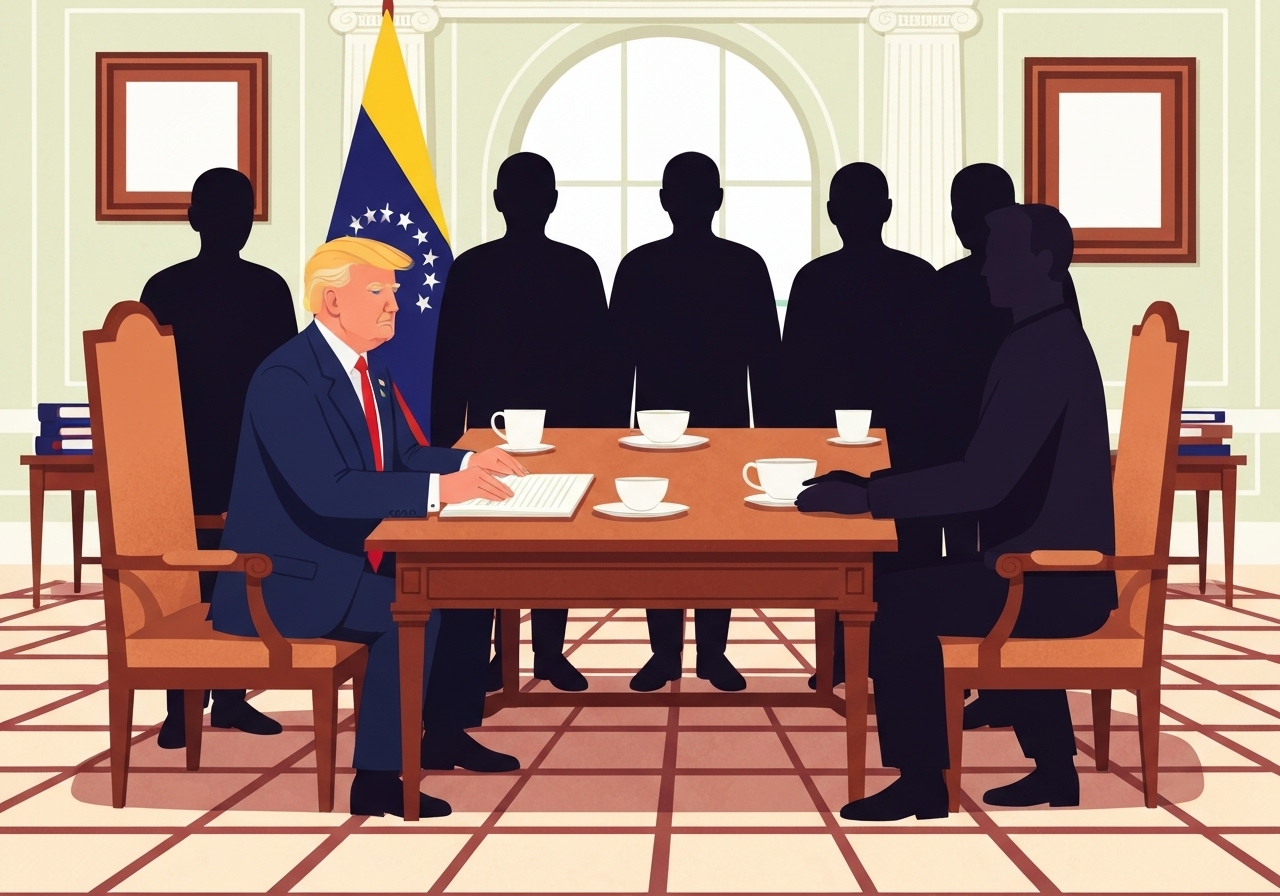
Lead: President Donald Trump will convene an Oval Office meeting on Monday evening to chart next steps on Venezuela, according to sources familiar with the planning. The session is scheduled for 5 p.m. ET and will gather senior cabinet and national security officials as the administration intensifies pressure on Caracas. The meeting comes amid US strikes on suspected drug vessels and a US military buildup in the Caribbean, steps officials say are aimed at disrupting trafficking and signaling deterrence.
Key Takeaways
- The meeting is set for Monday at 5 p.m. ET in the Oval Office and will include senior cabinet and national security aides.
- Expected attendees named by sources include Secretary of Defense Pete Hegseth, Chairman of the Joint Chiefs Gen. Dan Caine, Secretary of State Marco Rubio, Chief of Staff Susie Wiles and Deputy Chief of Staff Stephen Miller.
- The Pentagon has reported more than a dozen warships and approximately 15,000 troops massed in the Caribbean under “Operation Southern Spear.”
- The administration has carried out strikes on suspected drug vessels; those operations have been linked to more than 80 deaths in the region.
- Last week the administration designated President Nicolas Maduro and selected allies as members of a foreign terrorist organization, a move officials say expands US options.
- Lawmakers from both parties have raised legal concerns about follow-up strikes and whether any actions could amount to war crimes.
- President Trump has warned airlines, pilots and criminal networks to avoid Venezuelan airspace and said land interdiction of drugs will happen “very soon.”
Background
For months the Biden administration’s successor has escalated pressure on Venezuela, citing the country’s role in regional narcotics trafficking and the Maduro government’s alleged ties to criminal networks. Officials have pursued a mix of diplomatic measures, economic sanctions and limited military actions intended to disrupt traffickers and signal consequences for continued illicit flows. The recent designation of Maduro and close associates as foreign terrorists represents one of the clearest legal shifts in US policy, signaling Washington’s intent to broaden the toolbox available to confront perceived threats.
Historically, US interventions in the Caribbean and Latin America have prompted intense domestic debate over legality, proportionality and geopolitical consequences. Congressional oversight has often followed major operations, and members of both parties have pushed for briefings and access to decision-makers after lethal military actions. The administration’s naming of the operation as “Operation Southern Spear” frames the deployment as interdiction-focused, but the scale of ships and troops has revived questions about mission scope and rules of engagement.
Main Event
Sources told reporters that the Oval Office session will assemble the president’s top national security and cabinet advisers to review options and legal considerations. Attendees are expected to receive briefings on intelligence related to trafficking networks, recent maritime strikes and the posture of US assets in the Caribbean. Officials will reportedly discuss whether to expand kinetic options, intensify interdiction at sea and pursue new measures targeting overland trafficking routes.
The administration has already ordered strikes on vessels suspected of carrying narcotics; US officials say these actions targeted criminal networks responsible for large-scale shipments. Media reports and congressional statements indicate follow-up strikes occurred after an initial attack, and those later attacks are the subject of heightened scrutiny because they reportedly resulted in many fatalities. The Pentagon has characterized its buildup as necessary to deter illicit traffic and to support interdiction missions, while critics argue the scale risks mission creep.
President Trump has publicly said he spoke with Venezuelan President Nicolas Maduro, but has not disclosed details of that conversation. He has also posted broad warnings on social media advising airlines and pilots to avoid Venezuelan airspace, a message he later asked reporters not to overinterpret. Senior White House figures are expected to clarify whether diplomatic or coercive lines of effort will be prioritized following the Oval Office meeting.
Lawmakers have sought answers about the chain of command for the strikes and the legal rationale used to authorize them. Senator Angus King, a member of the Senate Armed Services Committee, told reporters that if the allegations about a second strike intentionally targeting survivors are true, that would constitute a war crime and prompt Congress to seek interviews across the chain of command. Other members of Congress from both parties have called for briefings and for legal review documents to be made available.
Analysis & Implications
The administration’s combined use of designations, strikes and a visible military presence is intended to create leverage over Maduro while disrupting trafficking networks. Designating a sitting head of state and his circle as terrorists narrows diplomatic options and can complicate negotiations with third parties, but it also provides the administration with legal pathways that were previously more constrained. Analysts caution that such measures can harden Maduro’s domestic posture and bolster his narrative of external aggression, potentially increasing repression at home.
Militarily, the presence of more than a dozen warships and roughly 15,000 troops gives the US a range of capabilities for maritime interdiction, intelligence collection and rapid response. However, a large footprint raises questions about rules of engagement, oversight and the political signals sent to regional partners and competitors. If US forces undertake more aggressive strikes inside Venezuelan territorial waters or approach shore-based targets, Washington will face intensified legal and diplomatic pushback.
Economically and regionally, sustained confrontation risks disrupting trade and complicating relations with neighboring countries that host migrants or rely on Venezuelan commerce. Humanitarian advocates worry that escalatory measures could worsen migration flows and strain aid channels. Internationally, the moves will be watched by other powers with interests in Latin America; a broader confrontation risks spillover into diplomatic disputes and proxy competition in the hemisphere.
Comparison & Data
| Asset | Reported count |
|---|---|
| Warships | More than a dozen |
| Troops | ~15,000 |
| Civilians reported killed in strikes | More than 80 |
The table summarizes the principal figures cited by officials and reporting: an at-sea and regional military posture that includes a two-digit number of surface vessels, a multi-thousand-troop presence, and a death toll tied to recent strikes. These metrics have driven congressional interest and demand for legal and operational transparency.
Reactions & Quotes
Members of Congress across party lines have pressed for information and expressed alarm about follow-up strikes that reportedly killed survivors. Oversight committees are preparing requests for interviews and documents related to the decisions that authorized the operations.
If the facts are as alleged — that a second strike targeted survivors in the water — that would be a stone-cold war crime.
Sen. Angus King (Independent)
King framed the legal stakes succinctly and indicated Congress would pursue testimony from officials up and down the chain of command to establish who issued orders and how they were carried out.
We will stop Venezuelan drug trafficking by land and sea very soon.
President Donald Trump (public remarks)
The president’s short public assertion underscores the administration’s intent to expand interdiction efforts, but it leaves unspecified the tactics and timeline lawmakers and regional partners are seeking to clarify.
Operation Southern Spear is designed to disrupt transnational criminal networks and support interdiction missions in the Caribbean.
Department of Defense (statement)
The Pentagon’s description emphasizes interdiction and deterrence; it also highlights how officials are framing the military presence as mission-focused rather than preparatory for wider conflict.
Unconfirmed
- Precise content and outcomes of President Trump’s phone call with President Maduro have not been disclosed and remain unconfirmed.
- Details about whether a second strike was deliberately aimed at survivors stem from media sourcing and have not been independently verified by official channels.
- Any specific orders issued by individual commanders or the secretary of defense regarding the follow-up strikes have not been publicly released.
Bottom Line
The Oval Office meeting will be a focal point for deciding whether the US will widen its mix of diplomatic, economic and military tools against Venezuela. Officials will need to balance the operational desire to disrupt trafficking with legal constraints and the diplomatic cost of escalating actions against a sitting foreign government.
Congressional scrutiny and public attention to the reported fatalities raise the political stakes for the administration’s next moves. Transparency about rules of engagement, the chain of command and legal justifications will shape congressional responses and international perceptions in the days ahead.