
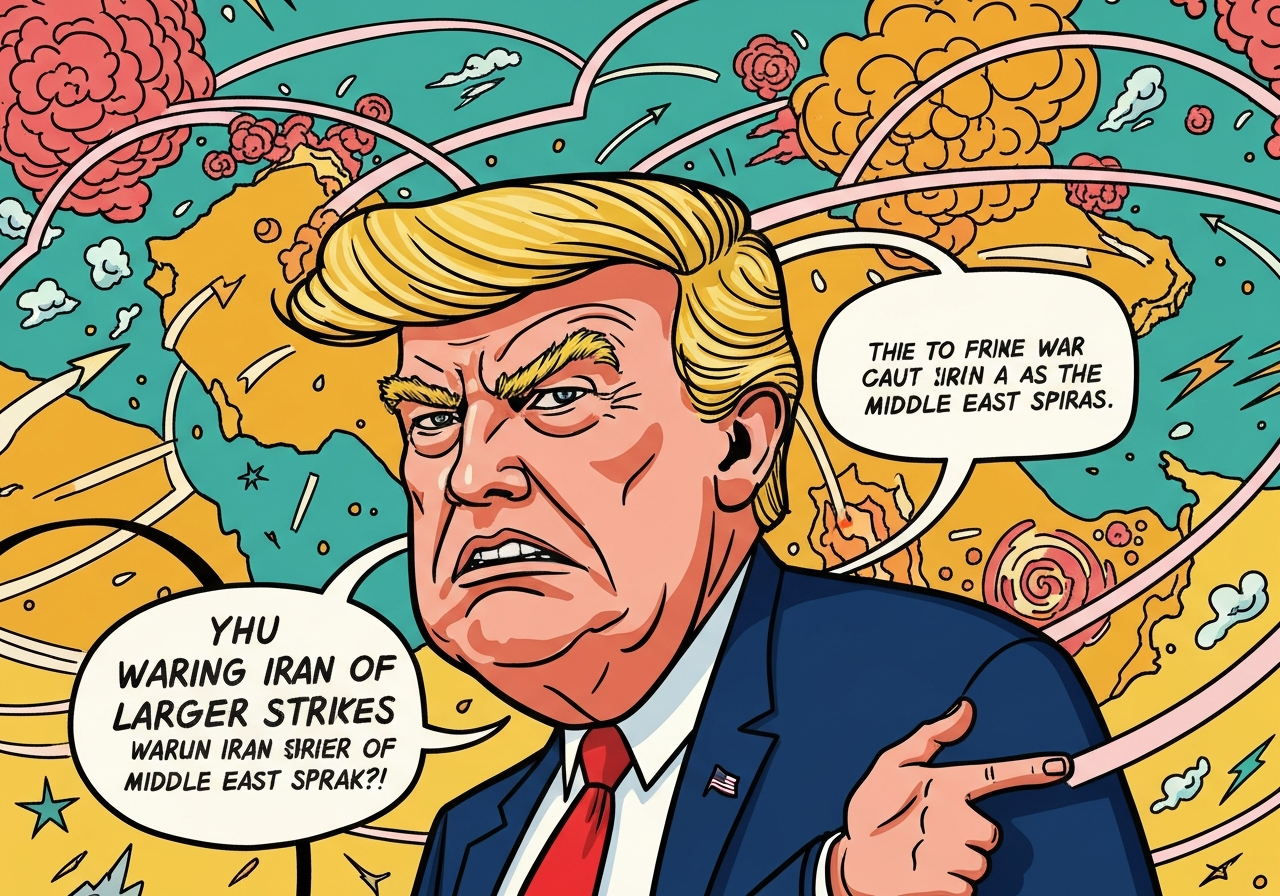
Lead: President Donald Trump warned Monday that a “big wave” of strikes against Iran is still to come as US-led operations with Israel expand across the Middle East. The warning came amid continuing cross-border exchanges between Israel and Hezbollah, missile and drone attacks across Gulf states and strikes that U.S. officials say have degraded Iranian military and nuclear capabilities. The intensifying campaign has disrupted energy production and regional airspace, and has resulted in civilian casualties on both sides.
Key Takeaways
- Trump told CNN the US is “knocking the crap” out of Iran and said a larger wave of strikes is forthcoming; he did not rule out deploying US troops “if necessary.”
- US and Israeli strikes this weekend targeted Iranian military and nuclear sites; the White House says previous June strikes “totally” obliterated Iran’s nuclear program.
- Iranian missile fire struck Beit Shemesh near Jerusalem, killing at least nine people including three teenage siblings, officials said.
- The UAE reported intercepting dozens of incoming projectiles on Monday and put cumulative tallies at roughly 174 ballistic missiles, eight cruise missiles and 689 drones launched since Saturday.
- Three US fighter jets were reportedly shot down by Kuwaiti air defenses in an apparent friendly-fire incident; all crews are said to be in stable condition.
- QatarEnergy halted liquefied natural gas (LNG) output after damage at its Ras Laffan facility, and Brent crude briefly rose above $82 a barrel before settling near $77.
- Four US service members have died in the campaign, and US officials say objectives include destroying Iranian missile capabilities, neutralizing its navy and preventing nuclear reconstitution.
Background
Over the past week a joint US-Israeli operation struck multiple Iranian targets, including sites U.S. officials described as tied to nuclear activity and long-range missile capabilities. Washington says those actions follow a series of Iranian attacks on regional shipping, military bases and Gulf infrastructure that escalated tensions. The US withdrew from the 2015 nuclear deal during the prior Trump administration, a move the current White House cites when framing Iran’s resumed nuclear ambitions.
Regional actors and global powers have rapidly taken positions: Gulf states have expanded air defenses and closed airspace; European capitals are convening energy and security groups; and Russia has warned that the strikes risk wider regional conflagration. Energy markets have reacted quickly because the Gulf supplies a substantial share of global oil and gas; Qatar alone supplies roughly 20% of global LNG exports, amplifying the economic stakes of attacks on energy infrastructure.
Main Event
President Trump spoke publicly Monday from the White House, outlining a four-part objective: degrade Iranian missile forces, neutralize elements of its navy, prevent a return to nuclear weapons work and stop Tehran from arming proxy groups. In a separate phone interview with CNN, he said the US military is “ahead of schedule” but that the “big wave” of action has yet to occur and that he would not rule out ground forces if required.
On the ground, Iranian strikes and reciprocal Israeli actions have spread beyond direct Tehran-Israel exchanges. Explosions and intercepts were reported in Gulf cities including Dubai, Abu Dhabi and Doha. Qatar’s defense ministry said it shot down Iranian Su-24 aircraft on Monday, and Gulf air defenses — including UAE systems and allied Patriot and THAAD batteries — reported numerous interceptions.
A missile strike in the Israeli city of Beit Shemesh hit a residential neighborhood and a synagogue-shelter, killing at least nine civilians including three teenagers. Emergency services and municipal officials described chaotic rescue efforts and grieving funerals. In Gaza and across southern Israel, authorities tightened crossings and civil-defense measures in anticipation of further strikes.
Energy and industrial sites have also been hit: drones and missiles reportedly sparked a fire at Saudi Arabia’s Ras Tanura refinery and damaged Qatar’s Ras Laffan LNG complex, prompting QatarEnergy to pause production. Analysts warn that repeated strikes on processing facilities could sharply tighten global energy markets and further raise prices at the pump.
Analysis & Implications
The operational aim stated by US leaders is to blunt Iran’s ability to project long-range force and to disrupt any pathways to a resumed weapons program. If the United States and partners systematically degrade missile inventories, air defenses and naval staging areas, Tehran’s conventional reach would shrink — but such degradation risks prompting asymmetric retaliation by proxies or opportunistic actors across the region.
Energy markets respond more immediately than politics. With Qatar pausing LNG output and strikes affecting refining capacity, near-term supply risk has already pushed Brent crude above $82 per barrel intraday and US pump prices have begun to climb. For energy-importing economies, even small sustained price increases are inflationary and can constrain fiscal space and consumer spending.
Militarily, the campaign increases the chance of miscalculation. Incidents such as the reported shoot-down of US jets by Kuwaiti air defenses underscore the fog of high-tempo operations where identification and command-and-control are strained. Each accidental strike or collateral death raises the political cost for capitals weighing further involvement.
Comparison & Data
| Item | Reported figure |
|---|---|
| Beit Shemesh fatalities | At least 9 (including three teenagers) |
| US military deaths | 4 service members |
| UAE cumulative incoming launches (since Saturday) | ~174 ballistic missiles, 8 cruise missiles, 689 drones |
| Brent crude price (Monday intraday) | Briefly > $82 / settled ~ $77 (≈ +6% day) |
| Qatar share of global LNG exports | ~20% |
The table summarizes key verified figures reported by regional authorities and international markets. Those numbers show both humanitarian impact on civilians and the strategic pressure on energy flows that can ripple into global prices and national budgets.
Reactions & Quotes
“We’re knocking the crap out of them. I think it’s going very well. The big wave hasn’t even happened.”
President Donald Trump, White House remarks / CNN interview
“This is a morphing of the crisis…continued attacks on energy infrastructure could cause the situation to spiral and drive much bigger moves in energy prices.”
David Oxley, Chief Commodities Economist, Capital Economics
“Qatar Armed Forces possess full capabilities and resources to safeguard the state’s sovereignty and lands.”
Qatar Ministry of Defense (official statement)
Unconfirmed
- Reports that the wife of Iran’s supreme leader died after being wounded in strikes are based on local media accounts and have not been independently verified by an international agency.
- Some field claims about exact tallies of intercepted missiles and drones vary between official statements and third-party observers; cumulative totals should be treated as provisional.
- Details of the reported Kuwaiti friendly-fire downing of three US fighter jets are from military briefings and remain under formal investigation, with some operational details not yet confirmed publicly.
Bottom Line
The conflict has moved quickly from discrete strikes to a wider confrontation that touches civilian populations, critical energy infrastructure and the airspace of multiple Gulf states. US and Israeli statements frame the campaign as necessary to remove immediate threats; regional actors and global markets judge the moves on their broader stability and economic consequences.
Key near-term risks include further damage to energy export facilities, errant engagements between air-defense systems and coalition aircraft, and a cycle of retaliation by Iran or its proxies that could draw other states into direct confrontation. Close monitoring of official releases and independent verification of battlefield claims will be essential to separate confirmed facts from competing narratives as events unfold.
Sources
- CNN Live Coverage — live reporting / international news