
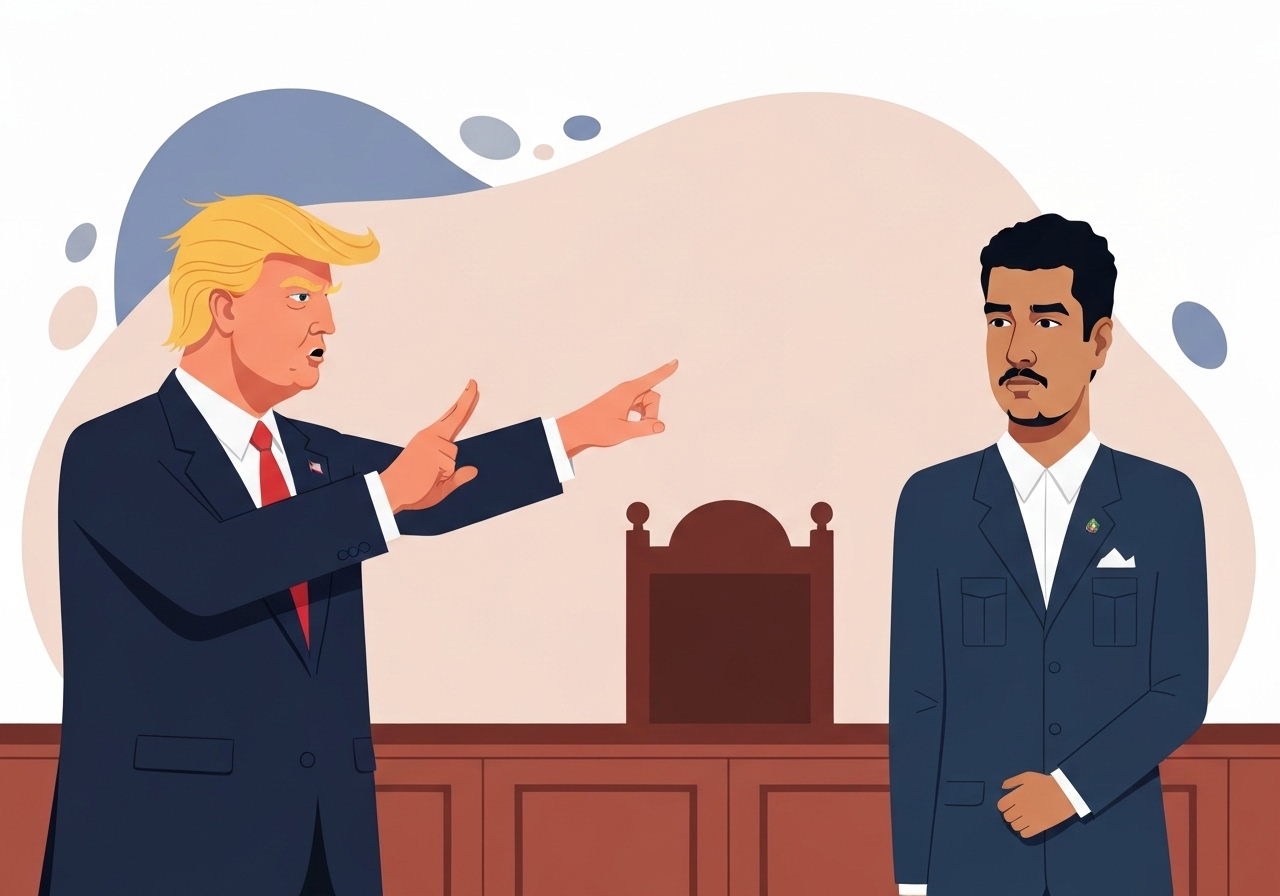
Lead: Former US President Donald Trump warned Venezuela’s new interim leader, Delcy Rodríguez, she could “pay a very big price” if she fails to cooperate, comments made as deposed president Nicolás Maduro was flown to the United States and set to appear in a New York court on Monday. Maduro faces charges including drug trafficking and weapons offences brought by US prosecutors. Rodríguez — previously Maduro’s vice‑president — signalled readiness to cooperate at her first cabinet meeting ahead of being sworn in in Caracas at 08:00 local time (12:00 GMT). The developments follow a US special‑operations action in Caracas that removed Maduro and his wife from power and prompted regional and domestic debate over legality and risk.
Key Takeaways
- Donald Trump told The Atlantic that Delcy Rodríguez “is going to pay a very big price” if she “doesn’t do what’s right,” a public warning issued as Maduro was transported to the US for legal proceedings.
- Nicolás Maduro is charged in US courts with drug trafficking and weapons offences and was scheduled to appear in a New York courtroom on Monday following his capture in a Saturday operation.
- Rodríguez will be sworn in as Venezuela’s president in Caracas at 08:00 local time (12:00 GMT) with backing from the Venezuelan Supreme Court and the military.
- The Cuban government reported 32 Cuban combatants killed during the US operation; that casualty figure and many operational details remain contested.
- US Secretary of State Marco Rubio characterized the action as a law‑enforcement operation against drug networks and said the US retains multiple levers of leverage, including an oil ‘‘quarantine.’’
- Some senior US Democrats called the operation an “act of war,” citing lack of congressional notification and concerns about scale; House and Senate leaders signaled moves to restrict further unilateral action.
- A number of Latin American governments and Spain denounced the US action as a dangerous precedent for regional security and civilian safety.
Background
Nicolás Maduro has led Venezuela since 2013 and his government has long been accused by opponents and foreign officials of repressing dissent and manipulating elections. Many international actors judged Venezuela’s 2024 election illegitimate, intensifying existing tensions with the United States, which has labeled Maduro’s administration a “narco‑terrorist” regime.
The United States has maintained sanctions and other measures aimed at cutting the regime’s revenue streams, including restrictions on Venezuelan oil. Relations with Caracas were further complicated by Havana’s close alliance with Maduro; Cuba provided political and security support historically and condemned the US operation this week.
US involvement in regime changes and overseas operations carries a long, contentious history in the Americas, shaping regional sensitivity and legal scrutiny. Questions over congressional authorization, international law and civilian risk now frame the global response to this week’s events.
Main Event
In the early hours of Saturday, a US special‑operations action struck locations in Caracas, including at least one major military base. Venezuelan authorities say strikes hit Fuerte Tiuna; Maduro and his wife, Cilia Flores, were taken captive at their compound and flown to the United States, according to US officials and reporting shared by international outlets.
US prosecutors subsequently charged Maduro and his wife with drug trafficking and weapons offences. US officials described the capture as carried out on the ground by FBI and special‑operations personnel; Secretary of State Marco Rubio and other administration figures characterized it as a law‑enforcement operation targeting transnational criminal networks.
Delcy Rodríguez, who served as vice‑president under Maduro, adopted a conciliatory tone at her first cabinet meeting and invited US cooperation on development within international law. She is due to be sworn in on Monday with backing from Venezuela’s Supreme Court and the military.
President Trump — who had posted a photograph of Maduro aboard the USS Iwo Jima — said the US would “run” Venezuela until a “safe and proper” transition; he also promised US oil companies would enter to rebuild infrastructure. Separately, Trump made critical remarks about Colombian President Gustavo Petro, suggesting possible military options and accusing him of facilitating drug flows — comments that raised additional regional concern.
Analysis & Implications
The immediate legal trajectory centers on US criminal proceedings against Maduro and the domestic legitimacy concerns created by an external capture of a sitting head of state. A US court process will focus on evidence and criminal statutes; political fallout will depend on how regional governments and Venezuelan institutions respond to Rodríguez’s interim rule.
Legally, the US administration’s framing of the operation as law enforcement rather than an act of war is critical to its domestic standing. Several senior Democrats questioned that characterization and noted the absence of prior congressional consultation; that dispute could prompt legislation limiting further unilateral actions.
Regionally, the action risks deepening divisions. Brazil, Chile, Colombia, Mexico, Uruguay and Spain jointly warned of a dangerous precedent, and Cuba declared national mourning after reporting 32 Cuban combatant deaths. Those reactions could harden diplomatic rifts and complicate humanitarian and migration dynamics already affecting neighbouring countries.
Economically, renewed US involvement in Venezuela — including proposals to open the oil sector to US firms — could change global oil markets and the Venezuelan fiscal picture, but reconstruction depends on stability, legal clarity over assets and broad international recognition of any interim authority.
Comparison & Data
| Item | Detail |
|---|---|
| Maduro in power | Since 2013 |
| Capture and strikes | Early hours, Saturday (major base: Fuerte Tiuna) |
| Swearing‑in (Rodríguez) | Monday, 08:00 local (12:00 GMT) |
| Maduro court appearance | Monday, New York federal court |
| Cuban casualties (reported) | 32 combatants (Cuban government claim) |
The table highlights core timepoints and contested figures. While legal proceedings in New York will proceed under US federal law, political legitimacy inside Venezuela will hinge on domestic institutions, military loyalties and public reaction. Casualty figures and operational details provided by state actors remain subject to independent verification.
Reactions & Quotes
Officials and lawmakers responded sharply on both sides of the aisle. Here are representative excerpts alongside context.
Trump’s warning to Rodríguez came amid broad statements about US intentions in Venezuela and offers to open the oil sector to US companies as part of a transition plan.
If she doesn’t do what’s right, she is going to pay a very big price, probably bigger than Maduro.
Donald Trump (interview with The Atlantic)
Secretary of State Marco Rubio defended the operation as targeting drug networks and not constituting a war with Venezuela, emphasizing US leverage including an oil quarantine.
We are at war against drug trafficking organisations. That’s not a war against Venezuela.
Secretary of State Marco Rubio
By contrast, congressional Democrats raised constitutional and legal objections, arguing the scale and secrecy of the operation require oversight and could amount to an act of war.
This was an act of war; the American people pay the price in blood and dollars when we undertake regime‑change operations without clear authorization.
House Minority Leader Hakeem Jeffries
Unconfirmed
- The exact number and identity of non‑Venezuelan casualties, including Cuba’s claim of 32 combatant deaths, has not been independently verified by neutral observers.
- Full details on the composition and nationalities of forces involved in the operation — and the precise chain of custody in Maduro’s removal — remain publicly incomplete.
- Allegations about Colombian government involvement or support in illicit drug networks mentioned by some US officials are unresolved and require further evidentiary confirmation.
Bottom Line
The removal and transfer of Nicolás Maduro to US custody and Donald Trump’s public warning to Delcy Rodríguez mark an unprecedented escalation in US‑Venezuelan relations in recent years. Legally, the immediate path will be US criminal proceedings; politically, the region faces heightened instability, contested legitimacy and potential diplomatic ruptures.
Key things to watch: the US court’s handling of Maduro’s case; how Venezuelan institutions and the military respond to Rodríguez’s interim presidency; potential congressional actions in Washington; and regional diplomatic moves by Brazil, Colombia, Mexico and others. Independent verification of casualty figures and operational claims will be essential to assessing the humanitarian and legal consequences.
Sources
- BBC News — (news media: report synthesizing Reuters and other coverage)
- Reuters — (news agency: on‑the‑ground and wire reporting)
- The Atlantic — (magazine: interview cited for Trump’s remarks)
- U.S. Department of State — (official: statements from US government)