
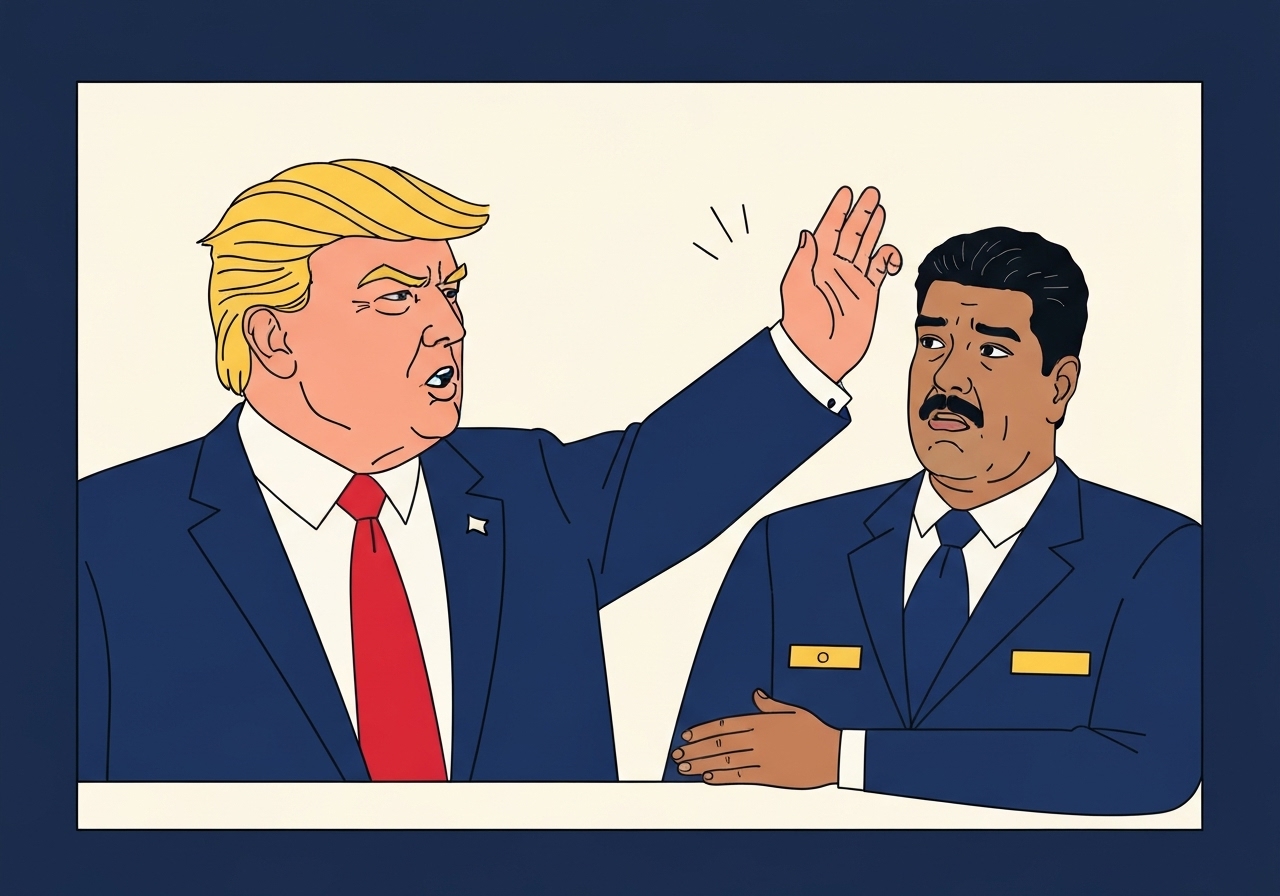
In a tense weekend escalation, former US president Donald Trump warned Venezuela’s incoming leader Delcy Rodríguez that she could “pay a very big price, probably bigger than Maduro” if she fails to cooperate, remarks published as Nicolás Maduro was due to appear in a New York courtroom on Monday. Maduro and his wife Cilia Flores were flown to the United States after a special forces operation in Caracas and have been charged with weapons and drug offences; Maduro denies leading a cartel. Rodríguez, who served as Maduro’s vice president, signalled cooperation at her first cabinet meeting and is scheduled to be sworn in as president in Caracas at 08:00 local time (12:00 GMT) on Monday, backed by the Supreme Court and the military.
Key Takeaways
- Donald Trump told The Atlantic on Sunday that Delcy Rodríguez would “pay a very big price, probably bigger than Maduro” if she “doesn’t do what’s right,” escalating rhetoric toward Venezuela’s new leadership.
- Nicolás Maduro, charged in the US with drug trafficking and weapons offences and accused by US officials of running a “narco-terrorist” regime, was transported to New York and was due to appear in court on Monday.
- Delcy Rodríguez addressed her first cabinet meeting on Sunday with a conciliatory tone, inviting US cooperation “within the framework of international law,” and will be sworn in Monday at 08:00 local time (12:00 GMT).
- Cuban authorities said 32 Cuban combatants died during the US operation that captured Maduro and his wife; Cuba declared two days of national mourning.
- US Secretary of State Marco Rubio defended the operation as a law-enforcement action against drug trafficking, while some Democratic leaders, including Hakeem Jeffries and Chuck Schumer, characterized the raid as an act of war and questioned its legality and congressional notification.
- Trump said the US would “run” Venezuela temporarily and that US oil companies would move in to repair infrastructure and generate revenue for the country.
- A group of governments — Brazil, Chile, Colombia, Mexico, Uruguay and Spain — warned the US action sets a dangerous precedent for regional peace and security.
Background
Nicolás Maduro has led Venezuela since 2013 and his 2024 re-election was widely contested by opponents and several foreign governments. Years of economic collapse, hyperinflation and accusations of political repression have left state institutions weakened and the military and Supreme Court pivotal in power transitions. The United States has previously imposed sanctions and a partial “quarantine” on Venezuelan oil as leverage, and US officials have long accused Maduro’s government of facilitating illegal narcotics networks, allegations he denies as a pretext for seizing the country’s oil wealth.
Delcy Rodríguez, once Maduro’s vice president, has deep ties to the ruling United Socialist Party and is supported by Venezuela’s Supreme Court and senior military commanders. Her rapid elevation follows the special forces operation that removed Maduro from his compound and transported him to US custody — an intervention that marks a sharp escalation in direct US involvement. Regional actors and international bodies have historically expressed concern about unilateral regime-change operations, which raises immediate diplomatic and legal questions.
Main Event
In the early hours of Saturday, special forces struck military targets in Caracas and detained President Maduro and his wife, Cilia Flores, after strikes on military bases and a raid at their compound. US officials say Maduro was apprehended on the ground by FBI agents and that no American troops were reported killed; Venezuela’s Defence Minister Vladimir Padrino, however, reported casualties among Maduro’s security detail and civilians. Maduro and Flores were flown to the United States and charged with weapons and drug offences, with prosecutors setting a Monday court appearance in New York.
On Sunday Rodríguez convened her first cabinet meeting and adopted a conciliatory tone, offering to work with the US on a cooperative development agenda within international law. Still, she is taking office backed by the Supreme Court and the military, signaling continued domestic institutional support. Trump used an interview with The Atlantic to repeat his threat to Rodríguez and to say that regime change would be preferable to the current situation in Venezuela.
Secretary of State Marco Rubio defended the operation across several US broadcasts, framing it as an action against drug trafficking organisations rather than an attack on the Venezuelan state. Rubio also reiterated that the US retains economic levers, notably the oil quarantine, to influence Venezuela’s decisions. Democratic congressional leaders voiced sharp criticism, warning the administration that further military or unilateral actions without Congressional approval would face pushback in both chambers.
Analysis & Implications
Legally, the cross-border capture of an incumbent head of state raises complex questions under international law, US domestic law and customary norms on sovereignty and extraterritorial enforcement. The Trump administration and supporters argue the operation targeted criminal activity — drug trafficking and weapons violations — and therefore falls within law-enforcement prerogatives. Critics counter that the scale and secrecy of the operation resemble military action and that bypassing Congress risks constitutional and political fallout.
Regionally, the operation has already produced diplomatic strain: Cuba reported 32 dead among its personnel and declared national mourning, while a bloc of Latin American governments condemned the US action as dangerous to regional security. Those responses may complicate coordination on migration, counter-narcotics and economic ties, and could prompt retaliatory diplomatic measures or hardened regional alignments against US influence.
Economically, Trump’s comments inviting US oil companies to move into Venezuela underline a simultaneous strategic and commercial motive: restoring oil production would be a major task but could reshape global oil markets if sustained investment and security can be guaranteed. However, uncertainty about governance, potential insurgency, and international backlash make large-scale investment risky in the near term.
Comparison & Data
| Item | Detail |
|---|---|
| Maduro in power | Since 2013 |
| Court appearance | New York — Monday |
| Rodríguez inauguration | Caracas, 08:00 local (12:00 GMT) Monday |
| Cuban casualties reported | 32 (Cuban government statement) |
The table highlights the immediate timeline and key numeric claims. While Maduro’s long tenure (since 2013) frames the political crisis, the rapid sequence — a weekend raid, a Monday court date and a near-simultaneous inauguration — compresses decision windows for diplomats and markets. The Cuban death toll, if verified, is the single most consequential casualty figure for regional reaction and will shape Havana’s response.
Reactions & Quotes
US domestic reaction split sharply along partisan lines. Officials aligned with the Trump administration defended the operation as necessary to counter drug trafficking; many Democrats and several foreign governments described the action as dangerously unilateral.
“If she doesn’t do what’s right, she is going to pay a very big price, probably bigger than Maduro.”
Donald Trump
This remark, made to The Atlantic, amplified threats toward Delcy Rodríguez and signalled a readiness to apply pressure beyond Maduro himself. The language increased political tensions at a moment when Rodríguez sought to project cooperation.
“We are at war against drug trafficking organisations. That’s not a war against Venezuela.”
Marco Rubio, US Secretary of State
Rubio used television interviews to characterise the operation as law enforcement aimed at criminal networks, insisting that the US is not waging war against the Venezuelan state — a framing aimed at domestic and international audiences to limit claims of unlawful aggression.
“This was an act of war.”
Hakeem Jeffries, House Minority Leader
Democratic leaders raised alarms about congressional notification and legal authority, with Jeffries and Senate Minority Leader Chuck Schumer warning of attempts to restrict the administration’s ability to take further military action without Congressional approval.
Unconfirmed
- The precise scale of US military assets involved in the operation remains contested; claims of “thousands of troops” and “at least 150 military aircraft” circulated but are unverified.
- Independent confirmation of the Cuban government claim that 32 “brave Cuban combatants” were killed is pending corroboration from third-party monitors or international observers.
- Allegations that Maduro personally ran a cartel remain contested in court filings and by Maduro’s denials; criminal charges in the US are subject to judicial process and evidentiary standards.
Bottom Line
The weekend operation and subsequent statements have thrust Venezuela into a volatile new phase: an embattled incumbent president has been transported to the United States to face criminal charges, and a handpicked successor is taking office amid threats and offers of cooperation. That mix of coercion and conciliatory rhetoric creates both immediate diplomatic strains and long-running legal and security questions.
For Washington and regional capitals, the immediate priorities are verifying casualty claims, clarifying the legal basis and authorization for the operation, and managing the diplomatic fallout that could reshape alliances across Latin America. For markets and investors, the situation introduces deep uncertainty about Venezuela’s oil sector and the pace at which reconstruction or foreign investment could proceed.