
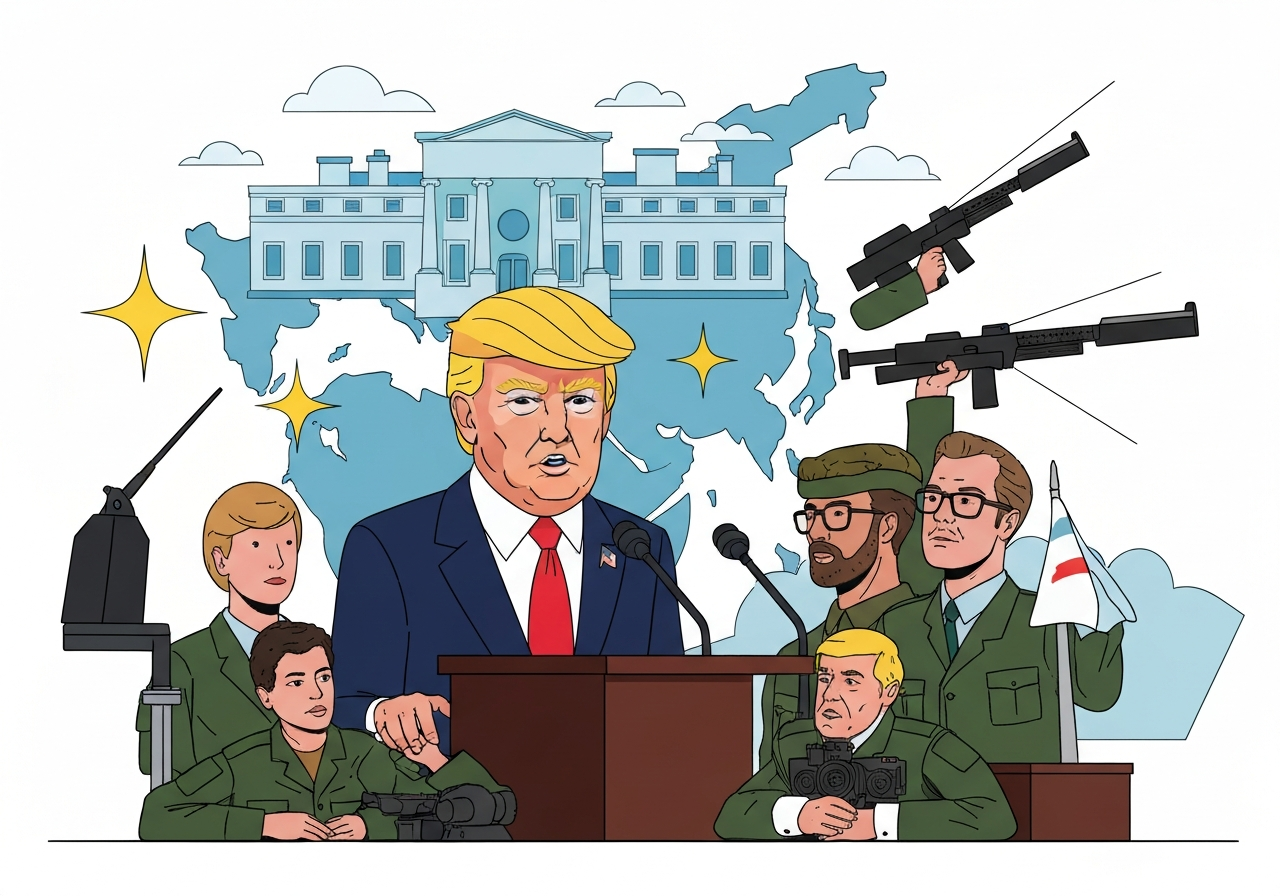
Lead: President Donald Trump delivered a televised White House address, outlining his administration’s rationale for recent operations related to the Iran conflict during remarks published at 02:11 BST. Speaking from the White House, he framed the campaign as a series of clear victories and said U.S. forces had degraded Iran’s capacity for missile and drone attacks. He referenced past administrations’ inaction as part of his justification and compared the operation to past U.S. efforts abroad, including Venezuela. The speech did not, however, set out a new or immediate military timetable for further action.
Key Takeaways
- Trump characterized U.S. efforts as “swift, decisive and overwhelming,” claiming senior Iranian figures have been killed and key strike capabilities reduced.
- The president asserted that Iran’s ability to launch missiles and drones has been “dramatically curtailed,” without presenting new corroborating evidence during the address.
- He repeatedly invoked Venezuela as an operational model, saying past U.S. actions there were rapid and left a cooperative government in place.
- Trump blamed previous U.S. administrations for failing to confront Iran over nearly 50 years of adversarial relations.
- Iran, publicly, has not acknowledged requesting a ceasefire or confirming that negotiations point to an imminent end to hostilities.
- The address emphasized victory narratives but did not detail an immediate need for a separate operation earlier this year or provide timelines for next steps.
Background
U.S.-Iran tensions stretch back almost half a century, shaped by the 1979 revolution, longstanding sanctions, proxy conflicts, and periodic direct confrontations. Successive administrations have alternated between diplomacy, sanctions and limited military actions, leaving a complex mix of deterrence and instability across the region. The Trump administration has repeatedly framed Iran as a persistent threat to U.S. interests and allies, arguing that stronger measures were necessary to degrade Tehran’s regional reach. Relations have been further complicated by Iran’s support for proxy groups in Iraq, Syria, Lebanon and elsewhere, which Washington says increases the risk of broader escalation.
Recent months saw heightened incidents at sea, attacks on facilities and strikes attributed to or aimed at Iranian-backed forces; those incidents set the immediate scene for the White House address. Domestically, the administration is balancing public messaging about operational success with legal and political constraints, including congressional oversight and international law considerations. International partners and regional actors have offered mixed responses, with some nations urging de-escalation while others emphasize support for countering Iranian influence. The administration’s references to prior U.S. interventions signal a continuity in using decisive force as both tactic and rhetorical device.
Main Event
In his televised remarks, Mr. Trump opened by highlighting what he described as recent battlefield successes, saying U.S. actions had achieved rapid and overwhelming results. He credited U.S. forces with causing the deaths of senior Iranian leaders — a claim framed as evidence of operational precision — and insisted that Iran’s strike capabilities were seriously weakened. The president repeated language that framed the campaign as a clear victory for American strategy and resolve, asserting, “America is winning, and winning bigger than ever before.”
He drew a parallel to Venezuela, characterizing that intervention as quick, forceful and ultimately leaving a cooperative government; he presented that episode as an instructive example for operations elsewhere. Notably, the address did not provide new, specific evidence to substantiate the scale of the claims about degraded missile and drone capacities. The speech also stopped short of explaining why an operation earlier in the year had not been mounted, instead attributing past inaction to previous administrations.
On the diplomatic front, the White House claim that hostilities are moving toward an end was contrasted by Tehran’s public posture: Iran has not acknowledged asking for a ceasefire nor confirmed talks that would signal an imminent cessation of fighting. The president appealed to both domestic and international audiences, seeking to justify the campaign as necessary to protect U.S. interests and allies while promising continued pressure on Iran until perceived threats are removed.
Analysis & Implications
Strategically, the administration’s emphasis on decisive victories aims to shape public perception and blunt criticism that military measures risk entangling the U.S. in a long conflict. Presenting removed leaders and curtailed capabilities as proof of success serves a domestic political purpose as well as a deterrent signal to Tehran and allied non-state actors. However, statements of battlefield success do not eliminate the risk of retaliation, escalation or proxy reprisals across the region, which remain material policy challenges.
From a legal and diplomatic standpoint, the administration’s narrative will be scrutinized by Congress, international bodies and partner governments seeking evidence and justification for kinetic actions. Allies may welcome an apparent reduction in immediate strike capabilities, but many will press for transparent assessments, de-escalatory channels and multilateral approaches to stabilize the region. Economically, renewed instability could further pressure energy markets and add volatility to global trade routes if maritime security concerns persist.
Politically, the address could bolster the president among supporters who prefer a robust use of force, while provoking critics who argue for clearer legal authority, oversight and exit strategies. If claims about degraded Iranian capabilities prove only partial, the administration risks reputational costs and potential strategic setbacks. Longer-term, the situation will test the effectiveness of punitive strikes versus diplomatic engagement in reducing Iran’s regional influence.
Comparison & Data
| Claim | Publicly Confirmed Status |
|---|---|
| Deaths of senior Iranian leaders | Claim made in address; independent confirmation not presented in speech |
| Missile/drone launch capacity “dramatically curtailed” | Administration assertion; detailed evidence pending outside of the address |
| Iran requested a ceasefire / talks leading to immediate end | Iran has not publicly confirmed such a request |
| Venezuela as operational precedent | Used as rhetorical comparison; operational contexts differ significantly |
The table summarizes claims from the address against what was publicly confirmed at the time. Without external assessments or third-party verification released alongside the speech, many operational claims remain assertions by the administration. Analysts will look for corroborating intelligence, independent monitoring and allied statements to validate the scope of the stated effects.
Reactions & Quotes
“America is winning, and winning bigger than ever before,” the president said, using the phrase to encapsulate his portrayal of the campaign’s results.
President Donald Trump (White House address)
One senior defense analyst in Washington cautioned that battlefield claims should be verified by independent sources before being treated as conclusive evidence of long-term capability degradation.
Defense analyst, Washington think tank
Foreign ministries and regional officials have urged restraint and transparent reporting, voicing concern about the risk of further destabilization in the Middle East.
Regional diplomatic sources (public statements)
Unconfirmed
- The precise number and identities of “senior Iranian leaders” reported killed have not been independently verified in the immediate aftermath of the speech.
- The full extent to which Iran’s missile and drone launch capacity has been “dramatically curtailed” lacks corroborating public evidence released with the address.
- Whether talks underway, if any, indicate a near-term ceasefire has not been confirmed by Iranian officials.
Bottom Line
The White House address framed recent operations as decisive successes, using vivid language and comparisons to earlier interventions to justify the administration’s approach toward Iran. While the speech communicated a clear political narrative of victory, it offered limited new evidence to substantiate operational claims, leaving independent verification as the key outstanding need. Observers should watch for corroborating intelligence releases, allied statements and Tehran’s next moves to assess whether the asserted effects are durable or partial.
In the near term, the situation remains unstable: claims of degraded enemy capabilities reduce some immediate threats but do not remove the risk of escalation through proxies or asymmetric attacks. The international community’s demand for transparency and the U.S. Congress’s oversight role will shape how this narrative translates into sustained policy and potential further action.