
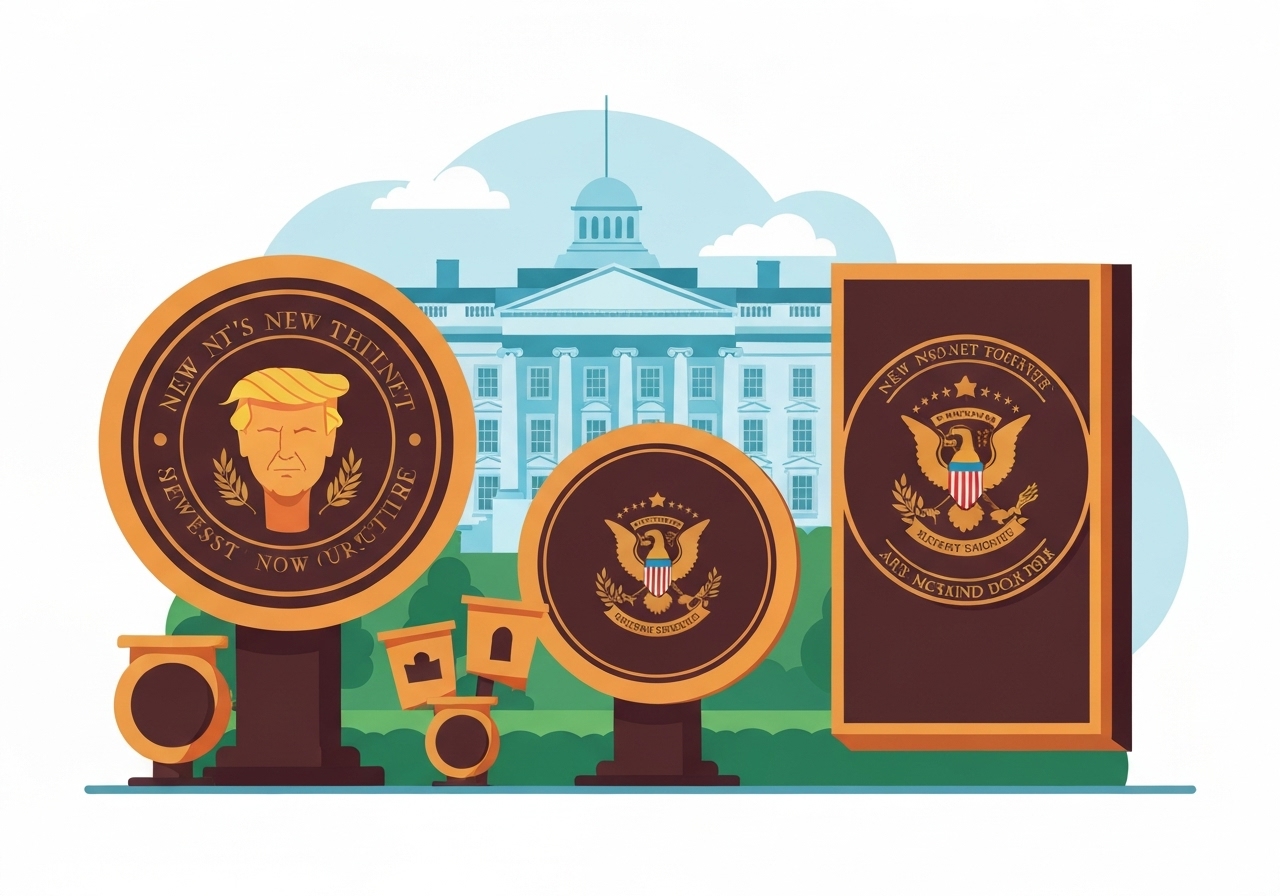
President Donald Trump installed a series of new plaques beneath presidential portraits outside the White House in January 2025 that make sweeping claims about his record, including that he “defeated inflation” and “ended eight wars.” This article reviews those assertions, comparing them with official data and open-source reporting to determine what is verifiable, what is overstated, and what remains contested. We find some claims reflect real but partial accomplishments, others are inaccurate when measured against historical data, and several depend on disputed interpretations of diplomatic activity. The assessment separates confirmed facts from claims that remain unverified or misleading.
Key Takeaways
- Inflation claim: U.S. inflation peaked at 9.1% in June 2022; by 2025 the annual consumer price index rise is about 3%—lower but not eliminated, contrary to the plaque’s “defeated inflation” wording.
- “Ended eight wars”: The White House list cites eight conflict pairs, but some entries (for example Egypt–Ethiopia) were diplomatic tensions rather than active wars; attribution of cessation to the president is often disputed.
- Short-duration skirmishes: Several cited conflicts lasted days or saw recurrent flare-ups after reported agreements, reducing the case for durable, unilateral resolution credit.
- Verified peace role: Trump did play a documented mediating role in certain agreements, notably the 2020 Armenia–Azerbaijan-related arrangements, but the longevity of these accords varies.
- Biden-related plaque errors: The plaques also attribute to President Biden the “highest inflation ever recorded,” which is incorrect historically (U.S. inflation exceeded 20% in 1920) and repeats an unproven claim of a “most corrupt” 2020 election.
- Source transparency: Many plaque statements lack citations; where official White House materials exist they do not always support the precise language used on the engravings.
Background
Public displays of presidential achievements outside the White House are unusual and politically symbolic. Placing engraved claims beneath portraits is a departure from longstanding, nonpartisan presentation of presidential images on the grounds, and it arrives amid an intensely polarized U.S. political environment where legacy-building is a core objective for incumbents.
The plaques appear after a period of heightened attention to economic and foreign-policy metrics. Inflation dominated domestic debate following its 2022 peak of 9.1% and has been an electoral flashpoint; success in reducing inflation is a prominent political claim for recent administrations. Meanwhile, U.S. diplomatic engagement across multiple theaters—Middle East, Africa, South Asia, and Europe—has produced intermittent ceasefires and agreements, some brokered multilaterally and some with U.S. involvement.
Stakeholders include the White House communications apparatus that produced or approved the plaques, opposition political actors who contest the claims, independent fact-checkers, and international partners whose roles in conflict resolution complicate single-party attribution. Historical records, economic datasets, and conflict tracking organizations serve as the empirical basis for verification.
Main Event
In January 2025 the White House installed a line of small engraved plaques beneath each presidential portrait on an external walkway. Each plaque summarizes a president’s tenure in terse, sometimes celebratory language. The Trump plaque for his current term includes the statements that he “defeated inflation” and “ended eight wars,” while predecessors’ plaques include similarly contestable assertions about economic management and election integrity.
Reporting by BBC Verify and other outlets documented the text of the plaques and sought primary evidence to support the claims. For inflation, the Bureau of Labor Statistics (BLS) CPI series provides a clear timeline: inflation rose steeply in 2021–22, peaked at 9.1% in June 2022, and subsequently declined to roughly 3% in 2025. That decline is real but does not equal elimination of inflationary pressure.
For the “eight wars” claim, the White House enumerated a list comprising: Israel–Hamas (Gaza), Israel–Iran (friction), Pakistan–India, Rwanda–Democratic Republic of Congo (DRC), Thailand–Cambodia, Armenia–Azerbaijan, Egypt–Ethiopia, and Serbia–Kosovo. Open-source timelines show variance: some items were active wars, some were diplomatic tensions, and several saw only short ceasefires or recurring hostilities after reported settlements.
Fact-checkers traced whether the Trump administration was the decisive agent in ending those conflicts. In multiple cases the U.S. played a facilitating or endorsing role among other actors, while in others the cited “end” was either a temporary lull or the result of third-party mediation. The available evidence shows a mixed record rather than a clear-cut closure of eight sustained wars attributable to one administration.
Analysis & Implications
The plaques function as political messaging as much as historical summary; their terse language compresses complex causal chains into simple claims. Politically, asserting total victory over inflation and warfare aims to present an unequivocal legacy, but policy outcomes—especially economic cycles and conflict trajectories—are rarely monolithic or solely attributable to one leader.
Economically, the decline from 9.1% to around 3% in annual CPI reflects a combination of monetary tightening by the Federal Reserve, shifting supply-chain conditions, and base effects from the 2021–22 spike. While the administration can claim credit for supportive fiscal and regulatory posture, saying inflation has been “defeated” omits continuing price pressures and the Fed’s central role.
On foreign affairs, modern conflict resolution typically involves multiple governments, regional organizations, non-state actors, and international mediators. Short-term ceasefires or diplomatic rapprochement do not always amount to durable peace. Where the U.S. had a clear, documented negotiating role—such as facilitating talks or applying diplomatic pressure—credit is reasonable; where disputes were resolved largely by regional actors or where hostilities resumed, attribution to a single actor is weaker.
Internationally, these plaques may affect diplomatic perceptions by overstating unilateral impact. Partners and adversaries alike monitor public narratives about U.S. influence; exaggerated claims could complicate future bargaining by fostering skepticism about official accounts. Domestically, the plaques contribute to a contested public record that fact-checkers and historians will continue to scrutinize.
Comparison & Data
| Metric | Peak/Claim | Recent (2025) |
|---|---|---|
| U.S. annual CPI inflation | 9.1% (June 2022) | ~3.0% (2025) |
| Number of conflicts listed on plaque | 8 (White House enumeration) | Mixed: several short, some ongoing |
The table highlights two central comparisons: the measurable decline in inflation from a documented peak, and the categorical listing of eight conflicts versus the heterogeneous realities of those disputes. The inflation numbers come from the U.S. Bureau of Labor Statistics; conflict duration and intensity are derived from open-source timelines and conflict databases, which show that some cited episodes were not sustained interstate wars and others experienced renewed violence after reported settlements.
Reactions & Quotes
Officials and analysts reacted quickly. The White House defended the plaques as concise summaries of presidential achievements; critics said the language crossed into political propaganda rather than sober historical record.
The plaque summaries are intended to “capture accomplishments for public record,” the administration said in a statement, arguing brevity does not equal falsehood.
White House (official statement)
Independent fact-checkers countered that brevity cannot excuse factual inaccuracy. Analysts emphasized the need to separate measurable outcomes from political spin when monuments or displays claim credit for complex trends.
Independent analysts noted the plaques conflate diplomatic involvement with complete conflict resolution in some cases, and that inflation remains above pre-2021 levels.
BBC Verify / Independent analysts
Members of the public and political opponents framed the plaques through partisan lenses, with supporters praising bold framing and opponents warning about historical distortion. The debate underscores how symbolic acts can quickly become focal points for broader disputes about truth in public life.
Unconfirmed
- The precise causal contribution of the Trump administration to ending each listed conflict remains contested; in several instances independent sources do not support sole attribution to U.S. action.
- Whether some of the short-term truces listed as “ended” will remain durable is uncertain; subsequent reports describe renewed clashes in multiple theaters.
- Any internal White House document explicitly authoring the exact plaque wording has not been publicly released, limiting ability to trace origin and intent for each claim.
Bottom Line
The plaques installed at the White House condense complex economic and diplomatic outcomes into marketing‑style assertions. Some statements rest on factual kernels—U.S. inflation has fallen from its 2022 peak and the administration engaged diplomatically across several conflicts—but the plaques overstate by implying definitive, unilateral victories where evidence shows mixed causation and, in some cases, ongoing instability.
Readers should treat the plaques as political messaging rather than a reliable historical ledger. For public record and historical accuracy, claims that are quantifiable (for example, CPI figures) should include citations; contested attributions of conflict resolution require transparent documentation of roles played by all relevant actors. Fact-checking and primary-source verification remain essential as these narratives are integrated into the public memory.
Sources
- BBC Verify live reporting — news organisation
- The White House — official U.S. government site
- U.S. Bureau of Labor Statistics (CPI data) — official statistics agency
- Uppsala Conflict Data Program — academic conflict dataset