
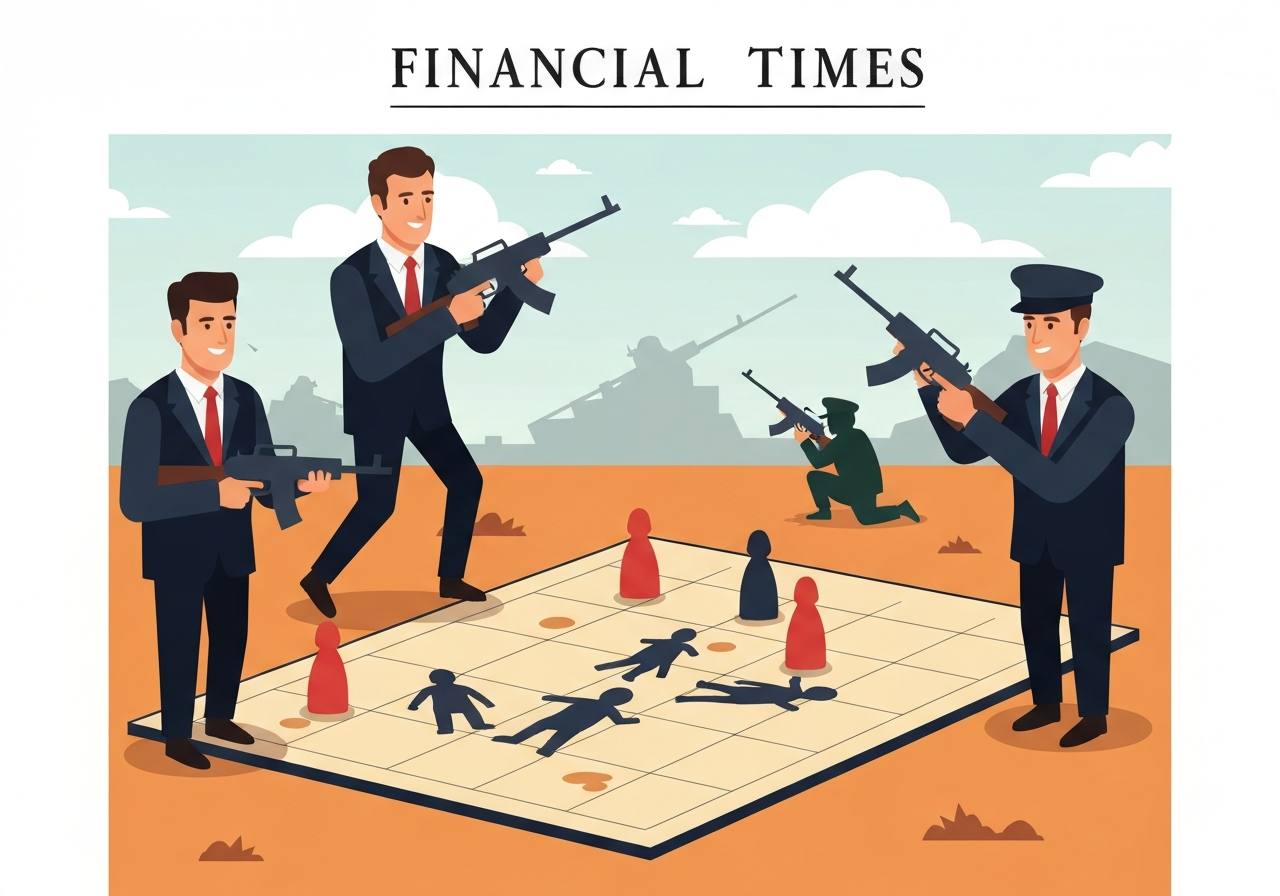
Lead: A recent Financial Times investigation says officials in the Trump White House framed military options and lethal force with language and presentation techniques more common to strategy games than to policymaking. The reporting, based on interviews and internal materials, asserts this approach shaped discussions inside the West Wing and in interagency meetings during the 2017–2021 administration. The result, the FT reports, was a narrowing of emphasis toward tactical scenarios and manageable outcomes rather than the human costs and diplomatic consequences of force. The account raises questions about how language and presentation influence decisions about war and the threshold for using violence.
Key Takeaways
- The Financial Times reports that staff and some advisers used metaphors and slide-deck formats that presented kinetic options as scenarios or simulations rather than real-world crises; the investigation is based on interviews with former officials and internal documents (FT, media).
- The pattern described in the reporting covers discussions within the Trump White House and interagency meetings across the 2017–2021 period, according to the FT’s account.
- Sources told the FT that game-like frames focused attention on outcomes measurable in strategic terms—targets, attrition rates and short-term objectives—rather than civilian harm or legal and moral constraints.
- Several former administration officials interviewed by the FT said the approach changed how risks were weighed, making kinetic responses appear more discrete and controllable.
- The FT investigation prompted public concern from commentators and some lawmakers about whether such framing lowers political and bureaucratic barriers to force.
- The reporting does not, and cannot, prove a direct causal chain from presentation style to any specific military action or casualty figure; that remains contested and partly unverified.
Background
War-gaming and scenario planning have long been tools in both military and policy circles. The Pentagon and allied militaries run structured exercises to explore options, identify vulnerabilities and test decisions without real-world consequences. Those established practices are distinct from the critique raised in the FT piece, which concerns how rhetorical and visual habits used in messaging and internal briefings may alter leaders’ perception of harm and risk.
Donald Trump’s presidency (2017–2021) was marked by unconventional communication styles and a compact executive team. That environment, the FT reports, encouraged rapid decision cycles and power concentrated in small groups. Critics have argued these features sometimes prioritized fast fixes and presentational clarity over deliberative, institutionally anchored review. Proponents counter that clear, concise framing is necessary for leaders faced with time-sensitive security choices.
Main Event
The Financial Times draws on interviews with former White House and Pentagon officials as well as a review of internal materials to describe how some aides presented military options. According to the FT account, briefings emphasized scenario outcomes—control of territory, elimination of an enemy capability, or retribution metrics—often shown in slide decks, maps and charts. Those formats, the reporting suggests, encouraged participants to treat options as discrete, testable moves in a contest rather than actions with complex political and humanitarian repercussions.
Interviewees told the FT they observed a recurring use of metaphors and language—competition, strategy, scoring—that is common in games and business war rooms. The reporting indicates that this rhetoric coexisted with routine legal reviews and operational planning performed by the Department of Defense and the Departments of State and Justice, but it reshaped how options were discussed at the political level.
Former aides quoted in the FT said the style had operational consequences: it made some scenarios seem more palatable and politically manageable. The FT story highlights instances where the visual and verbal shorthand used in high-level briefings reduced complex human costs to simplified variables for decisionmakers to compare. The report stresses that these effects are interpretive and disputed by some former officials who defend the administration’s deliberative safeguards.
Analysis & Implications
Language and presentation affect cognition. Behavioral research shows that framing can alter risk perception and moral salience—when decision options are abstracted into scenarios, subjective distance can increase and empathy can decrease. If top-level political briefings consistently present force in game-like terms, that pattern may lower perceived moral friction against using military power.
Institutionally, the concern is not about the existence of simulations—those are a standard planning tool—but about what happens when simulation metaphors leak into political advocacy and public messaging. The FT reporting suggests that blurred boundaries between analytical war-gaming and political argument can change how advisers prioritize objectives and measure success. That shift can favor short-term, measurable gains over long-term stability or non-kinetic solutions.
Internationally, adversaries and allies observe not only actions but the narratives that justify them. If policy discourse consistently trivializes the humanitarian or diplomatic fallout of force, that may undermine credibility in negotiations and complicate alliance management. Conversely, defenders argue that clearer, scenario-based briefings can help leaders make timely decisions when threats are real and time-constrained.
Comparison & Data
| Feature | Traditional Policy Briefing | Reported Game-like Framing |
|---|---|---|
| Focus | Legal constraints, humanitarian impact, strategic end-state | Scenario outcomes, metrics, controllable objectives |
| Presentation | Text-heavy memos, legal assessments, deliberative options | Slide decks, maps, simplified scoring and stepwise scenarios |
| Decision emphasis | Weighing long-term political costs and exit strategies | Comparing discrete tactical moves and immediate effects |
The table above summarizes contrasts described in the FT coverage between conventional briefing habits and the game-like presentation allegedly used in parts of the Trump White House. Those contrasts are interpretive; different actors within government preserved standard legal and operational review processes, while others favored more visual, scenario-driven approaches.
Reactions & Quotes
Commentary and pushback followed the FT story. Observers across the political and policy spectrum acknowledged the importance of clarity in briefings while warning about the risks of abstraction.
“Briefings that reduce lethal options to tidy scenarios risk obscuring the real human and diplomatic costs involved.”
Financial Times (reporting, media)
“War-gaming is a legitimate planning tool; the problem arises when its language bleeds into advocacy without proper safeguards.”
Former Pentagon official (interviewed by FT)
“The public and allies notice not only what leaders do but how they talk about force—terminology matters for credibility.”
Foreign policy analyst (quoted in FT)
Unconfirmed
- Whether any single internal slide or memo directly caused a specific military action remains unproven; the FT materials are fragmentary and interpretive.
- Attribution of intent—whether staff deliberately sought to trivialize harm or merely to clarify complex choices—is contested and not settled by the reporting.
- Quantitative impact on casualty rates or mission outcomes linked to briefing style has not been demonstrated and remains an open question.
Bottom Line
The Financial Times investigation surfaces a significant governance question: how the framing and presentation of force shape high-level judgment. Presentational choices—language, visuals and metaphors—do not replace legal or operational safeguards, but they can shape which options feel salient, urgent or acceptable to leaders.
For policymakers and the public, the episode underscores the need for transparent processes that foreground human costs, legal constraints and long-term strategy alongside any scenario-based analysis. Oversight bodies, professional military planners and legal advisers play critical roles in preserving those balances; the debate prompted by the FT story may lead to recommendations for clearer distinctions between analytic simulation and political advocacy.
Sources
- Financial Times — media (investigative reporting cited throughout)