
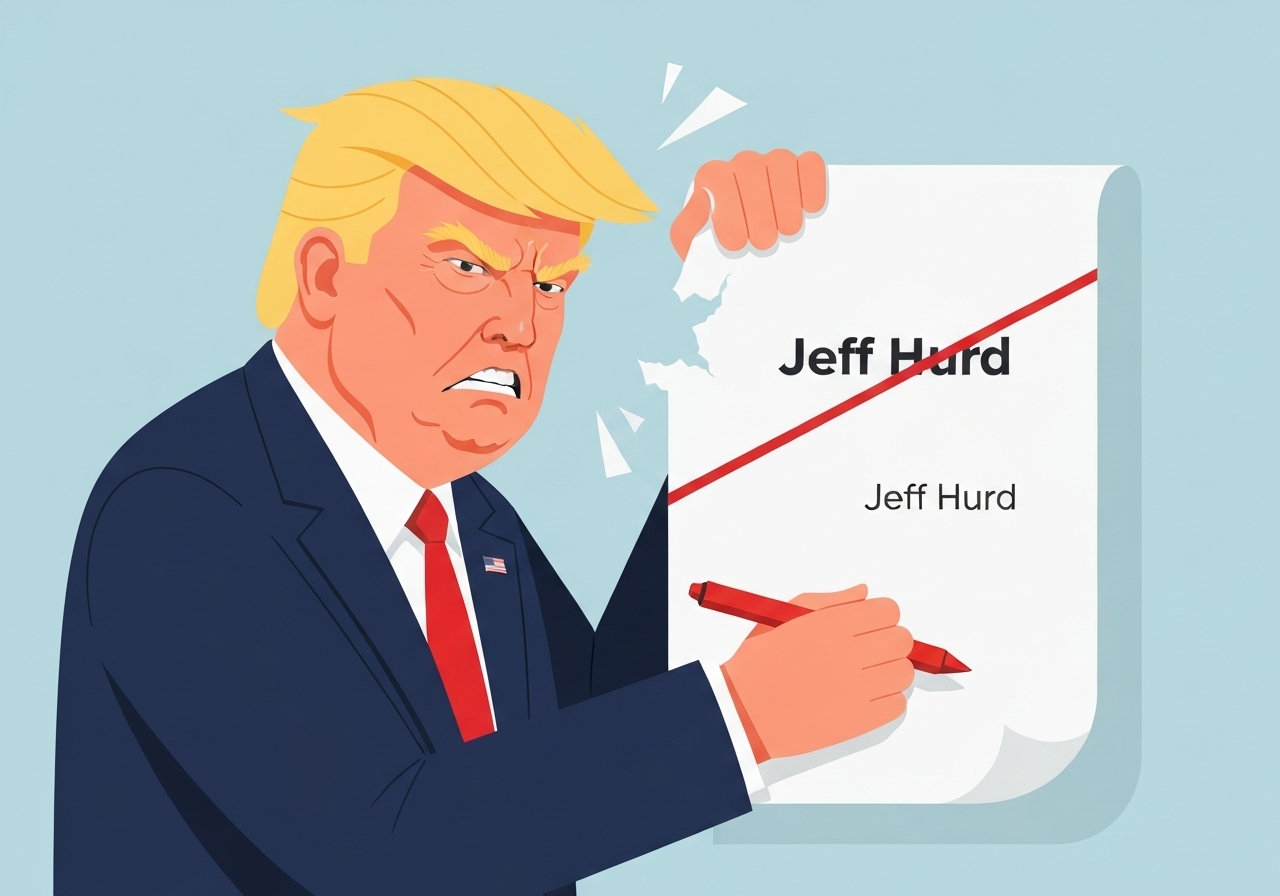
— President Donald J. Trump on Saturday rescinded his endorsement of Representative Jeff Hurd of Colorado after Mr. Hurd joined a small group of Republicans in supporting a House measure to cancel tariffs on Canadian goods. The president shifted his backing to Hurd’s right-wing primary challenger, Navy veteran Hope Scheppelman, intensifying uncertainty in the competitive Western and Southern Colorado district. The move follows Mr. Trump’s earlier public warning that Republicans who voted to lift the levies would “seriously suffer the consequences” at the ballot box. The reversal could complicate Republican efforts to hold the House in November’s midterms.
Key Takeaways
- On Feb. 21, 2026, President Trump withdrew his endorsement of Rep. Jeff Hurd of Colorado after Hurd voted to cancel tariffs on Canada.
- Hurd was one of six House Republicans who joined nearly all House Democrats in the tariff vote, an action described by some members as an assertion of Congressional authority.
- Mr. Trump endorsed Hope Scheppelman, a Navy veteran and former nurse practitioner, as Hurd’s primary opponent.
- Scheppelman was removed from her post as vice chair of the state party in 2024 by fellow Republicans following controversy over anti-gay posts and disputes tied to the party chair.
- Hurd is a first-term congressman and a member of the center-right Republican Main Street Partnership, representing a district that leans Republican but is considered competitive.
- Mr. Trump publicly labeled Hurd a “RINO” and warned that lawmakers who opposed his tariffs would face consequences in primaries and general elections.
- The episode highlights ongoing tensions within the GOP over trade policy and presidential influence on down-ballot races ahead of the midterms.
Background
Mr. Trump’s tariffs on Canadian imports have been a prominent policy of his administration and a frequent point of contention inside the Republican Conference. The House vote to cancel the levies, held earlier in February 2026, was largely symbolic but marked a rare bipartisan assertion of Congressional authority over executive trade measures. Most House Democrats supported repeal, and six Republicans crossed the aisle; Representative Jeff Hurd was among them.
Hurd, a first-term member of the Republican Main Street Partnership, has positioned himself as a center-right lawmaker in a district that stretches across Western and Southern Colorado. His vote reflected both local economic concerns—some constituents and industries opposed the tariffs—and a broader fracture in the GOP between Trump-aligned conservatives and more moderate Republicans. Mr. Trump had publicly warned earlier in the month that Republicans who backed lifting the levies would face electoral penalties, including in primary contests.
Main Event
On Saturday, Mr. Trump posted on social media that any Republican who supported cancelling the tariffs would “seriously suffer the consequences come Election time, and that includes Primaries.” He followed through by withdrawing his endorsement of Mr. Hurd and throwing his support to Hope Scheppelman, who is running in the Republican primary against Hurd. The endorsement switch came amid heightened attention to the district, which national strategists view as winnable but vulnerable for both parties.
Scheppelman is a Navy veteran and former nurse practitioner who had previously been removed from her vice chair role in the state party in 2024 after intra-party backlash tied to anti-gay social media posts and disputes involving the party chair. Her profile places her to the right of Hurd on many issues, and Mr. Trump’s backing effectively signals a preference for a more Trump-aligned candidate in the primary.
The decision to penalize a member of Congress for a relatively small group vote underscores the president’s effort to enforce loyalty among House Republicans on trade policy. For Hurd, the loss of a presidential endorsement in a close district raises immediate fundraising and turnout concerns, and it shifts how national Republican groups may allocate resources for the race over the coming months.
Analysis & Implications
Republican leaders are entering the midterm cycle with slim margins and a need to present a unified message; ruptures over major policies such as tariffs complicate that task. Mr. Trump’s move reinforces his capacity to shape GOP primaries and to penalize lawmakers who deviate from his agenda, potentially deterring other Republicans from breaking with him on trade or high-profile issues. That dynamic can push Republicans toward nominating stronger Trump-aligned candidates, which may improve primary cohesion but could make general-election matchups harder in competitive districts.
For Colorado’s 3rd (district descriptor approximate by region), the immediate practical consequence is a tougher path for Hurd in the primary and a recalibration of outside spending. If Scheppelman secures the nomination with the president’s backing, Democrats could see a clearer path to contest the seat in November because more ideologically extreme nominees can be harder to defend in swing areas. Conversely, a successful defense by a Trump-backed nominee would deepen the party’s alignment behind the former president’s trade stance.
Policy-wise, the episode signals that tariffs will remain a live electoral issue. Lawmakers weighing votes that could be construed as opposing the president’s core trade policies must now factor in primary risk as well as general-election considerations. On a national scale, repeated enforcement of loyalty through endorsements and withdrawals could accelerate the consolidation of a Trump-aligned Republican caucus or, alternatively, provoke greater internal pushback if enough members judge the electoral risk too high.
Comparison & Data
| Item | Count/Note |
|---|---|
| Republicans who voted to cancel tariffs | 6 |
| Representative’s tenure | Jeff Hurd — first term |
| Scheppelman’s party position | Removed as state vice chair in 2024 (party vote) |
The table above summarizes the concrete counts and status points cited in the House tariff episode and the local party dispute. While the tariff repeal vote was numerically small in terms of GOP defections, the symbolic weight is larger: crossing the president on a high-profile trade action invites political consequences that can ripple through candidate recruitment, fundraising, and turnout calculus.
Reactions & Quotes
The president’s social-media post framed the matter as a test of party loyalty and electoral consequence:
“Any Republican who backed lifting the levies would seriously suffer the consequences come Election time, and that includes Primaries.”
Donald J. Trump (social media)
Mr. Trump also used a pejorative label to describe Hurd, underscoring the personal tone of the reprimand and its intended deterrent effect:
“He is one of a small number of Legislators who have let me and our Country down.”
Donald J. Trump (social media)
Local and national party operatives are interpreting the endorsement switch as a signal that the White House will continue to weigh in heavily on contested GOP primaries, especially where policy votes are visible and contentious.
Unconfirmed
- Whether the president’s withdrawal of support will materially change Hurd’s standing in internal polling; no public, verifiable poll data has been released yet.
- Any private discussions between Hurd and White House officials about the vote or potential consequences have not been independently confirmed.
- The long-term effect of a Scheppelman nomination on November turnout and down-ballot races in Colorado remains undetermined and subject to further data.
Bottom Line
President Trump’s decision to pull his endorsement from Representative Jeff Hurd after the tariff vote sharpens existing fault lines within the Republican Party and raises the stakes for midterm strategy. The symbolic nature of the tariff repeal vote belies the practical political consequence: the loss of a presidential endorsement in a competitive district is a material handicap, particularly in fundraising and national party support.
More broadly, the episode illustrates how policy disputes—here over tariffs on Canada—are being refracted through the prism of intra-party loyalty tests. With control of the House already in play for November, GOP strategists must weigh whether enforcing loyalty in primaries strengthens the party’s cohesion or increases the risk of losing vulnerable seats to Democrats in the general election.
Sources
- The New York Times — news reporting on the endorsement withdrawal and House tariff vote.