
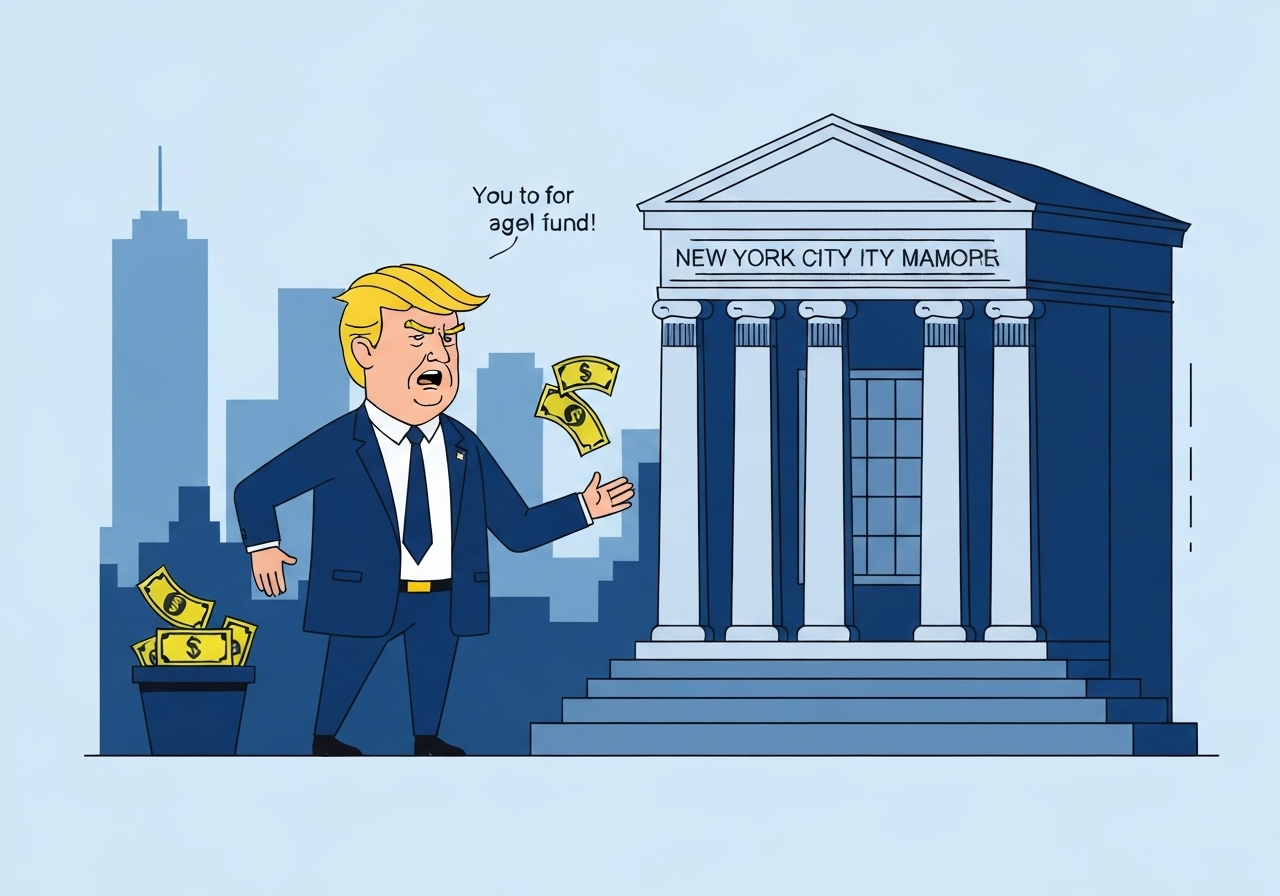
On the eve of New York City’s closely watched mayoral election on 3 November 2025, President Donald Trump warned voters that a victory by Democratic councilman Zohran Mamdani — whom he labeled a “communist” on Truth Social and in broadcast remarks — could prompt him to withhold most federal funding to the city. The comments came after Trump repeated similar warnings during an appearance on CBS’s 60 Minutes and followed a pattern of funding disputes between the federal government and New York state. Legal and constitutional limits on presidential control over appropriations complicate any attempt to withhold funds, but the president’s statements have already reshaped campaign messaging and drawn responses from rivals and the candidate himself. Recent polling ahead of the vote showed Mamdani leading his principal opponents by a clear margin.
Key takeaways
- President Trump posted on Truth Social and told CBS’s 60 Minutes that he would be unlikely to provide more than the minimum federally required funds to New York if Zohran Mamdani wins the mayoralty.
- Trump’s claim echoed earlier actions and disputes: the White House withheld $18 billion linked to a tunnel project during the government shutdown and rescinded about $34 million in counterterrorism funding before a judge ordered the reversal.
- Trump characterized Mamdani as a “communist” and urged voters toward other candidates, saying he preferred a Democrat with a record of governance over an inexperienced left-wing candidate.
- Former governor Andrew Cuomo, running as an independent, and Republican Curtis Sliwa were both invoked in pro-Trump messaging; Cuomo publicly reiterated concerns about federal funding and suggested stronger measures.
- Zohran Mamdani dismissed Trump’s post as a political threat at a Queens campaign event, stressing that federal funding is owed to New York and noting legal constraints on presidential authority.
- An Atlas Intel poll ending 30 October put Mamdani at 41%, Cuomo at 34%, and Sliwa at 24%, giving Mamdani a double-digit margin over both rivals in that survey.
Background
Federal grants and appropriations to cities are constitutionally controlled by Congress, not the president. While presidents can influence budget priorities and administration officials can delay or reinterpret disbursements, outright permanent withholding of congressionally authorized funds faces legal limits and often court challenges. In recent years, federal-state friction over New York policy issues — including congestion pricing and major infrastructure projects — has heightened scrutiny of how and when federal funds are allocated or paused.
Political actors have used funding disputes as leverage before: during a past shutdown, the federal government paused an $18 billion transport-related transfer, and a rescission of roughly $34 million in counterterrorism aid to New York prompted a federal judge to rule that the reversal was “arbitrary, capricious and a blatant violation of the law.” Those precedents show both the political tools available and the judicial pushback that can follow. Against that institutional backdrop, election‑period rhetoric can rapidly shift local campaign dynamics and voter perceptions.
Main event
On 3 November 2025, just before polls opened for the New York mayoral contest, Trump used his Truth Social platform to single out Zohran Mamdani as a candidate whose victory, he said, would make it “highly unlikely” he would contribute federal funds beyond the minimum legal requirement to New York. The post mirrored language Trump used in a CBS 60 Minutes interview, where he suggested it would be difficult to send money to a city run by someone he labeled a communist.
Trump’s message framed the race as a choice not only about local governance but about federal support and national politics. He urged votes away from Mamdani — at times portraying a vote for Republican nominee Curtis Sliwa as effectively a vote against Mamdani — and signaled openness to backing independent Andrew Cuomo, whom he described as a Democrat with a record of success relative to Mamdani’s experience.
Cuomo, the former governor who entered the mayoral contest as an independent, repeated elements of Trump’s warning on 77WABC radio and in later interviews, at one point invoking the possibility of stronger federal responses. Mamdani, speaking at a campaign event in Astoria, Queens, said he had anticipated Trump’s intervention and framed it as proof of outside forces aligning against what they view as an independent progressive candidacy.
Analysis & implications
Legally, the president cannot unilaterally rewrite congressional appropriations; Congress controls the purse, and the Impoundment Control Act of 1974 limits executive withholding of funds. Courts have repeatedly rebuked administration actions that rescinded or delayed congressionally authorized aid without proper justification or statutory authority. Any attempt to permanently block funds would therefore likely prompt litigation and create operational uncertainty for agencies and local programs that rely on federal support.
Politically, Trump’s intervention aims to nationalize a municipal contest and to reshape voter calculus by attaching the specter of federal retribution to a Mamdani victory. That strategy can be effective with some constituencies, especially among voters sensitive to public safety, federal grants, and perceived administrative competence. It may also consolidate opposition among moderates and independents who fear fiscal or governance disruptions.
For New York City governance, practical impacts could range from short-term delays in disbursement and federal reviews to longer-term risk for multi-billion-dollar infrastructure projects if political conflict persists. Yet historical precedent suggests that many such funding fights end in partial restoration following negotiations, congressional action, or court rulings rather than permanent denial of support.
Comparison & data
| Candidate | Poll support (Atlas Intel, 30 Oct 2025) |
|---|---|
| Zohran Mamdani | 41% |
| Andrew Cuomo (independent) | 34% |
| Curtis Sliwa (Republican) | 24% |
The Atlas Intel snapshot ending 30 October gives Mamdani a 7-point lead over Cuomo and a 17-point advantage over Sliwa. Polls vary by sample, timing and likely‑voter models; nonetheless, the numbers indicate a substantive lead that Trump’s late intervention may be trying to narrow by reframing the stakes. Historical turnout patterns in New York municipal elections and late-deciding voter blocs will determine whether that framing alters the outcome.
Reactions & quotes
The president’s post and broadcast remarks produced immediate responses across the campaign trail and in media.
“If Communist Candidate Zohran Mamdani wins the Election for Mayor of New York City, it is highly unlikely that I will be contributing Federal Funds,” the president posted, framing the vote as carrying fiscal consequences.
Donald Trump / Truth Social
Context: That post reiterated comments made on national television and became a focal point for debates about executive authority, with critics noting the constitutional role of Congress in appropriations and supporters arguing for political pressure on local voters.
“This is a threat. It is not the law,” Mamdani said at a Queens event, asserting that federal funding is owed to New York and condemning political interference.
Zohran Mamdani, mayoral candidate
Context: Mamdani framed the comments as predictable intervention by national figures and emphasized legal remedies and civic resilience rather than immediate panic, positioning himself as defending municipal entitlements.
“Now it’s gonna be up to the Republicans, and I hope they listen to the president,” Andrew Cuomo said on 77WABC radio, echoing concern about the ideological framing of the race.
Andrew Cuomo, mayoral candidate (independent)
Context: Cuomo’s remarks signaled a complicated alignment where a former Democratic governor running as an independent accepted aspects of Trump’s critique to court moderate or right‑leaning voters.
Unconfirmed
- Whether the Trump administration will follow through with a systematic, legally sustainable program to cut or permanently rescind congressionally authorized funds remains unconfirmed and would likely face litigation.
- The practical effect of Trump’s statements on actual voter behavior — whether they will shift undecided voters toward Cuomo or Sliwa — is not established and depends on turnout dynamics.
- Any immediate deployment of federal forces such as the National Guard in response to a mayoral outcome has not been announced and would involve separate legal and procedural steps.
Bottom line
President Trump’s public warning ahead of the 3 November mayoral election escalates national attention on a municipal contest and introduces a test of executive rhetoric against constitutional and judicial limits on budgetary power. While the statements are politically significant and have already influenced campaign narratives, actual changes to ongoing federal funding would face statutory constraints, oversight and likely court challenges.
For New Yorkers and municipal officials, the nearest-term consequences are political and operational uncertainty rather than an immediate, lawful cutoff of essential services. Observers should watch congressional responses, potential administrative actions that would need legal justification, and whether late polling or turnout shifts materially alter the election outcome.
Sources
- The Guardian — press reporting on the president’s statements and campaign reactions.
- 60 Minutes / CBS News — broadcast interview in which the president discussed funding for New York (media source).
- The New York Times — reporting referenced for Mamdani’s on‑the‑record response at a campaign event (press).
- Atlas Intel — polling organization cited for the 30 October poll snapshot (polling firm).