
Lead
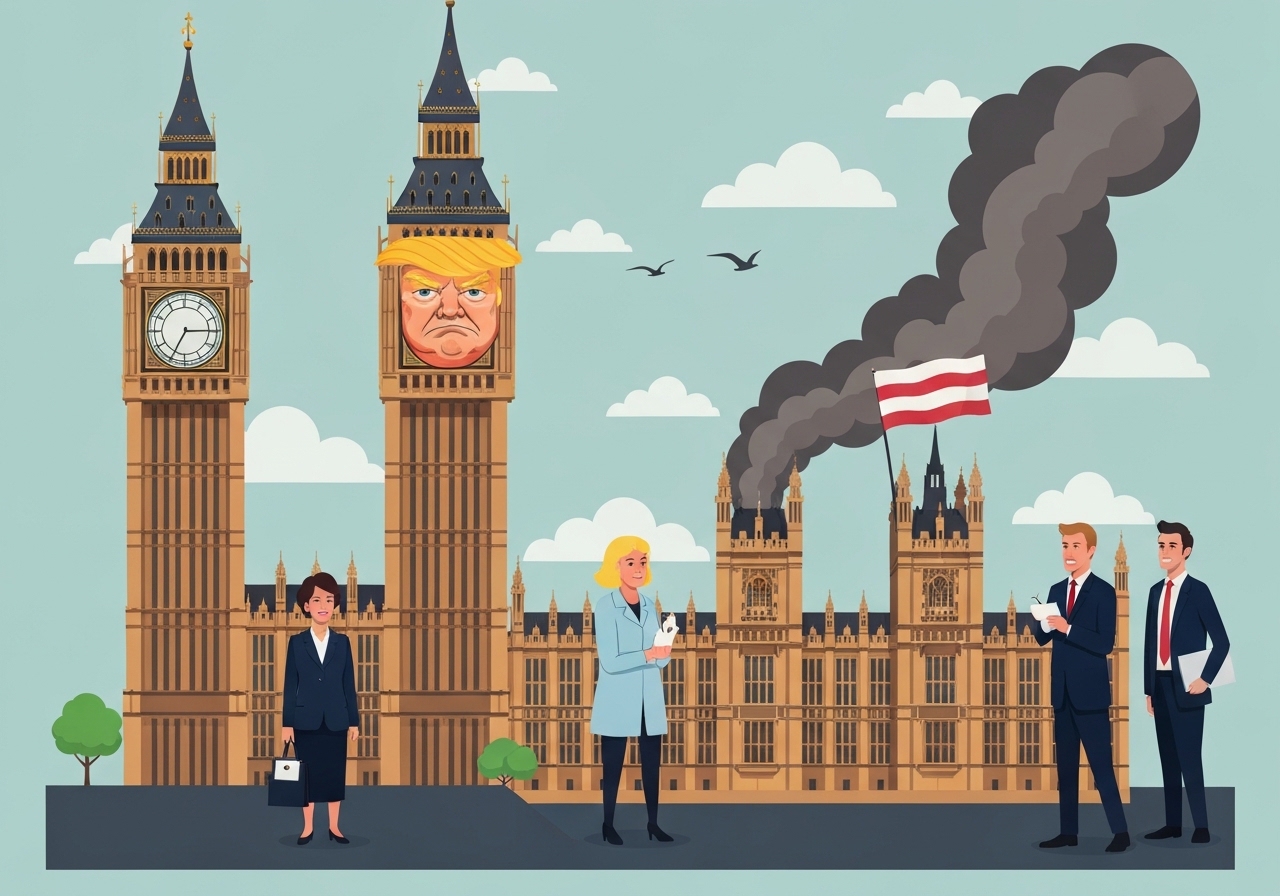
Over the past year Britain has been pulled into repeated clashes with President Donald J. Trump, culminating in a public standoff over Greenland that underscored how little an allied government could alter the president’s impulses. Prime Minister Keir Starmer kept a conciliatory line during Mr. Trump’s September state visit to Chequers but still faced fresh tariff threats and sharp social-media attacks after resisting an American move on Greenland. Mr. Trump then criticized a separate British plan to transfer the Chagos Islands to Mauritius, amplifying domestic political attacks. The episode has left Britain both diplomatically constrained and politically exposed.
Key Takeaways
- President Trump’s state visit to Britain in September 2025 included tense exchanges with Prime Minister Keir Starmer and preceded repeated online attacks and tariff threats from the White House.
- The Greenland dispute became a flashpoint: Mr. Trump floated ambitions involving Greenland and publicly criticized Britain when Mr. Starmer declined to acquiesce.
- Mr. Trump described a UK deal on the Chagos Islands as an “act of GREAT STUPIDITY,” redirecting criticism at Mr. Starmer and energizing opposition voices.
- The Chagos chain contains Diego Garcia, the largest island and site of a major air base jointly operated by the United States and Britain, a fact cited by critics of the handover to Mauritius.
- Conservative leader Kemi Badenoch publicly echoed Trump’s language on the Chagos handover, framing it as surrender of territory and raising domestic political stakes.
- Britain’s negotiations to return the Chagos Islands began under a previous Conservative government, complicating claims that the policy is a recent Labor initiative.
- Economic pressure was signaled through public tariff threats and social-media posts rather than immediate legislation, leaving the scale of any trade impact uncertain.
- The episodes have sharpened debate in London over how to balance alliance management with domestic political risk.
Background
The relationship between Washington and London has long been personal as well as institutional; the past year amplified that dynamic. After Brexit, successive British governments have sought to diversify trade and diplomatic ties while preserving the special relationship with the United States. That balancing act has become harder under an American presidency willing to air grievances publicly and to tie bilateral goodwill to transactional demands.
Keir Starmer’s center-left government came to office promising steadier, pragmatic diplomacy. Mr. Starmer adopted a measured approach during Mr. Trump’s state visit to Chequers in September 2025, aiming to preserve technocratic cooperation on defense and trade. But U.S. pressure—expressed in tweets, interviews and public comments—has repeatedly tested that strategy, exposing tensions between alliance obligations and domestic political narratives in Britain.
The Chagos Islands dispute has additional layers: a sovereignty claim by Mauritius, decolonization-era legal rulings, and the strategic presence of Diego Garcia, a base used jointly by the United Kingdom and the United States. That combination turns what might otherwise be a bilateral land-transfer into a wider geopolitical and political flashpoint.
Main Event
The immediate sequence began during and after Mr. Trump’s September state visit, when diplomatic pleasantries were followed by pointed public remarks. Washington raised the Greenland idea publicly; London’s refusal to accommodate that proposal drew a cascade of critical posts and threats from the president’s circle. The public nature of the spat made it both a diplomatic headache and a domestic political storyline.
Shortly afterward, Mr. Trump pivoted to criticize a separate British decision: a plan endorsed by Mr. Starmer to transfer the Chagos Islands to Mauritius. Mr. Trump labeled that move harshly in public commentary, focusing attention on Diego Garcia and energizing critics who argued the transfer jeopardized strategic interests. The criticism landed amid a broader conversation about Britain’s defense posture and its reliance on American cooperation.
Conservative leader Kemi Badenoch amplified the attack in British media, framing the transfer as unnecessary surrender of territory and citing Diego Garcia’s military role. Her comments underscored how Mr. Trump’s interventions reshaped domestic debate, giving opposition figures a foreign source for home-front political ammunition. The exchange has not produced immediate legal reversal but has altered public framing and political momentum.
Analysis & Implications
First, the episode highlights the limits of traditional diplomatic courtesies when a U.S. president uses public platforms to press allies. Mr. Starmer’s conciliatory posture did not prevent sharp criticism or the threat of trade measures; the transaction costs of refusing a high-profile U.S. idea can be political as well as economic. For London, that raises questions about how to defend national decisions without provoking punitive responses.
Second, domestically the confrontation has strengthened skeptical voices on the right and complicated Labour’s position. When a foreign leader’s critique is echoed by a domestic opposition leader, it collapses an external grievance into internal politics. The Chagos debate—grounded in legal and historical claims as well as strategic concerns—has become a tool for critics to question the government’s judgment on defense and sovereignty.
Third, the alliance itself faces transactional friction. The U.S.-UK security partnership remains deep—Diego Garcia is an example of shared military infrastructure—but public spats can corrode trust and make coordinated responses to crises harder. Allies dependent on shared basing arrangements may face renewed domestic scrutiny of those deployments if political attacks link them to territorial concessions.
Finally, the broader implication is that U.S. domestic politics and an individual president’s rhetoric now have outsized capacity to shape allied policy debates. That raises longer-term questions about predictability in transatlantic relations and about how smaller powers hedge when trusted bilateral frameworks can be unsettled by episodic public interventions.
Comparison & Data
| Event | Date/Period | Immediate Effect |
|---|---|---|
| Trump state visit to Chequers | September 2025 | High-profile diplomatic engagement; preceded public disputes |
| Public dispute over Greenland | Late 2025–early 2026 | Social-media attacks and tariff threats from the U.S. administration |
| Criticism of Chagos transfer | January 2026 (publicized) | Domestic political escalation; questions over Diego Garcia |
The table summarizes key moments and their immediate effects. While no binding U.S. tariffs have been enacted as of January 24, 2026, the repeated public threats have raised investor and political concern in the UK government. The Chagos negotiation timeline predates the current government, a point that complicates partisan narratives.
Reactions & Quotes
Responses ranged from outright echoing of the president’s language to measured defense of diplomatic process. Media and political figures used the dispute to frame competing narratives about sovereignty, security and political judgment.
“This is surrendering British territory, with a strategic military base on it, for no reason whatsoever.”
Kemi Badenoch, Leader of the Conservative Party (Sky News)
“An act of GREAT STUPIDITY.”
President Donald J. Trump (public comment)
Government spokespeople emphasized adherence to legal and diplomatic processes in the Chagos negotiations and highlighted the continuing operational role of Diego Garcia for both allies. Outside experts warned that public pressure from a U.S. president can amplify political attacks in allied capitals even when underlying policies have multiyear, multigovernment roots.
Unconfirmed
- Whether the president’s objections to the Chagos transfer were driven primarily by strategic concerns about Diego Garcia or as political retaliation for Britain’s stance on Greenland remains unclear.
- There is no confirmed timetable for any U.S. imposition of tariffs tied to the Greenland dispute as of January 24, 2026.
- The long-term legal mechanics and final implementation date for the Chagos transfer to Mauritius are not finalized in public documents available at this writing.
Bottom Line
The past year shows that personal diplomacy and public presidential rhetoric can reshape allied politics in ways that formal institutions struggle to contain. Keir Starmer’s choice to avoid confrontation preserved working ties but did not insulate Britain from public rebuke or political fallout at home. For London, the challenge moving forward will be to protect strategic interests—such as shared bases—while maintaining an independent diplomatic posture that can withstand episodic U.S. pressure.
Watch for three developments: whether tariff threats materialize into concrete measures; how the Chagos transfer proceeds legally and operationally; and how British domestic politics reframe defense and sovereignty debates ahead of future elections. Each will test the resilience of the special relationship and Britain’s capacity to set policy without being swayed by episodic external pressure.
Sources
- The New York Times — news analysis of U.S.-UK disputes and the Greenland episode.
- Sky News — broadcast reporting and interview with Kemi Badenoch (media outlet).