
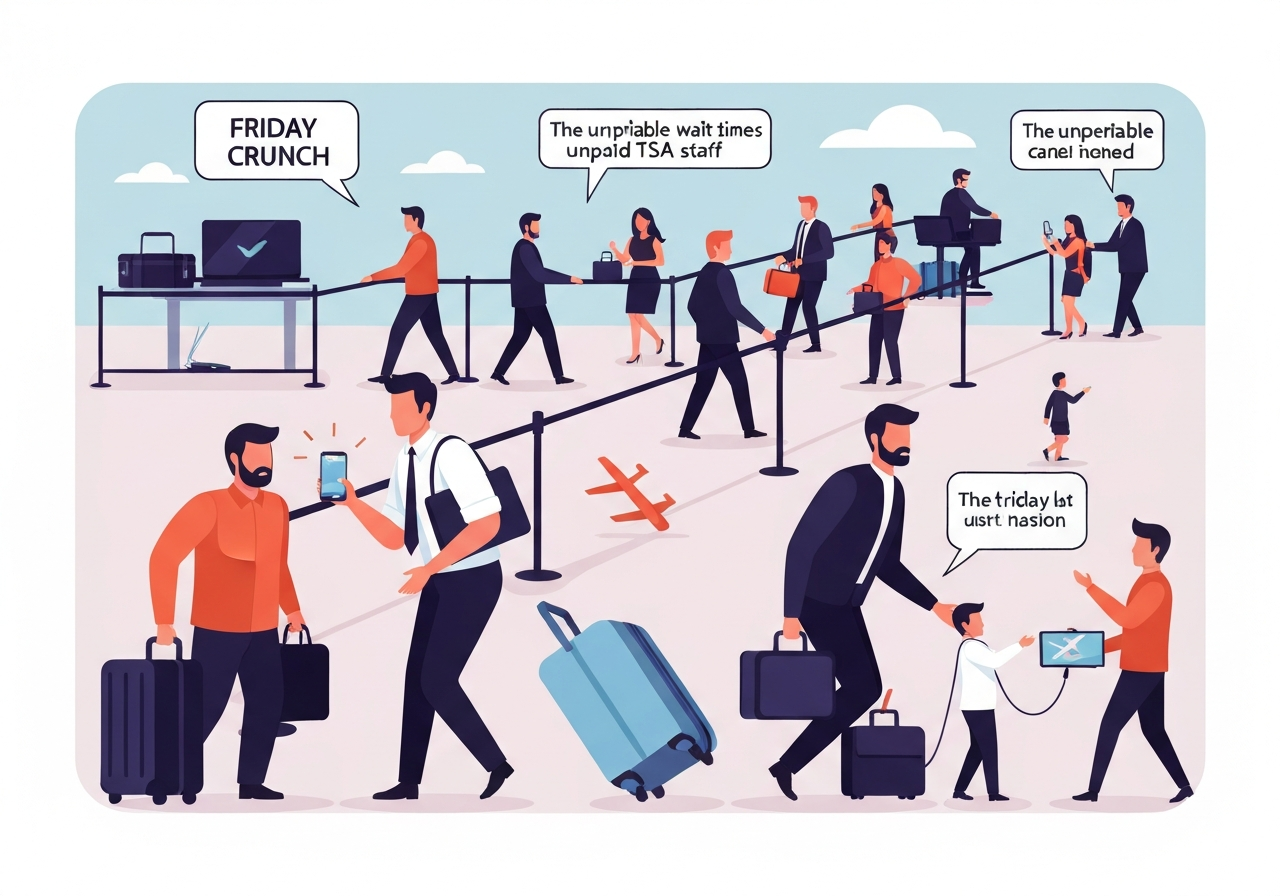
— Travelers encountered unusually long and erratic security lines on Friday as many Transportation Security Administration (TSA) employees worked without pay amid a partial Department of Homeland Security (DHS) funding lapse. Major hubs including Hartsfield-Jackson Atlanta and Houston’s George Bush Intercontinental reported waits ranging from two hours to more than three hours, producing missed flights and mounting frustration. The staffing shortfall follows a lapse in DHS funding in mid-February and the first missed full paycheck for many TSA workers; officials and unions warned the operational strain could worsen if the impasse continues. Lawmakers on Capitol Hill remain at odds over broader DHS reforms, leaving the immediate staffing crisis unresolved.
- At least 366 TSA agents have resigned since the shutdown began, DHS said; each new recruit requires roughly 4–6 months of training before operating independently.
- Hartsfield-Jackson Atlanta reported more than a third of officers absent for several days this week; one traveler described a 3½-hour wait after being warned of two hours.
- Houston’s George Bush Intercontinental saw wait times swell to about 2½ hours early Friday, with one checkpoint closed for lack of staff.
- Nationwide, DHS reported that more than 10% of TSA staff did not report for duty on a recent weekday, with several busy airports seeing much higher callout rates.
- Union leaders say employees are facing eviction notices and other financial hardship after missing pay, and called on Congress to act before leaving for recess.
- Federal officials warned that prolonged funding gaps could force small airports to close and further degrade security screening consistency.
- Airlines generally say they will try to rebook passengers who miss flights due to screening delays but are not required to compensate for missed connections caused by TSA wait times.
Background
The current staffing crisis stems from a partial DHS funding lapse in mid-February during negotiations over agency policy changes. Senate Democrats tied funding to reforms in immigration enforcement after the January deaths of Alex Pretti and Renee Nicole Good in Minneapolis, seeking restrictions on roving patrols, tighter warrant requirements, mandatory body cameras for some agents and changes to use-of-force rules. Republicans have resisted many of those demands and pushed for concessions on immigration priorities, prolonging the impasse.
TSA employees have now missed at least one full pay period since the lapse, repeating a pattern seen during earlier funding gaps this year. The American Federation of Government Employees (AFGE), which represents TSA staff, has urged lawmakers to pass stopgap funding before returning to recess, arguing sustained unpaid work undermines both employee welfare and airport operations. DHS leaders have emphasized they lack authority to pay the agency without appropriations and warned that staffing losses shrink screening capacity.
Main Event
On Friday morning, airport terminals at several U.S. hubs were filled with long serpentine lines. At Hartsfield-Jackson Atlanta International Airport a family who arrived at 2:50 a.m. missed a 6 a.m. flight after actual screening times exceeded the two-hour estimates; one traveler reported spending about three and a half hours waiting. Atlanta’s main security atrium was overtaken by lines that wrapped around baggage carousels and extended beyond normal screening areas.
In Houston, travelers encountered a backlog that spilled onto a lower floor before being funneled through nylon stanchions and escalators to reach the main checkpoint. Airport staff kept some passengers waiting at the foot of escalators until additional screening lanes were opened. At least one checkpoint at George Bush Intercontinental remained closed that morning because of insufficient TSA coverage.
Special assistance lanes meant for passengers with reduced mobility or children also became congested. Reports from Atlanta described passengers in rolling chairs and parents with strollers being directed to a secondary line that quickly backed up into the atrium; one passenger with multiple sclerosis said she had to pay a stranger to push her through the crowd. Airports such as Denver, Seattle-Tacoma and Las Vegas began organizing community donations to help affected front-line workers with groceries, gas and hygiene supplies.
Union leaders and DHS officials both signaled mounting operational risk. AFGE sent letters to House and Senate members urging immediate action, while DHS and senior leaders warned that further staffing losses would significantly degrade screening throughput and could force smaller airports to suspend operations if the shutdown persists.
Analysis & Implications
The immediate consequence is a mismatch between passenger demand during spring break travel and available screening capacity, producing longer, less predictable wait times that ripple through airline schedules. Operational strain can increase the risk of errors or missed threats, according to former TSA leadership, because remaining officers face fatigue and distraction when working unpaid overtime and covering multiple roles. The training lag for replacements—4 to 6 months—means staffing holes will not be quickly fixed by hiring alone.
Politically, the standoff illustrates the difficulty of funding a sprawling agency like DHS by piecemeal measures. Some Democrats have proposed funding specific components such as TSA, FEMA and the Coast Guard while negotiations over ICE continue; Republicans have pushed back against segmented funding. If neither side yields, the practical outcome is operational erosion in services that directly affect millions of travelers and local economies tied to air travel.
Economically, extended disruption could raise costs for airlines (operational disruptions and rebookings), airports (staffing contingency plans, passenger assistance), and businesses reliant on timely travel. Reputation and traveler confidence may also suffer if passengers perceive airports as unreliable during peak travel periods. Short-term mitigation—like rerouting staff, opening temporary lanes or airline flexibility on rebooking—helps, but systemic stability depends on restoring funding.
| Airport | Reported wait (early Friday) | Staff callout |
|---|---|---|
| Hartsfield-Jackson (Atlanta) | 2–3.5 hours | More than one-third absent on several days |
| George Bush Intercontinental (Houston) | ~2.5 hours | One checkpoint closed; >33% absent reported |
| Nationwide (summary) | Varied; some airports 20 minutes–2+ hours | DHS: >10% absent on a recent weekday; hotspots higher |
| Resignations | — | At least 366 TSA agents have left during this shutdown |
The table above summarizes publicly reported wait times and staffing impacts cited by DHS and on-site reporting on March 20, 2026. Local conditions can change hour by hour; travelers should check live airport trackers and airline notices before heading to terminals.
Reactions & Quotes
“The time for excuses is over. Pass a measure to reopen DHS, pay these workers, and don’t go home until you do.”
Everett Kelley, AFGE president (union)
AFGE urged immediate congressional action, saying unpaid employees face growing financial hardship and community strain.
“It is a situation that needs to be addressed.”
John Pistole, former TSA administrator (security expert)
Pistole warned that long queues and distracted officers raise security risks by creating opportunities for people who would seek to exploit crowding.
“As we get into next week … and they’re about to miss another payment, this is going to look like child’s play compared with what could follow.”
Sean Duffy, Secretary of Transportation (federal official)
The transportation secretary cautioned that continued funding gaps could force smaller airports to suspend operations and broaden travel disruptions.
Unconfirmed
- Projections that “some airports may be forced to shut down” are contingent on future staffing trends and remain a warning rather than an immediate, verified order.
- Exact, consolidated national counts of shifts missed or short-term resignations beyond the DHS-reported 366 departures have not been independently verified across every airport.
Bottom Line
The immediate travel picture is one of unpredictability: long lines at major hubs, uneven staffing across airports, and increasing hardship for TSA employees working without pay. Operational recovery will be slow because replacing trained screeners takes months; temporary stopgap measures will only partially blunt the impact. Travelers should build extra time into itineraries, monitor airport and airline updates, and consider earlier flights or alternate routes when possible.
Ultimately, restoring predictable, safe screening at scale depends on a political resolution to DHS funding and any attached policy disputes. Absent quick action, airports and airlines can expect ongoing disruptions that will ripple through schedules, costs and traveler confidence in the months ahead.