
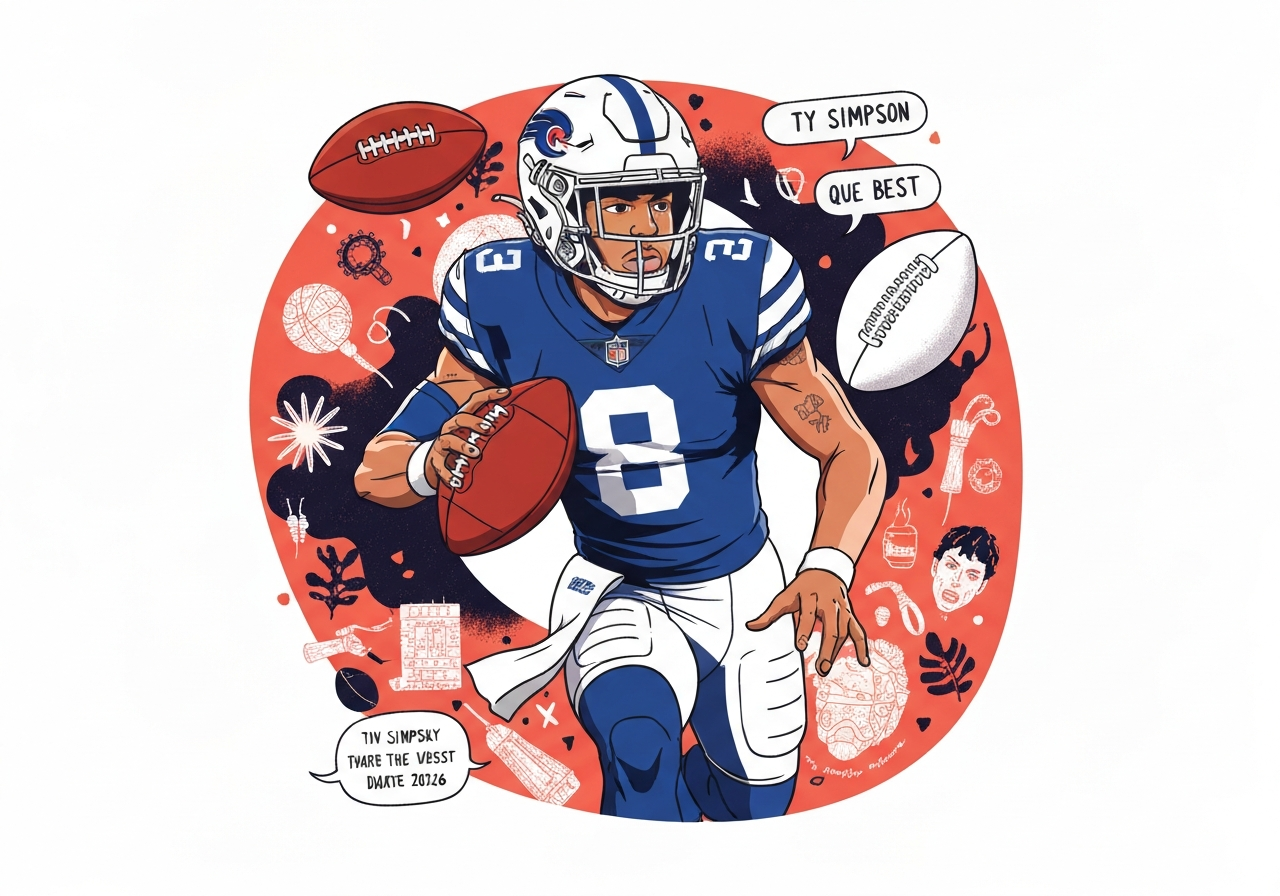
ESPN analyst Dan Orlovsky on March 24, 2026, argued that Alabama quarterback Ty Simpson is the top signal-caller in the 2026 NFL draft class, a stance he laid out on “Get Up” and reiterated on the “Pat McAfee Show.” Orlovsky contrasted Simpson’s body of work with Heisman winner Fernando Mendoza, saying Simpson made more “real NFL throws” and did more with fewer supporting resources. The comments reignited debate about draft value and position ranking after Mendoza’s national championship and Heisman campaign at Indiana in 2025. The exchange produced criticism and speculation about motives, which Orlovsky publicly denied.
Key Takeaways
- Dan Orlovsky told ESPN on March 24, 2026, he ranks Ty Simpson as the best quarterback in the 2026 draft class despite Fernando Mendoza’s Heisman and championship run.
- Simpson posted 3,567 passing yards, 28 touchdowns and 5 interceptions in his first season as Alabama’s starter, plus 93 rushing yards.
- Mendoza totaled 3,535 passing yards, 41 touchdowns and 6 interceptions across his most recent season(s) and won the 2025 Heisman by nearly 1,000 points over Diego Pavia.
- Orlovsky cites Simpson’s frequency of “pro-ready” downfield throws and ability to carry a team with fewer resources as decisive factors.
- He suggested Simpson could represent better value if selected in the mid-to-late first round (roughly picks 15–20) compared with Mendoza near the top of the board.
- Orlovsky denied accusations that an agency paid him to influence Mendoza’s stock, calling such claims unfounded on the “Pat McAfee Show.”
- Size and starting experience remain dividing points: Mendoza is listed at 6-foot-5 versus Simpson at 6-foot-1, and Mendoza has two seasons as a starter between Cal and Indiana.
Background
Fernando Mendoza emerged as a consensus college star in 2025 after leading Indiana to an undefeated season and a national title, capped by winning the Heisman Trophy with a substantial margin over the runner-up, Diego Pavia. That resume typically elevates a passer’s draft grade because voters and scouts value on-field results, leadership in high-stakes games and sustained production. By contrast, Ty Simpson’s profile is rooted in technique, limited turnovers and flashes of pro-style throwing at Alabama; he spent earlier seasons backing up Jalen Milroe before stepping into the starting role.
NFL evaluators often balance production, physical traits and film traits such as anticipation and accuracy. Mendoza’s 6-foot-5 frame and two years as a starter give him the prototype look and tape volume teams prize. Simpson, at 6-foot-1, offers a contrasting package: fewer rushing yards and less starting tenure, but a statistical season marked by 3,567 yards, 28 TDs and just five interceptions, which scouts interpret as efficiency and decision-making. That tension—experience and size versus accuracy and pro-ready mechanics—frames much of the current draft conversation.
Main Event
On March 24, 2026, Orlovsky told ESPN’s “Get Up” that, when comparing film and context, Simpson’s body of work suggested higher NFL readiness. He argued Simpson repeatedly made throws that project to professional schemes and often had to shoulder more of his team’s passing responsibility given Alabama’s circumstances last season. Orlovsky emphasized that the question isn’t only raw numbers but the type of throws and how frequently a quarterback faces true NFL-like coverages and timing-window demands.
Orlovsky contrasted that view with Mendoza’s resume: Mendoza’s Heisman season and Indiana’s championship run provided high-level results and volume—3,535 passing yards and 41 TDs—but Orlovsky said the types of throws under pressure tilted toward Simpson in his evaluation. He said Simpson’s downfield accuracy, performance on go routes and read-pass-option (RPO) execution were comparable or better on critical throws. Still, Orlovsky stopped short of predicting Simpson as the No. 1 overall pick; instead, he suggested Simpson could yield more value for a team selecting him later in the first round.
The analyst’s comments prompted immediate pushback online, including claims that agency affiliations influenced his take. Orlovsky addressed those accusations on the “Pat McAfee Show,” rejecting any financial or representational motive and noting he lacks that level of influence with agencies. He repeated his core evaluation—Simpson’s pro-style throws and capacity to create in moments of adversity—as the basis for his ranking.
Analysis & Implications
The dispute highlights two competing draft philosophies: drafting the cleaner, lower-risk, high-upside passer who projects well into NFL concepts versus selecting the proven winner with size and ample starting film. Teams valuing immediate starter traits and the measure of college success might prefer Mendoza early, while clubs targeting cost-effective upside and specific pro-ready mechanics could favor Simpson in the 15–20 pick range.
From a roster-building perspective, choosing Simpson later in Round 1 could be attractive because of perceived price efficiency—an effective passer requiring less draft capital than a presumed top pick. Conversely, Mendoza’s Heisman and championship résumé can alter team and media narratives, potentially inflating his market value and draft cost. Front offices will weigh scheme fit, offensive line play, receiver quality and coaching capacity to develop size-limited but accurate quarterbacks.
Orlovsky’s public stance also matters for perception. High-profile analyst endorsements can nudge conversation but rarely overturn consensus team evaluations based on private workouts, interviews and medical checks. Scouts will still prioritize pro days, the NFL Combine, and team interviews; Orlovsky’s view is one data point among many in a fluid pre-draft process. Expect both players’ stock to move with additional measurable testing and pre-draft meetings.
Comparison & Data
| Player | Passing Yards | Passing TDs | INTs | Rushing Yards | Height |
|---|---|---|---|---|---|
| Ty Simpson (Alabama) | 3,567 | 28 | 5 | 93 | 6’1″ |
| Fernando Mendoza (Indiana/Cal) | 3,535 | 41 | 6 | — | 6’5″ |
The table juxtaposes each player’s headline numbers from the most recent seasons cited in public commentary. While Mendoza has more passing touchdowns and the Heisman accolade, Simpson’s lower interception total and comparable yardage underpin Orlovsky’s argument about efficiency and pro-style decision-making. Teams will parse these numbers alongside game film, competitive level, and situational throws to determine projection to NFL schemes.
Reactions & Quotes
Orlovsky’s initial remarks on ESPN drew immediate social-media response and industry attention. Analysts and fans debated whether the Heisman and a national title should outweigh perceived pro-readiness.
“When you look at what was asked of these two quarterbacks, who had to do more to carry their team? To me, that’s Ty Simpson,”
Dan Orlovsky, ESPN analyst
Following online allegations that he had been paid by an agency to influence Mendoza’s stock, Orlovsky responded directly on the Pat McAfee program, refuting financial motives and reiterating his film-based evaluation.
“There’s no ulterior motive here—I’m not important enough financially to an agency to be paid to say this,”
Dan Orlovsky, on the Pat McAfee Show
Unconfirmed
- Claims that Orlovsky was paid by CAA or another agency to denigrate Fernando Mendoza are unproven; Orlovsky has publicly denied any financial motive.
- Assertions that Mendoza is the undisputed QB1 in the 2026 class are unconfirmed; some evaluators still list other quarterbacks, including Simpson, as competitive candidates.
Bottom Line
The exchange between Orlovsky and critics crystallizes a core pre-draft debate: do teams reward college results and prototypical size, or do they prioritize mechanics and situational pro readiness? Fernando Mendoza brings a Heisman, a national championship and clear size advantages; Ty Simpson brings efficiency, fewer turnovers and throws Orlovsky deems more NFL-ready. Both profiles are draftable, but they appeal to different team strategies and roster contexts.
As the pre-draft process unfolds, expect both players to face intense scrutiny in drills, interviews and medical checks. Teams looking for value in the mid-to-late first round may target Simpson, while clubs seeking a perceived safer, proven winner could pay a premium for Mendoza. Ultimately, private team evaluations and measurable testing will decide draft placement more than any single analyst endorsement.
Sources
- New York Post — media report summarizing Orlovsky’s remarks and surrounding coverage (news).
- ESPN “Get Up” — original broadcast appearance where Orlovsky outlined his evaluation (official broadcast).
- The Pat McAfee Show — platform where Orlovsky addressed criticism and denied agency payments (official broadcast).
- Awful Announcing (tweet) — social-media post highlighting the exchange and video clips (media/social).