
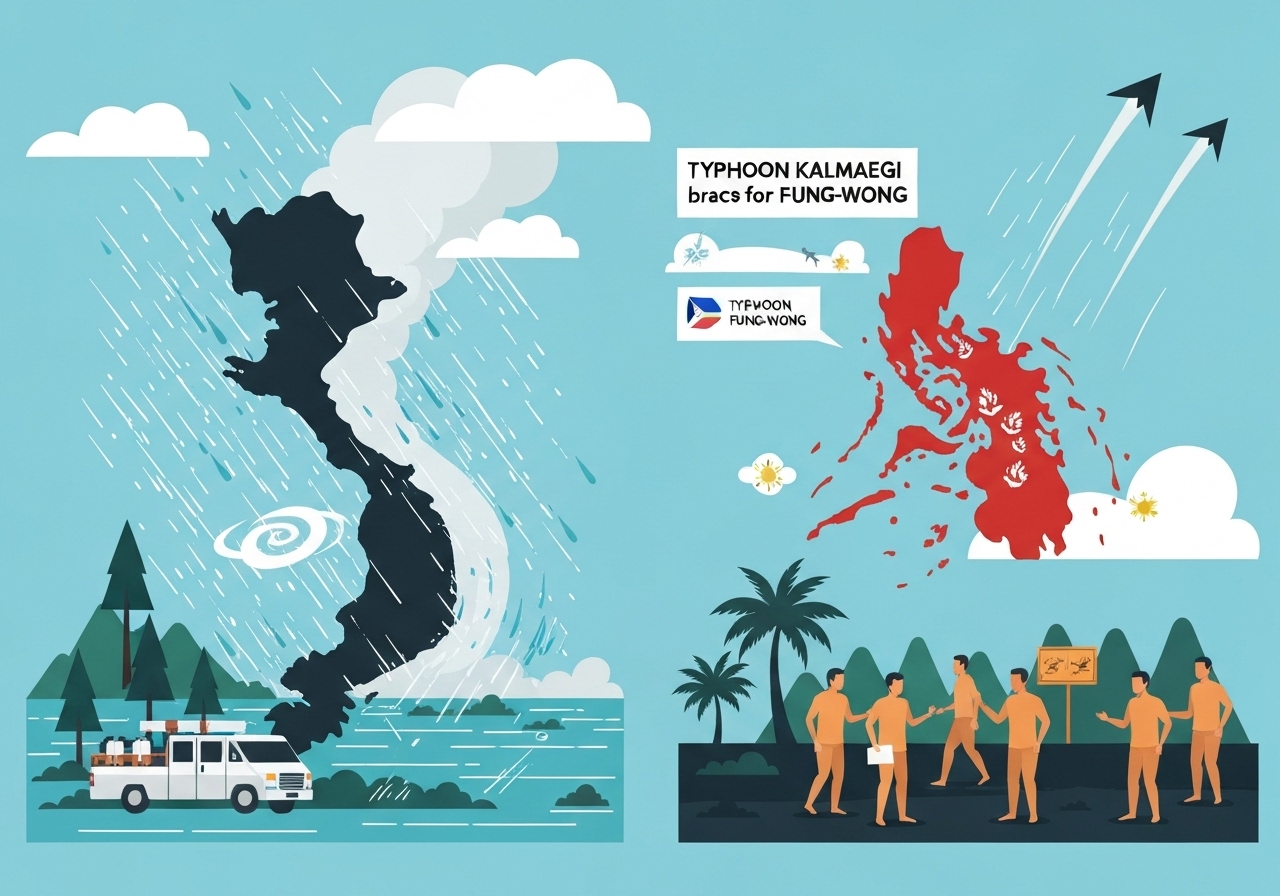
Lead: Typhoon Kalmaegi struck central Vietnam and swept on from the Philippines Friday, bringing destructive winds and heavy rains that killed at least five people in Vietnam and compounded losses in the Philippines, where authorities earlier reported 204 dead and 109 missing. Rescue and recovery work began in towns across both countries as residents cleared debris and repaired roofs. In the Philippines families mourned dozens of flood victims while the nation prepared for a second system, Typhoon Fung-wong (locally Uwan), expected to approach late Sunday or early Monday. Governments reported widespread displacement, major infrastructure damage and ongoing power outages as emergency teams coordinated responses.
Key Takeaways
- Casualties: The Philippines reported 204 dead and 109 missing after Kalmaegi; Vietnam reported five fatalities and three missing as the storm passed.
- Evacuations and displacement: More than 537,000 people were evacuated in Vietnam; the Philippines said nearly 450,000 were moved to shelters, with about 400,000 still in evacuation centers or with relatives.
- Housing damage: In Vietnam 52 houses collapsed and nearly 2,600 houses were damaged or lost roofs, including over 2,400 in Gia Lai province.
- Power outages: Kalmaegi cut electricity to more than 1.6 million households in Vietnam; officials reported roughly 500,000 households remained without power after partial restorations.
- Rainfall and flooding: The storm was forecast to bring up to 600 mm (24 inches) of rain in some areas and pushed rivers to record heights, causing rapid flooding and landslide risk.
- Philippine context: Cebu province alone recorded 141 deaths, many caused by flash floods; President Ferdinand Marcos Jr. declared a national state of emergency.
- Follow-on risk: Meteorological agencies warned that Typhoon Fung-wong (Uwan), spanning an estimated 1,400 km, could reach northern Aurora and potentially affect Metro Manila by late Sunday or Monday.
Background
Typhoon Kalmaegi formed amid an active western Pacific season that has already produced multiple strong systems for the Philippines and Vietnam. The Philippines typically sees about 20 named storms each year; this season reached its 26th and 27th named storms with Kalmaegi and Fung-wong, exceeding recent climatological averages, according to atmospheric scientists. Vietnam also faces roughly a dozen storms annually and this year has endured a string of events, including Typhoon Ragasa, Typhoon Bualoi and Typhoon Matmo, which collectively caused dozens of deaths and substantial economic losses in recent months.
Regions most affected are low-lying coastal and central highland provinces where flood-control infrastructure and river dikes were overwhelmed by intense, concentrated rainfall. Both countries combine national disaster agencies, local governments and international aid actors to coordinate evacuations, sheltering and search-and-rescue. Emergency preparedness in the Philippines was elevated after heavy rains and overflowing rivers triggered rapid inundation in residential areas, forcing residents to climb to roofs and upper floors to wait for rescue.
Main Event
In Vietnam, state media reported five fatalities: three in Dak Lak and two in Gia Lai provinces, with three still missing in Quang Ngai. Authorities described streets littered with corrugated metal and uprooted trees as residents assessed damage in the clearing skies. Emergency crews and residents worked to clear debris, repair roofs and restore basic services, while markets and shops dragged out waterlogged goods to dry in the sun.
Power infrastructure suffered extensive damage: hundreds of poles were toppled, causing outages that affected more than 1.6 million households at the storm’s peak. Officials said repairs had restored power to most areas by Saturday, but approximately 500,000 households still lacked electricity. In Binh Dinh and Quy Nhon, flooding stripped factories of roofs and left equipment water-damaged; in one coastal city, residents used a mall’s backup power to charge phones and contact loved ones.
In the Philippines the toll remained concentrated in the central island of Cebu where 141 people died, mainly in flash flooding. A state of national emergency declared by President Ferdinand Marcos Jr. remained in effect as authorities prepared for Fung-wong. Families gathered at temporary funeral parlor sites and evacuation centers as search teams continued to account for missing people and recover bodies in flooded communities.
Meteorological agencies warned that Fung-wong could span roughly 1,400 kilometers (870 miles) and make landfall in northern Aurora province late Sunday or early Monday, with potential effects on Metro Manila. Forecasters emphasized heavy rain, strong winds and storm surge risks that would compound already saturated waters and damaged flood-control systems across the region.
Analysis & Implications
Immediate humanitarian needs include shelter, clean water, medical care and power restoration. Hundreds of thousands displaced in both countries increase the complexity of aid delivery, raising concerns about disease, food security and the capacity of local authorities to sustain prolonged relief operations. The concentration of displaced people in collective shelters also heightens logistical demands for sanitation and protection services.
Economically, damage to housing, agriculture and industry will slow short-term recovery in affected provinces. Damage to factories and the loss of equipment in Binh Dinh and other coastal industrial zones may disrupt supply chains and wages for local workers, while repair costs for power infrastructure and homes will pressure already strained municipal budgets. Insurance coverage in the region is limited, meaning much reconstruction will rely on public funds and household savings.
Strategically, repeated storm impacts highlight policy challenges: maintaining and upgrading flood-control infrastructure, improving early-warning communication, and integrating climate projections into land‑use planning. Scientists link a warming ocean and atmosphere to stronger storms and heavier rainfall; this season’s elevated named-storm count and the intensity of Kalmaegi and similar systems reinforce calls for longer-term adaptation investments across Southeast Asia.
Comparison & Data
| Metric | Philippines | Vietnam |
|---|---|---|
| Reported deaths | 204 | 5 |
| Missing | 109 | 3 |
| Evacuated/displaced | ~450,000 evacuated; ~400,000 in centers/homes | ~537,000 evacuated |
| Houses damaged/lost roofs | Included among hundreds of thousands displaced | ~2,600 damaged; 52 collapsed |
| Peak rainfall forecast | Up to 600 mm (24 in) in some areas | Up to 600 mm (24 in) in some areas |
| Power outages | Widespread local outages reported | 1.6 million households affected; ~500,000 without power |
The table compares available official counts and forecasts reported by national agencies and state media. Differences in reporting windows and methodology can cause variation; for example, provincial tallies may be updated subsequently as search operations conclude. The rainfall forecast and storm size reflect regional weather bureau estimates used for evacuation planning and infrastructure warnings.
Reactions & Quotes
“I was able to swim. I told my family to swim, you will be saved, just swim, be brave and keep swimming,”
Jimmy Abatayo, Cebu resident (bereaved family member)
Abatayo’s short statement, given as he mourned multiple relatives, illustrates the human toll in communities caught in sudden river surges and flash floods. Local funeral scenes—rows of white coffins and grieving relatives—underscore the scale of loss in Cebu province and the emotional strain on survivors.
“If you look at the climatology for the Philippines and for Vietnam, it’s almost the entire year that they can get them because the warm waters that fuel the storm just are there,”
Kristen Corbosiero, Professor of Atmospheric and Environmental Sciences, University at Albany
Corbosiero’s observation places this season in a longer-term climatic context: a warmer ocean makes more energy available for storm formation, increasing the likelihood of intense rain and higher storm counts in a given year. Her comments have informed national advisories that emphasize sustained preparedness beyond conventional seasonal windows.
“An unusually large volume of rain overwhelmed dikes and flood-control safeguards,”
President Ferdinand Marcos Jr. (national statement)
The president’s statement acknowledged structural limits in flood defenses and accompanied a national state of emergency declaration intended to mobilize resources for rescue, relief and rapid rehabilitation. Officials said the declaration aimed to accelerate funding and interagency coordination across affected provinces.
Unconfirmed
- Exact final counts: Provincial and national tallies remain subject to revision as search-and-rescue teams complete operations and local reports are consolidated.
- Long-term economic loss estimates: Preliminary damage summaries cite factory and housing losses, but comprehensive economic impact assessments have not yet been published.
- Missing fishermen: Reports of three missing fishermen near Ly Son Island were reported, but their fate remained unverified when search operations were suspended due to weather conditions.
Bottom Line
Kalmaegi delivered a sharp reminder of the region’s vulnerability to intense tropical cyclones: acute human suffering, large-scale displacement and substantial damage to housing and utilities. Immediate priorities are search-and-rescue, restoring power and water services, delivering shelter and medicine, and accounting for the missing.
Over the medium term, repeated storms in one season will strain recovery budgets and highlight the need to invest in resilient infrastructure, better early-warning systems and land-use planning that accounts for increasing rainfall extremes. With Fung-wong approaching, authorities and communities face a critical window to shore up defences, move vulnerable people to safety and limit further loss of life.
Sources
- Associated Press — AP News (international news organization)
- Philippines Office of Civil Defense (official government agency)
- PAGASA — Philippine Atmospheric, Geophysical and Astronomical Services Administration (national weather bureau)
- Vietnam News Agency (state media)
- University at Albany — Department of Atmospheric and Environmental Sciences (academic source)