
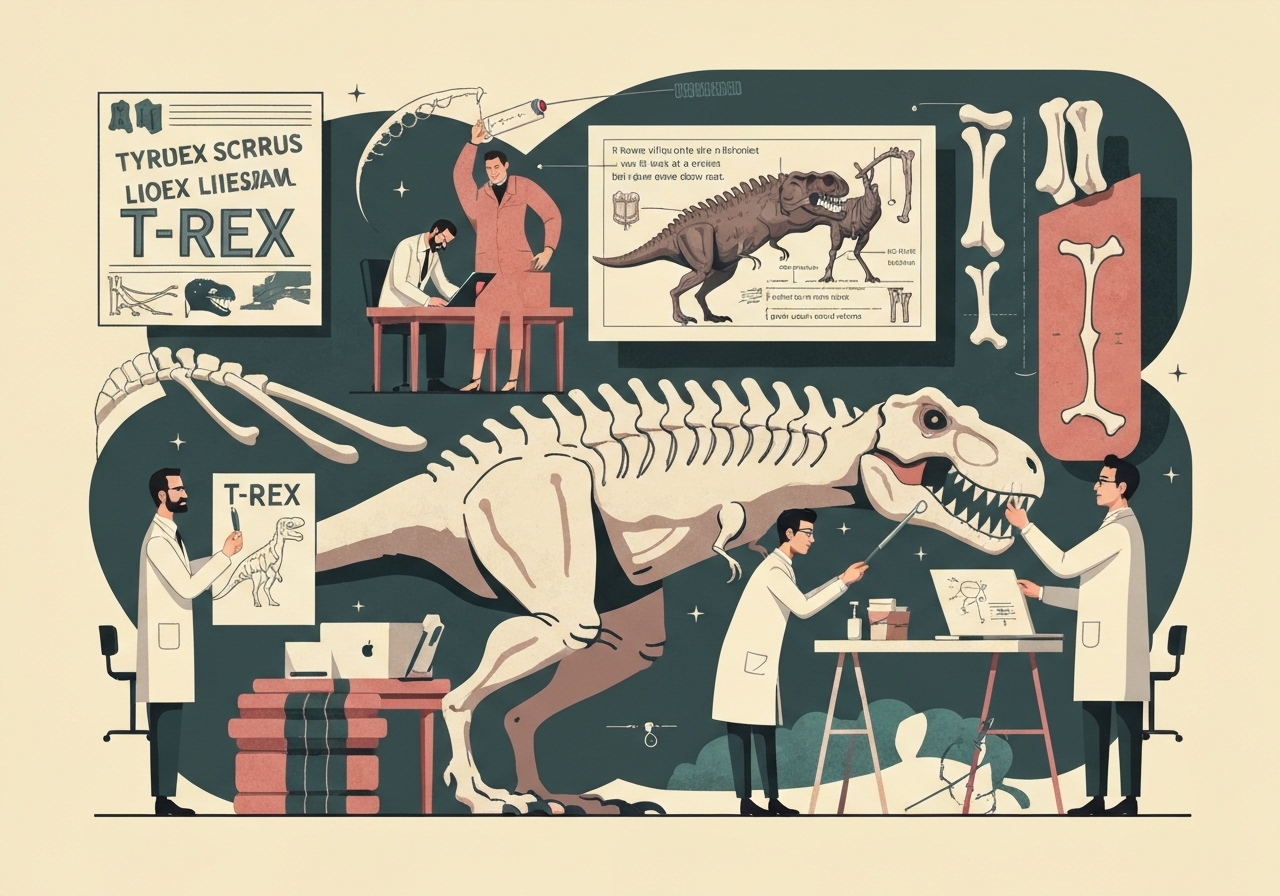
— A team publishing in the journal Peer on Wednesday reported that Tyrannosaurus rex grew more slowly and lived longer than earlier estimates suggested. Researchers re-examined bone thin sections from 17 specimens under polarized light and identified additional annual growth rings that had been missed in prior studies. The new counts push the age of peak mass—about eight tons—into the mid-30s rather than the mid-20s, revising the species’ life-history timeline and its ecological role as a long-lived apex predator.
Key Takeaways
- Study sample: 17 T. rex individuals were analyzed using polarized-light microscopy of bone thin sections, revealing previously undetected growth lines.
- Revised age estimates: New growth-ring counts indicate T. rex reached maximum bulk at roughly 35–40 years, not ~25 years as earlier work suggested.
- Size benchmark: The species’ mass at peak size remains about eight tons and a total length near 40 feet in fully mature individuals.
- Growth pattern: Growth-ring spacing varied among specimens, consistent with environmental and resource-driven fluctuations in growth rate.
- Ecological implication: Prolonged maturation likely allowed individuals to occupy a wider range of prey-size niches over decades before converging on adult feeding ecology.
- Methodological note: Polarized-light reanalysis was key to detecting rings that previous methods overlooked, affecting longevity estimates.
Background
Tyrannosaurus rex has long been a focal species for studies of dinosaur physiology and life history because of its large size and apex status. Earlier histological studies inferred a rapid adolescent growth spurt that carried many individuals to near-maximum size by about 25 years of age, with mortality often following soon after. Those conclusions helped shape interpretations of T. rex ecology—portraying it as a relatively short-lived giant that achieved dominance quickly. Histology-based age estimates depend on counting annual growth markers in bone, but preservation, sampling location and microscopic methods can alter visibility of those markers.
Improvements in microscopy and sampling protocols have periodically revised dinosaur growth models over the past two decades, and debates have persisted over how representative museum specimens are of wild populations. Stakeholders in this field include university paleobiologists, natural history museums holding specimens, and journals that disseminate methods and findings. The new Peer article enters a lineage of papers that reassess life-history traits as techniques evolve and more specimens are examined.
Main Event
The team examined thin sections from leg bones and other cortical elements of 17 T. rex specimens using polarized light microscopy, which enhances contrast in mineralized tissues. By rescanning samples and looking for subtle, closely spaced growth lines, researchers detected ring sequences that previous surveys had missed or miscounted. These additional rings extended age estimates for several individuals by a decade or more in some cases.
Lead author Holly Woodward summarized the pattern as one of extended growth: “T. rex spent most of its life in the mid-body size range rather than achieving a total body length of 40 feet quickly.” Woodward and colleagues argue that the slower accumulation of mass implies an extended period of ecological flexibility for individuals. The paper reports that variation in ring spacing among specimens aligns with what would be expected if food availability and local conditions periodically slowed or accelerated growth.
The practical outcome is a shifted life table for T. rex: instead of a rapid jump to adult size and an early plateau, individuals appear to undergo protracted maturation, occupying multiple size classes over decades. The study authors underscore that specimen preservation and sampling choices remain critical for accurate age estimates, and they document their methodology and re-counts in supplementary material to allow verification.
Analysis & Implications
If T. rex indeed matured over 35–40 years, the species’ population dynamics and ecological impacts must be reconsidered. Longer-lived predators reproduce and compete on different timescales than short-lived species; age structure within populations affects reproductive output, territoriality and intraspecific competition. A protracted juvenile-to-adult transition would have allowed individuals to exploit a wider range of prey sizes as they grew, reducing direct competition with fully mature conspecifics for some portion of life.
From a paleoecological perspective, extended longevity complicates models of predator–prey interactions in Late Cretaceous ecosystems. Prey species would have faced a mostly mid-sized subset of T. rex individuals for many years, with only the oldest reaching the largest-giant predatory role. That shifts assumptions about carcass availability, scavenging dynamics and niche partitioning among large carnivores documented in the fossil record.
Methodologically, the study highlights the importance of reexamining classic specimens with updated imaging. Polarized-light microscopy recovered subtle histological features that can be obscured by diagenetic alteration or by using coarser optical techniques. Future studies will need to reconcile results across labs and refine sampling standards to ensure age estimates are comparable across collections and studies.
Comparison & Data
| Parameter | Prior estimate | Revised estimate (this study) |
|---|---|---|
| Age at peak mass | ~25 years | ~35–40 years |
| Estimated adult mass | ~8 tons | ~8 tons |
| Sample size | varied (fewer high-resolution counts) | 17 specimens |
The table contrasts earlier consensus figures with the revised estimates reported in Peer. While estimated adult mass remains similar, the primary change is temporal: peak size occurs roughly a decade later. This single-study revision will need corroboration from independent laboratories and additional specimens across geographic and stratigraphic ranges to test its generality.
Reactions & Quotes
Researchers and curators are evaluating the implications for museum-held specimens, life-history databases and ecological reconstructions. The study’s methodological emphasis has prompted calls for standardized histological protocols so ring counts can be compared reliably between teams.
“T. rex spent most of its life in the mid-body size range rather than achieving a total body length of 40 feet quickly.”
Holly Woodward, lead author
Woodward’s comment summarizes the study’s central revision: a prolonged period of incremental growth alters how individuals likely behaved and fed across life stages. The team provided detailed supplementary data so other researchers can examine the same thin sections and test the new counts.
“Additional, closely spaced growth marks recovered under polarized light extend longevity estimates for several specimens.”
Peer (journal) press release summary
The journal’s summary emphasizes the technical advance—polarized-light reanalysis—as the immediate reason for revised ages. Editors note that reproducibility and wider sampling are necessary next steps before the revision becomes the new consensus.
Unconfirmed
- Whether the 17 specimens represent the full geographic and temporal range of T. rex populations remains uncertain; broader sampling could change population-level age patterns.
- The extent to which diagenetic alteration obscured or produced rings in some specimens is not fully resolved and requires independent verification.
- Linking ring spacing directly to specific environmental events (droughts, resource crashes) is plausible but not proven for individual specimens without complementary paleoenvironmental data.
Bottom Line
The Peer study offers a notable revision to T. rex life-history: using polarized-light reanalysis of 17 specimens, researchers find additional growth rings that push age-at-peak-mass into the mid-30s. This changes how paleontologists should think about the species’ ecological role over an individual’s lifespan and suggests a longer window of ontogenetic niche shifts than previously assumed.
Confirmation will require independent re-analyses, expanded specimen sampling and standardized histological protocols across collections. If upheld, the revision has broad implications for models of Late Cretaceous ecosystems, predator–prey dynamics and the evolutionary ecology of large theropods.