
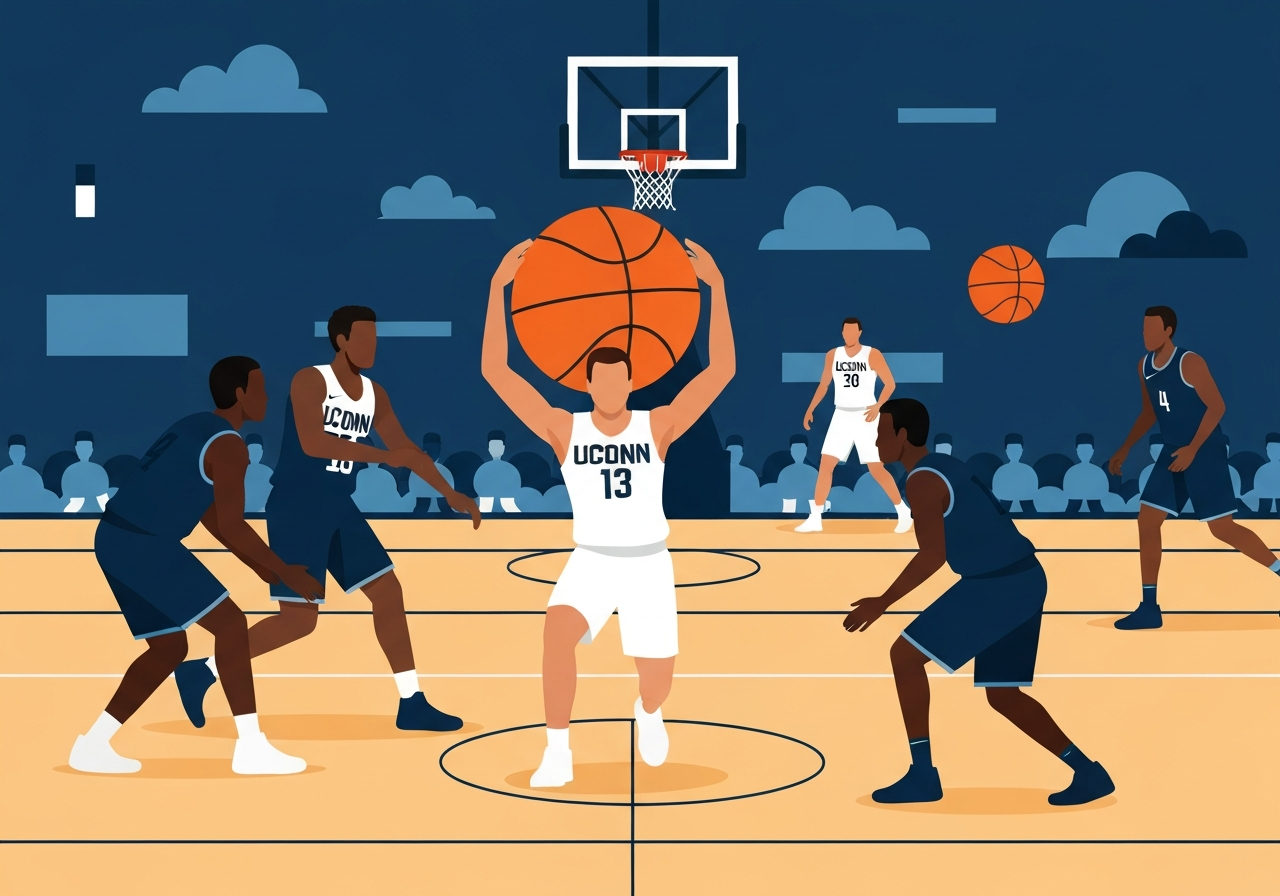
Lead: Second-seeded UConn survived a tense Sweet 16 in Washington on March 27, 2026, beating third-seeded Michigan State 67-63 to reach the East Region final. Tarris Reed Jr. delivered 20 points and sank clutch free throws in the closing minute, and Alex Karaban added 17 points. Michigan State rallied from an early double-digit hole but could not overcome late free-throw pressure and missed 3-pointers that left them short. The win sends UConn (32-5) into Sunday’s Elite Eight showdown with top-seeded Duke.
Key Takeaways
- Tarris Reed Jr. scored 20 points and, despite a 59% season free-throw rate, made all four of his attempts in the final minute to secure the win.
- Alex Karaban contributed 17 points and converted both ends of a one-and-one with 22.5 seconds remaining to extend UConn’s lead.
- Final score: UConn 67, Michigan State 63; UConn improves to 32-5, Michigan State finishes the season 27-8.
- Michigan State shot 4-of-16 from 3-point range on the night and staged a comeback from a 19-point deficit earlier in the game.
- Key late-game sequence: Reed foul shots at 44.8 seconds, Jeremy Fears Jr. answered at 32.3, Karaban’s one-and-one at 22.5, and Carson Cooper’s late free-throw miss with 4.6 seconds left.
- Jaylin Stewart returned from a knee issue, played three minutes and hit his only 3-point attempt.
- UConn’s next opponent is top-seeded Duke in the East Region final on Sunday; the programs previously met in the 1999 NCAA title game, a UConn victory.
Background
The NCAA East Region’s Washington site featured four programs with a combined 13 national championships, underscoring the depth and pedigree present in this stage of the tournament. UConn entered the game as the No. 2 seed with a 32-5 record, carrying defensive identity and experience into March. Michigan State, a No. 3 seed at 27-8, relied on coach Tom Izzo’s tournament reputation and a roster built for second-half runs.
The matchup paired UConn’s interior presence and disciplined tempo against Michigan State’s traditionally physical and opportunistic defense. Across the season, UConn leaned on frontcourt scoring and perimeter balance, while the Spartans showed resilience in games where they could force turnovers and generate transition opportunities. Historical context heightened the stakes: if UConn advanced, it would face top-seeded Duke in a game that many labeled a de facto Final Four-level contest.
Main Event
The game opened with UConn building a dominant early stretch — a 25-6 run highlighted by contributions from Malachi Smith, Solo Ball and Jaylin Stewart, who collectively knocked down four 3-pointers during that burst. That sequence produced a 19-point margin that forced Michigan State to rethink its approach. By halftime the Huskies led 35-27, but the Spartans chipped away in the second half.
Michigan State scored the first seven points after intermission and later took a 45-44 lead on a three-point play by Jaxon Kohler with 10:06 remaining, illustrating the Spartans’ physical persistence. UConn responded by tightening defensively and leaning on its interior scorers; a Reed steal and dunk swung momentum back to the Huskies and energized the crowd behind coach Dan Hurley’s sideline urging.
The closing stretch hinged on free-throw execution. Reed made two foul shots with 44.8 seconds left to restore a lead, and Jeremy Fears Jr. countered with two free throws at 32.3 seconds. Karaban’s one-and-one conversion at 22.5 seconds pushed the advantage to three, and Michigan State could not find a clean look after Kur Teng’s 3-pointer missed. A foul on the rebound allowed Carson Cooper to make one of two with 4.6 seconds remaining; his second attempt rimmed out and Reed secured the rebound, then hit two free throws to effectively end the game.
Analysis & Implications
UConn’s late-game composure, especially at the free-throw line, was decisive. Reed’s ability to make four high-pressure attempts despite a 59% season mark suggests focused preparation and mental adjustment; those makes altered the expected win probability in UConn’s favor in the final minute. For a program that prizes defensive steadiness, closing a tight tournament game this way reinforces their credibility as a national contender.
Michigan State’s comeback from an early 19-point deficit highlighted the team’s fight and coaching adjustments, but the Spartans’ 4-of-16 night from beyond the arc limited their ceiling. In modern tournament play, prolonged cold spells from 3-point range are difficult to overcome, especially against disciplined opponents who contest shots and protect the paint.
The forthcoming UConn-Duke matchup carries both stylistic and narrative weight. Duke, the region’s No. 1 seed, presents a different set of matchups and offensive spacing that will test UConn’s interior defenders and ability to contest perimeter shots. Tournament fatigue, matchup specifics, and bench depth will likely be decisive variables in that Elite Eight contest.
Comparison & Data
| Item | UConn | Michigan State |
|---|---|---|
| Final score | 67 | 63 |
| Record (postgame) | 32-5 | 27-8 |
| Top scorer | Tarris Reed Jr. (20) | Jeremy Fears Jr. (key late foul shots) |
| 3-point shooting (noted) | (not specified) | 4-of-16 |
| Reed season FT rate | 59% | — |
| Reed final-minute FTs | 4-of-4 | — |
The table summarizes verifiable game facts and season marks reported in the postgame coverage. Where full box-score details were not provided in the source, items are marked as not specified rather than estimated to preserve accuracy.
Reactions & Quotes
“I feel like I put in the work… So I took a deep breath and took my time at the line.”
Tarris Reed Jr., UConn forward
Reed framed his late free-throw success as the result of preparation and confidence from teammates, a common theme for players who improve under pressure.
“Give our guys credit. We bounced back and picked away… We just kind of wore down.”
Tom Izzo, Michigan State head coach
Izzo credited his team’s second-half push but noted physical and situational fatigue as factors in the final stretch.
“He’s a calming influence for me… It’s like having a top assistant that’s on your team and always around your players.”
Dan Hurley, UConn head coach
Hurley emphasized Reed’s leadership role beyond the stat sheet, framing him as both a player and a steadying presence in the program’s culture.
Unconfirmed
- Whether Carson Cooper’s missed second free throw with 4.6 seconds remaining was intentional remains unclear; coverage noted it did not appear intentional but offers no definitive confirmation.
- The extent to which fatigue or schedule-related wear influenced Michigan State’s late performance is inferred from coach remarks but not independently verified by physical load or minute-analysis in the source.
Bottom Line
UConn’s 67-63 victory over Michigan State advanced the Huskies to the East Region final, where a high-profile matchup with Duke awaits. The game was decided by late free-throw execution and clutch plays from frontcourt leaders, underscoring the value of composure in single-elimination play.
For Michigan State, the loss ends a 27-8 season that featured a notable comeback in this game but ultimately faltered under perimeter inefficiency and late-game misses. The forthcoming UConn-Duke game will test both teams’ ability to manage pressure, matchups and depth — and could shape the national title conversation heading into the Final Four.