
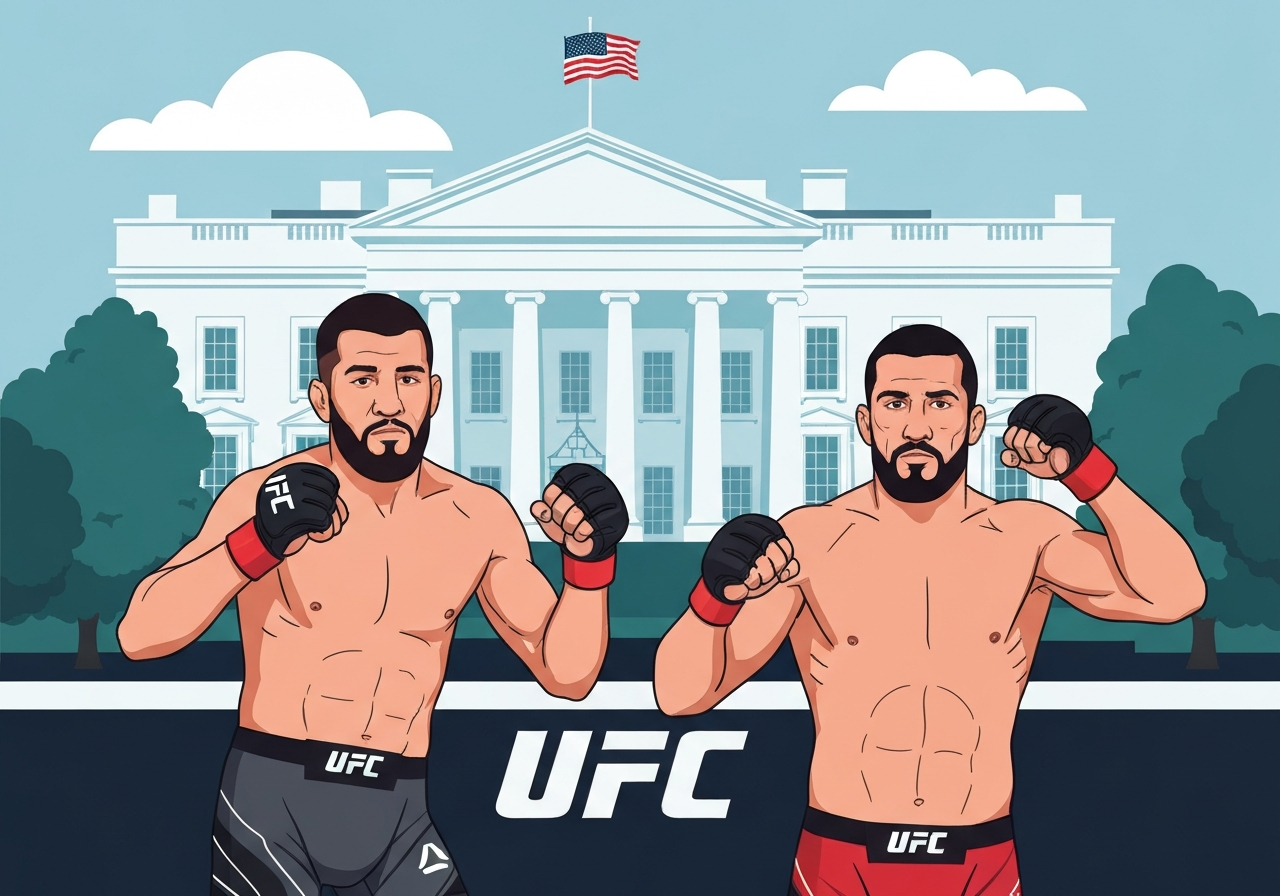
On June 14, the UFC announced it will hold a special card at the White House—branded “UFC Freedom Fights 250″—headlined by two title fights: Ilia Topuria vs. Justin Gaethje for the undisputed lightweight title and Alex Pereira vs. Ciryl Gane for an interim heavyweight crown. The date coincides with former U.S. president Donald Trump’s 80th birthday and the 250th anniversary of U.S. Independence. The promotion revealed the matchups during the UFC 326 broadcast and confirmed four additional bouts for the card. The announcement positions the event as both a major sports spectacle and a symbolic celebration tied to the June date.
- Event: “UFC Freedom Fights 250” is scheduled for June 14 at the White House, announced during the UFC 326 broadcast.
- Main event: Ilia Topuria (17-0) will defend the undisputed lightweight title against interim champion Justin Gaethje (27-5).
- Co-main event: Two-weight champ Alex Pereira (13-3) will challenge Ciryl Gane (13-2) for the interim UFC heavyweight title.
- Additional fights: Sean O’Malley vs. Aiemann Zahabi; Mauricio Ruffy vs. Michael Chandler; Bo Nickal vs. Kyle Daukaus; Diego Lopes vs. Steve Garcia.
- Context: The heavyweight interim bout leaves Tom Aspinall (15-3) as undisputed champion while he recovers from eye injuries sustained in his last fight with Gane.
- Topuria background: The 29-year-old Spaniard moved up from featherweight and won the 155-pound title by first-round KO of Charles Oliveira; he took time off in late 2025 for personal reasons.
- Gaethje notes: The 37-year-old is an 18-year veteran, two-time interim champion and won the interim lightweight title in January over Paddy Pimblett by unanimous decision in Las Vegas.
The White House card reflects the UFC’s growing appetite for staging high-profile, attention-grabbing events in unique venues. The promotion framed the June 14 date as a dual celebration: a high-profile fight night and a nod to national milestones. Historically, the UFC has pursued special-location cards to expand its cultural footprint and media reach, and this event continues that strategy. The choice of fighters—current champions and established stars—underscores an attempt to blend sporting legitimacy with mainstream visibility.
Stakeholders include UFC executives, fighters and their camps, the White House event organizers, and a global fanbase watching pay-per-view and broadcast partners. Promoters must coordinate security, production and regulatory oversight for a politically sensitive venue while also managing fighter readiness, travel and medical clearances. Fighters such as Topuria and Pereira bring championship narratives that the UFC can market worldwide, while opponents like Gaethje and Gane provide credible, widely recognized challengers. The combination aims to draw both hardcore MMA viewers and casual audiences intrigued by the venue and occasion.
Topuria vs. Gaethje represents a clash between an unbeaten champion and a veteran interim titleholder. Topuria, 29, carries a 17-0 record and earned the lightweight crown last June with a first-round knockout of Charles Oliveira after moving up from featherweight. He paused competition late in 2025 to address personal matters and returns for his first defense. Gaethje, 37, a long-time fan favorite, captured the interim belt in January by beating Paddy Pimblett via unanimous decision in Las Vegas and seeks a first undisputed title after prior unsuccessful bids in 2020 and 2022 against Khabib Nurmagomedov and Oliveira, respectively.
The Pereira-Gane co-main pits a multi-division former champion against a heavy contender with a recent controversial finish. Pereira, 13-3, is a former middleweight and light heavyweight champion who won the 185-pound title in 2022 by knocking out Israel Adesanya and added the 205-pound crown by defeating Jiří Procházka the following year. He lost and then regained the 205 belt in a 2025 exchange with Magomed Ankalaev. Gane (13-2) is a former interim heavyweight titleholder who recently fought Tom Aspinall in October; that fight was ruled a no-contest after Aspinall could not continue due to injuries judged to result from an accidental eye poke.
Beyond the two headliners, the undercard includes marquee names that bolster pay-per-view interest. Sean O’Malley will face Aiemann Zahabi in a bantamweight bout that tests O’Malley’s standing among top 135-pound contenders. Mauricio Ruffy vs. Michael Chandler adds lightweight depth and veteran star power. Bo Nickal vs. Kyle Daukaus and Diego Lopes vs. Steve Garcia round out the televised card with prospects and experienced competitors seeking momentum. Together, the six-fight televised lineup balances title implications with entertainment value.
Holding a UFC card at the White House raises regulatory, logistical and symbolic questions. Practically, the promotion will need to coordinate with venue security, medical teams and athletic commissions to meet licensure and fighter-safety standards in an atypical setting. Politically and culturally, staging fights at the presidential residence links a combat sport with a national institution, which can broaden exposure but also invite scrutiny from critics who question the appropriateness of such associations. For the fighters, the setting amplifies profile and potential endorsement opportunities, but also increases pressure and distraction ahead of championship contests.
Economically, the event is likely to generate significant media value and pay-per-view buys if the spectacle translates to mainstream curiosity beyond the core MMA audience. The matchup lineup—two title fights featuring household names—improves the UFC’s chances of crossover interest and premium pricing. Internationally, the event demonstrates the UFC’s capacity to stage symbolic spectacles that play both to domestic audiences and global streaming markets, possibly setting a template for future high-visibility cards at non-traditional venues.
Sporting implications are immediate: a Topuria successful defense cements his status as a generational lightweight talent and may open a path to further moves (including a potential move to welterweight down the line). Conversely, a Gaethje win would crown a veteran who has been on the cusp of undisputed gold multiple times, changing lightweight title lineage. At heavyweight, Pereira’s attempt to capture a third weight-class title would be unprecedented in UFC history; a win over Gane for the interim belt intensifies the heavyweight picture, returning the focus to Tom Aspinall’s recovery timeline.
| Fighter | Record | Notable Titles/Notes |
|---|---|---|
| Ilia Topuria | 17-0 | Undisputed lightweight champion; moved up from featherweight; KO of Charles Oliveira to win title |
| Justin Gaethje | 27-5 | Interim lightweight champion (won Jan vs. Paddy Pimblett); two-time interim titleholder; 18-year veteran |
| Alex Pereira | 13-3 | Former middleweight & light heavyweight champion; seeking interim heavyweight title |
| Ciryl Gane | 13-2 (10-2 UFC) | Former interim heavyweight champion; contested Aspinall in Oct (no-contest) |
The table summarizes records and titles to provide quick context for how each headliner earned this slot on the White House card. Comparing resumes highlights the narrative stakes: Topuria’s unbeaten run and youth versus Gaethje’s experience and interim regained status; Pereira’s multi-division history versus Gane’s heavyweight pedigree and recent controversial finish with Aspinall. That contrast helps explain fan interest and broadcast strategies ahead of June 14.
Officials, fighters and commentators offered immediate reactions after the broadcast announcement. UFC spokespeople framed the card as a landmark moment that fuses championship stakes with a unique venue. Managers and camps are now tasked with finalizing medical, promotional and travel logistics under an accelerated timeline that accompanies high-profile events.
We view this as a historic platform for our sport and the athletes involved.
UFC spokesperson (official statement)
The UFC statement emphasized the promotional value and logistical complexity, signaling that the organization expects elevated scrutiny but also substantial media attention. That framing aligns with the promotion’s recent trend of staging destination or spectacle-driven cards to reach new audiences.
I’m focused on defending my title and delivering for the fans—wherever the fight happens.
Ilia Topuria (champion)
Topuria’s comment—concise and performance-oriented—was shared to underline the athlete’s intent to treat the White House setting as secondary to in-cage execution. Camps often use such statements to steady public expectations amid promotional noise.
I want the biggest challenge, and this is exactly that.
Justin Gaethje (interim champion)
Gaethje’s remark framed his return as a pursuit of legacy, reinforcing the competitive stakes and his veteran narrative heading into a hostile, high-profile environment for Topuria’s first defense.
- It is unconfirmed whether regulatory waivers or special licensing will be required for a White House venue and how quickly athletic commissions will finalize approvals.
- There is no public timeline yet for Tom Aspinall’s return; his recovery pace could affect whether a full undisputed heavyweight unification fight follows.
- Details on ticketing, broadcast windows and international streaming partners for the White House card have not been released publicly as of the announcement.
The White House card is a deliberate escalation in the UFC’s playbook of high-visibility events: it pairs two title fights with a symbolic venue to maximize attention and revenue potential. For fans and industry observers, the core questions are competitive: will Topuria defend successfully and cement a new era at lightweight, and can Pereira secure a third divisional title at heavyweight? Those outcomes will shape divisional lineages and immediate matchmaking priorities after June 14.
Operationally, the promotion must manage complex logistics and potential political fallout while ensuring fighter safety and regulatory compliance. A smooth execution would validate the UFC’s capacity to stage atypical, high-stakes cards; missteps could invite criticism and regulatory headaches. For fighters, the event is a rare platform that magnifies legacy opportunities and commercial prospects, but it also elevates pressure—both inside and outside the cage.
- ESPN report on the White House card — media report providing original event details and fight announcements.
- UFC official site / broadcast announcement — official organization source for event naming, scheduling and promotional materials.