
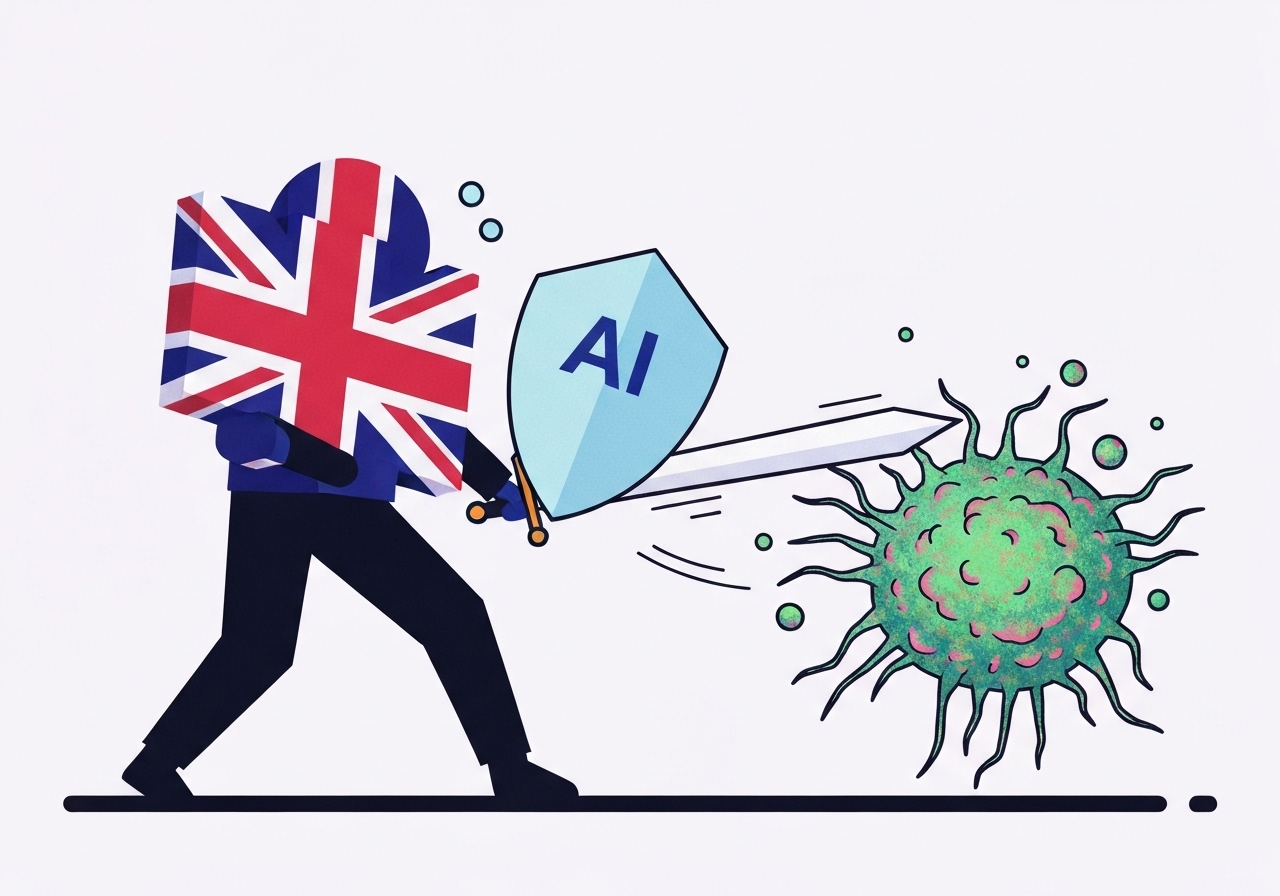
The UK has announced a £45 million partnership between the Fleming Initiative and GSK to apply artificial intelligence to the accelerating global threat of drug‑resistant infections. Launched in 2025, the programme targets six research areas, with an early focus on hard‑to‑treat Gram‑negative bacteria and emerging fungal threats such as Aspergillus. Project leaders say the aim is to speed discovery of new antibiotics and predict how resistance will appear and spread, turning years of laboratory work into tasks a computer can perform. Organisers warn the effort responds to a growing toll: superbugs directly kill around one million people a year and contribute to many more deaths worldwide.
Key takeaways
- The UK collaboration will invest £45 million across six research fields to accelerate antibiotic discovery using AI and predictive models.
- Initial laboratory work will concentrate on Gram‑negative bacteria — including E. coli and Klebsiella pneumoniae — which are hard to penetrate with current drugs.
- Teams will generate data on which molecular structures can enter and remain inside Gram‑negative cells; that data will train machine‑learning models.
- The initiative also plans to extend AI methods to fungal pathogens, beginning with Aspergillus, which threatens immunocompromised patients.
- Researchers cited recent untreatable infections from the Ukraine conflict as evidence of severe clinical consequences, including limb amputation in some cases.
- Current UK data indicate close to 400 new antibiotic‑resistant infections are being detected each week, underscoring rising pressure on health systems.
Background
Antimicrobial resistance has been a public‑health concern since the antibiotic era began; Alexander Fleming himself warned of resistance decades ago. Overuse and misuse of antibiotics in people, animals and agriculture accelerate bacterial evolution, creating strains that standard drugs cannot control. Gram‑negative bacteria pose particular scientific challenges because an additional outer membrane and active efflux pumps can exclude or expel antibiotics, reducing drug efficacy.
National and international bodies have labelled resistant infections a ‘silent pandemic’ because their impact is diffuse, chronic and rising. Estimates attribute about one million direct deaths each year to drug‑resistant infections, with indirect contributions to many more fatalities. Pharmaceutical pipelines for novel antibiotics have been thin for years, and public‑private collaborations are becoming a central strategy to rebuild discovery capacity.
Main event
The Fleming Initiative and GSK announced a joint programme to apply AI to antibiotic discovery and resistance forecasting, committing £45 million to six focused research streams. Imperial College London researchers, led by Dr Andrew Edwards, will run laboratory experiments that vary chemical structures and measure which molecules can penetrate and persist inside Gram‑negative bacteria. Those experimental results will create the training sets needed for machine‑learning systems to recognise patterns that human researchers may miss.
Project scientists described the workflow as converting what can take years by manual experimentation into computational tasks that can be iterated rapidly. Once models identify chemical features that enable bacterial entry and retention, medicinal chemists can prioritise or redesign candidate molecules to evade bacterial defenses. The partnership also intends to use predictive models—analogous to weather forecasting—to map how resistant strains might emerge and spread regionally.
Beyond bacteria, the programme will trial AI methods against fungal pathogens, beginning with Aspergillus species whose spores can prove lethal to patients with weakened immune systems. GSK’s chief scientific officer highlighted the dual goal of discovering novel therapeutics and anticipating resistance so treatments remain effective over time. Researchers note parallel work in North America where AI has been used to shortlist or design compounds against resistant pathogens such as gonorrhoea.
Analysis & implications
From a scientific standpoint, integrating large, high‑quality experimental datasets with modern machine‑learning tools is a logical next step for antibiotic discovery. AI models perform best when they can learn from consistent, well‑annotated data, which is why the project emphasises systematic laboratory measurement of molecular uptake and retention. If successful, this approach could shorten early discovery cycles and increase the diversity of scaffolds explored.
Economically and industrially, the £45 million commitment is notable given chronic underinvestment in antibacterial R&D relative to other therapeutic areas. Public‑private collaborations can de‑risk early discovery for industry partners, but translating computational hits into safe, marketable drugs will still require substantial downstream investment for optimization and clinical trials. The project addresses a key bottleneck—designing molecules that reach the bacterial target—but later phases remain resource intensive.
On public‑health timelines, models that forecast emergence and spread of resistance could improve surveillance and targeted stewardship interventions. However, predictive capacity depends on data volume, geographic coverage and timely reporting. In low‑resource settings where much transmission occurs, gaps in surveillance could limit forecasting accuracy and equitable benefit from new therapies.
Comparison & data
| Metric | Figure | Notes |
|---|---|---|
| UK funding for project | £45,000,000 | Allocated across six research areas |
| Estimated direct deaths from superbugs | ~1,000,000/year | Global estimate cited by project leaders |
| New resistant infections in UK | ~400/week | Current UK detection rate reported |
The table condenses the headline financial and epidemiological figures driving the initiative. While investment and modelling are necessary responses, the data underline that building a pipeline of effective antibiotics will require sustained funding and coordinated global surveillance to track emerging resistance.
Reactions & quotes
“This is the largest single UK investment in an antibiotic programme I am aware of,”
Dr Andrew Edwards, Imperial College London (academic)
Dr Edwards emphasised the technical challenge of Gram‑negative pathogens and the need for experimental data to train AI tools that can reveal patterns for molecule design.
“We will open up new approaches for discovering novel antibiotics and anticipate resistance,”
Tony Wood, GSK (industry)
GSK framed its role as both drug discovery and helping to prevent resistance from undermining future treatments, noting the industry stake in sustainable therapeutics.
“Antibiotics are one of our greatest health resources and we have squandered them,”
Alison Holmes, Fleming Initiative (initiative director)
Leaders from the Fleming Initiative urged broader public awareness of routine conditions that depend on effective antibiotics and called for concerted stewardship alongside discovery efforts.
Unconfirmed
- Specific regional details and case counts of ‘untreatable’ infections from the Ukraine conflict are cited anecdotally and may lack comprehensive verification.
- Long‑term efficacy of AI‑driven candidates is not yet established — computational hits still require preclinical and clinical validation.
Bottom line
The UK’s £45 million AI‑centred programme marks a significant, targeted attempt to reinvigorate antibiotic discovery and resistance forecasting. By generating structured laboratory data on molecular entry and persistence in Gram‑negative bacteria, the project aims to supply machine‑learning models with the high‑quality inputs they need to identify promising chemical matter faster than traditional workflows.
Success would not be a single cure but a durable platform: better early discovery, improved prioritisation of candidates and prospective models that help health systems anticipate and mitigate resistance. Yet computational advances cannot substitute for sustained investment across development, clinical trials, equitable access and global surveillance — all of which will determine whether new discoveries translate into saved lives.
Sources
- BBC News (news report summarising the announcement and quotes)
- GSK (pharmaceutical company / industry)
- Imperial College London (academic institution)