
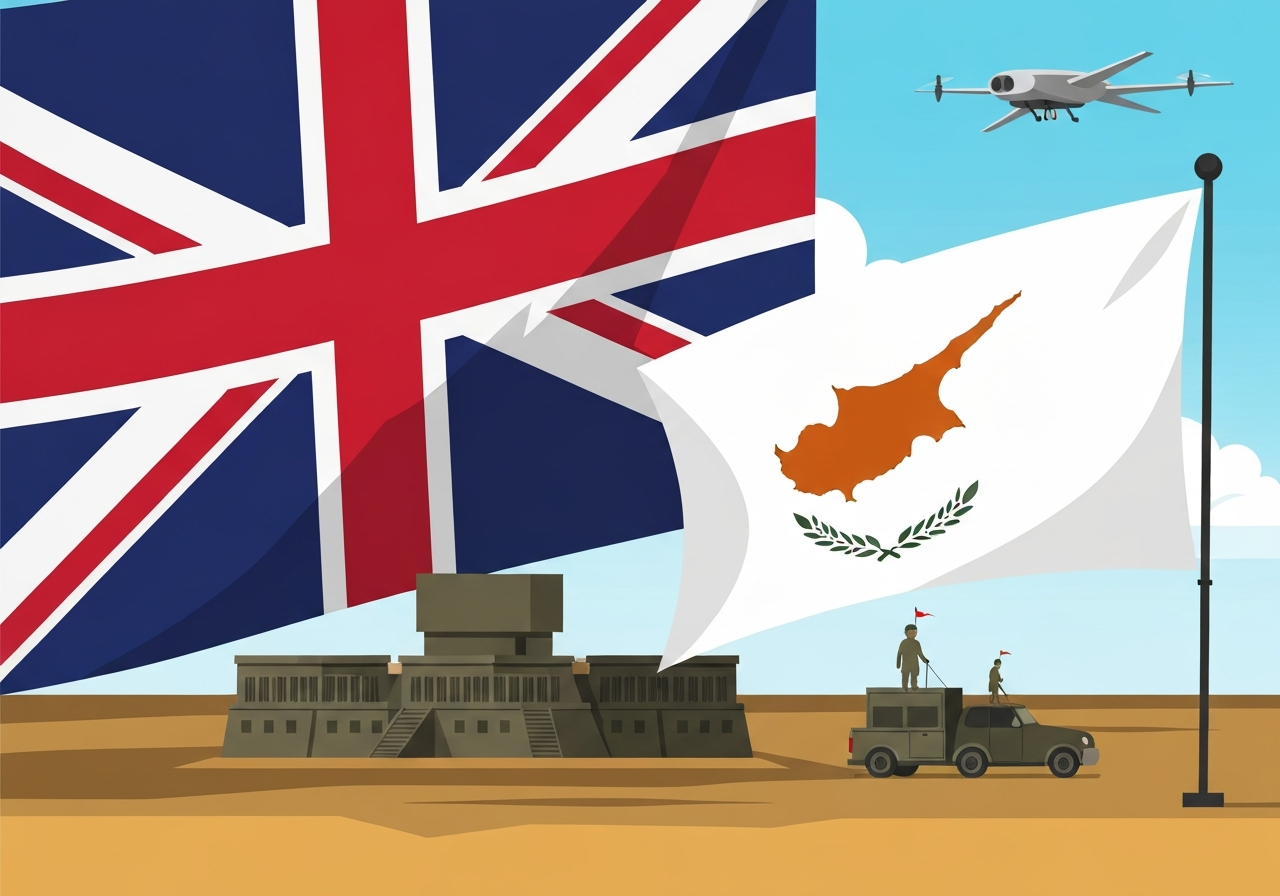
Lead: The UK Ministry of Defence has said a Shahed-type drone that struck RAF Akrotiri in Cyprus on Sunday was not launched from Iran, though the precise launch site and the perpetrators remain unconfirmed. The drone hit a hangar used by American U-2 reconnaissance aircraft and caught fire; officials reported no casualties and no damage to equipment inside the hangar. Defence sources say the unmanned vehicle likely evaded detection by flying low and slow, and investigators now point to a pro‑Iran militia operating from Lebanon or western Iraq as a possible origin. The incident has heightened tensions between London and Nicosia and prompted regional military reinforcements.
Key Takeaways
- The drone impacted a hangar at RAF Akrotiri on Sunday; it is described by UK officials as a Shahed‑type craft and ignited but caused no casualties.
- The MoD stated there was “no damage to equipment inside the hangar,” even though the structure burst into flames.
- Defence Intelligence has concluded the drone was not launched from Iran, though a definitive launch site has not been established.
- UK investigators suspect a pro‑Iran militia launched the drone from either Lebanon or western Iraq, but that attribution is not yet conclusive.
- Two additional unmanned aerial vehicles were intercepted while headed towards Akrotiri after the initial strike, according to Cypriot reports.
- British Defence Secretary John Healey travelled to Cyprus; France and Greece dispatched F‑16s and air‑defense systems, and a Royal Navy destroyer is en route.
- RAF Akrotiri has been a base for hundreds of surveillance sorties over Gaza during Israel’s war on the enclave, increasing its operational profile.
Background
RAF Akrotiri and the Dhekelia garrison are Britain’s two sovereign bases in Cyprus, retained since independence and used for regional operations and intelligence, surveillance and reconnaissance missions. In recent months Akrotiri’s operational tempo rose as RAF aircraft conducted numerous surveillance flights over Gaza during Israel’s military campaign, which in turn elevated the base’s regional profile and potential as a target. The eastern Mediterranean has seen growing activity from state and non‑state actors aligned with Iran, including militias in Lebanon and Iraq that possess medium‑range unmanned aerial capabilities. Attribution in such strikes is technically and politically difficult: drones can be launched from hundreds of kilometres away, relay through other assets, or be operated by proxy groups with murky command links to state sponsors.
Cyprus’s geographic proximity to Lebanon, Syria and the Levantine littoral makes its bases strategically useful for Western air operations across the Middle East, and also exposes them to asymmetric threats. The UK government has long balanced the bases’ operational value against local sensitivities and sovereignty concerns in Nicosia. Recent announcements by PM Keir Starmer allowing US forces to use UK bases for potential strikes on Iranian missile targets added a new diplomatic overlay to the incident, increasing Cypriot anxiety and public scrutiny of how warnings and protections are coordinated with local authorities.
Main Event
According to the MoD, a Shahed‑type unmanned aerial vehicle approached Akrotiri on Sunday, flying low and slow to slip past radar and air‑defence filters. The drone struck a hangar that stores or services American U‑2 reconnaissance aircraft; the impact caused the hangar to burn but officials emphasized no equipment inside was damaged and no personnel were hurt. Cypriot authorities reported that, following the strike, two additional unmanned aerial vehicles were intercepted while inbound to the same area, suggesting either a multi‑vector attack or follow‑on threats.
In parliamentary remarks after the incident, Prime Minister Keir Starmer said the strike occurred before he publicly authorised US use of UK military bases for targeting Iranian missile sites, underlining the sensitive timing. British Defence Secretary John Healey travelled to Cyprus and met Cypriot counterparts as Nicosia demanded explanations and assurances; the Cypriot government criticised the UK for not warning locals in time. Local evacuations occurred around the bases as a precaution, and allied contributions of air‑defence and fighter assets were reported in the immediate aftermath.
London’s initial technical assessment concluded the drone’s characteristics and estimated range made an Iranian launch unlikely, and attention shifted to pro‑Iran militias in Lebanon or western Iraq. Investigators, however, said they could not conclusively establish the launch point at the time of reporting, leaving a gap between intelligence inference and definitive attribution. The UK has also deployed a Royal Navy destroyer to the area, and other NATO partners moved defensive capabilities toward Cyprus.
Analysis & Implications
The attack underscores the evolving threat posed by relatively inexpensive, longer‑range unmanned systems that can menace fixed bases and high‑value assets without requiring state‑level air superiority. If a militia acting on behalf of or with tacit support from a state actor launched the drone, it evidences a hybrid‑threat model that complicates standard diplomatic and military responses. Attribution shortfalls—technical, legal and political—mean governments face trade‑offs between public accusation and the risk of escalation if incorrect claims are made.
For UK–Cyprus relations the incident raises questions about coordination and civil protection: Nicosia criticised London for perceived delays in warning local populations, a point that could strain bilateral ties if not addressed. Operationally, the strike will likely accelerate investment in layered air‑defence, counter‑UAV capabilities and sensor integration across the eastern Mediterranean among NATO partners, as shown by France’s and Greece’s immediate deployments. The arrival of additional assets may deter near‑term follow‑on attacks but also risks further militarising Cyprus’ airspace and surrounding waters.
Strategically, the event complicates US and UK planning around potential strikes on Iranian missile infrastructure. While Diego Garcia in the Indian Ocean remains a likely staging area for some US operations, reliance on forward bases such as Akrotiri presents political and operational dilemmas—particularly if host governments perceive their territory has not been adequately defended or consulted. In the longer term, repeated incidents of this sort could drive doctrinal changes in base hardening, distributed logistics and the use of unmanned systems for persistent local air‑defence.
Comparison & Data
| Base | Primary role | Recent activity |
|---|---|---|
| RAF Akrotiri | Surveillance, ISR, staging | Hangar hit by drone; U‑2 operations over Gaza |
| Dhekelia | Garrison, logistics | Maintained UK presence; no reported strike |
The table summarises the two sovereign British bases in Cyprus and their roles; Akrotiri’s increased intelligence and surveillance sorties during Israel’s Gaza campaign raised its operational profile. While concrete numbers for flight sorties and response times are not published in the MoD summary released to the press, the visible deployments of allied air‑defence assets indicate a multilateral view that the threat environment has intensified around Cyprus.
Reactions & Quotes
“Based on type of drone and its range and ability, Defence Intelligence can confirm that that drone was not launched from Iran.”
Unnamed Defence source (reported by The Sun)
This comment reflects the technical judgment about the drone’s capabilities cited by British officials; it is reported via a secondary media source rather than an MoD press release.
“The people are disappointed, the people are scared, the people could expect more.”
Kyriacos Kouros, Cypriot High Commissioner to the UK
The Cypriot diplomat voiced local public concern over perceived gaps in warning and protection for communities near the bases, a central political issue between Nicosia and London.
“All necessary steps will be taken to communicate our dissatisfaction … there was no timely warning to citizens of Cyprus living near the Akrotiri bases.”
Konstantinos Letymbiotis, Presidential Spokesperson, Cyprus
The presidential office framed the incident in terms of domestic accountability and diplomatic protest, indicating Nicosia will seek formal clarifications from the UK government.
Unconfirmed
- The precise launch site of the drone—whether Lebanon, western Iraq or a different area—has not been conclusively established by investigators.
- Responsibility has not been definitively attributed to any named militia or state actor; suggested links to pro‑Iran groups remain intelligence assessments rather than confirmed findings.
- Whether the US will choose RAF Akrotiri as a base for strikes on Iranian missile sites has not been confirmed; Diego Garcia remains a cited alternative.
Bottom Line
The strike on RAF Akrotiri demonstrates how unmanned systems can impose strategic and diplomatic costs even when they do not inflict casualties or significant equipment damage. The UK’s assessment that the drone was not launched from Iran reframes immediate attribution toward proxy actors in Lebanon or Iraq, but definitive proof is still lacking and will shape next steps in policy and military posture.
Short‑term consequences include heightened defence cooperation around Cyprus, bilateral tensions with Nicosia over warnings and civil protections, and likely acceleration of counter‑UAV investments among NATO partners operating in the eastern Mediterranean. Longer term, repeated incidents of this type may force changes in how forward bases are defended, how partners share warning information, and how political leaders weigh the risks of stationing or permitting strike operations from forward locations.
Sources
- Middle East Eye (Independent media report summarising MoD and Cypriot statements).
- UK Ministry of Defence (Official government ministry page for related press statements and guidance).
- Prime Minister’s Office (10 Downing Street) (Official site for statements by the Prime Minister).