
Lead
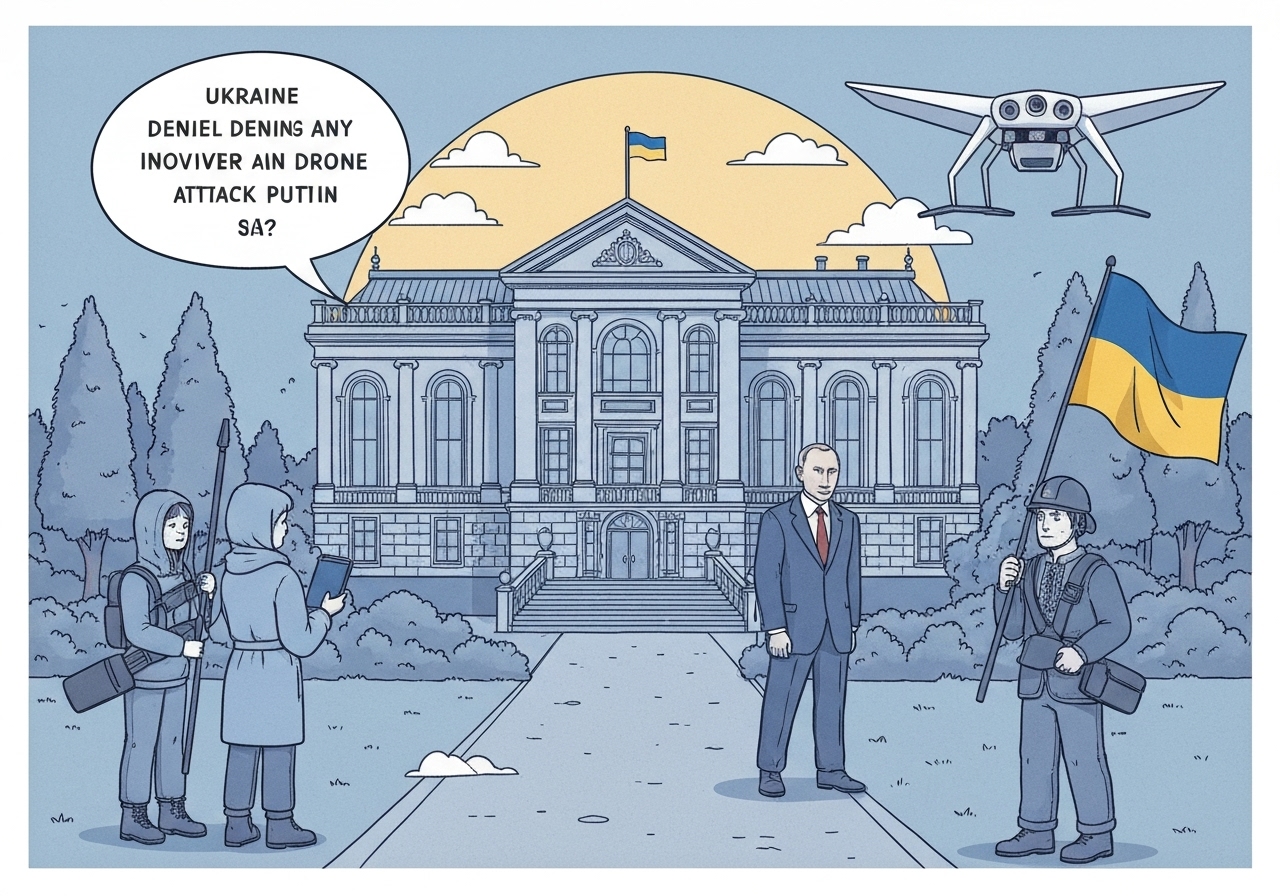
Ukraine’s president Volodymyr Zelensky has rejected Russian claims that Kyiv launched a drone strike on a presidential residence in the Novgorod region overnight, calling the allegation false and politically motivated. Russia’s foreign minister, Sergey Lavrov, said 91 long-range unmanned aerial vehicles were intercepted and destroyed and warned Moscow would re-evaluate its negotiating stance. Kyiv described the report as a pretext to undermine recent US‑Ukraine peace talks held in Florida, where leaders discussed a revised plan. It remains unclear where President Vladimir Putin was at the time and independent verification of the incident is not available.
Key takeaways
- Russia’s foreign minister said 91 long-range UAVs targeted Putin’s state residence in Novgorod and were intercepted with no reported casualties or damage.
- President Zelensky dismissed the allegation as “typical Russian lies” and accused Moscow of using the claim to derail peace negotiations.
- The assertion followed US‑Ukraine talks in Florida where leaders discussed a revised peace plan and a proposed 15-year US security guarantee for Ukraine.
- Moscow said it will revise its negotiating position but also reported it does not intend to exit talks with the United States.
- Yuri Ushakov, a Kremlin foreign-policy aide, said the alleged strike occurred shortly after what the US described as a productive round of talks.
- President Trump told reporters he was informed by Putin and said he was “very angry,” while adding verification of the event was still pending.
- Russia controls roughly 75% of Donetsk and about 99% of Luhansk; the future of Donbas remains a central unresolved issue in negotiations.
Background
The claim comes amid intensive diplomacy: US and Ukrainian officials met in Florida to discuss a revised peace framework that would include a 15-year security guarantee for Kyiv. High-level exchanges have intensified in recent weeks as negotiators seek a pathway to de-escalation, but positions on territorial questions remain far apart. Russia has repeatedly rejected key elements of proposals under discussion, particularly around the status of Donbas and security arrangements that would limit Moscow’s influence.
Throughout the war, Moscow and Kyiv have frequently traded allegations of strikes, sabotage and staged incidents; independent verification inside Russia is often limited by access restrictions and state media control. Novgorod region houses several official residences used by senior Russian officials, making any reported attack on such a site exceptionally sensitive. The pattern of immediate political responses to alleged incidents has in the past shaped diplomatic momentum.
Main event
On Monday, Sergey Lavrov publicly stated that 91 long-range UAVs had been launched at a presidential residence in Russia’s northwestern Novgorod region and that all were intercepted by air-defence systems, with no casualties or damage reported. He framed the action as evidence that Kyiv has adopted “state terrorism,” and said Russia would reassess its negotiating stance as a consequence. Lavrov’s comments were distributed via Russian channels and reported by state media.
Kyiv responded swiftly. President Zelensky characterized the report as a fabricated pretext to discredit Ukrainian diplomacy and justify further military action, noting prior Russian strikes on Kyiv government buildings. On social media, Zelensky urged the international community not to remain silent, arguing that allowing such claims to stand unchallenged would undermine peace efforts.
The allegation arrived after the Florida talks between US and Ukrainian delegations, where both sides described progress on some elements of a plan and discussed security guarantees. Kremlin aide Yuri Ushakov told reporters the alleged incident occurred almost immediately after what the United States considered a successful round of talks, and said President Putin informed US President Trump about the claim during a phone call.
Analysis & implications
If the claim is accurate, an attempted strike on a presidential residence would mark a notable escalation and could harden Moscow’s negotiating posture, as indicated by Lavrov. Russia’s immediate framing of the event as evidence of Ukrainian “state terrorism” is likely aimed at justifying both a tougher stance in talks and a domestic narrative of external threat. Conversely, if the allegation is false or overstated, Moscow’s announcement could be used tactically to deflect attention from diplomatic concessions or operational setbacks.
The timing — coming after high‑level US‑Ukraine discussions — magnifies diplomatic consequences. Officials in Washington will weigh Moscow’s claim in the context of bilateral communications with both Kiev and Moscow; public statements by the US president describing shock and anger signal potential short‑term strain in US engagement with Ukraine’s leadership. That friction may affect momentum on security guarantees under negotiation.
On the battlefield, tightened rhetoric could translate into renewed offensive or defensive operations that complicate humanitarian access and civilian safety. For Ukraine, allegations of an attack on Russian soil could be exploited by Moscow to seek broader international tolerance for retaliatory measures. For third-party mediators, credibility will depend on transparent verification, which is currently absent.
Comparison & data
| Region | Estimated Russian control |
|---|---|
| Donetsk | ~75% |
| Luhansk | ~99% |
These control estimates contextualize why Donbas remains a central, unresolved issue: Moscow holds most of Luhansk and large parts of Donetsk, making territorial negotiations both politically and militarily fraught. The Florida talks reportedly advanced some security-pledge elements but left territorial status and the Zaporizhzhia nuclear plant unresolved, sustaining a major obstacle to a comprehensive agreement.
Reactions & quotes
Russian officials framed the incident as proof of Kyiv’s escalation and a reason to recalibrate diplomatic engagement.
“All 91 drones were intercepted and destroyed; there are no reports of casualties or damage.”
Sergey Lavrov / Russian Foreign Ministry (as reported)
Ukraine and its Western partners rejected the Moscow account and warned against allowing such claims to derail negotiations.
“Typical Russian lies,”
Volodymyr Zelensky (social media)
US reactions were mixed in public remarks, reflecting concern about the claim’s implications for talks and the need for verification.
“I was told about it by President Putin; I am very angry,”
President Donald Trump (press briefing)
Unconfirmed
- Independent verification that 91 long-range UAVs were launched toward the Novgorod residence is not available from open, impartial sources.
- Confirmed location of President Putin at the time of the alleged incident has not been publicly established.
- Forensic evidence of intercepted UAV wreckage or third-party radar tracks has not been released for independent review.
Bottom line
The episode exemplifies how battlefield claims can spill into diplomacy: Moscow’s assertion, whether accurate or not, immediately affected the public tone of negotiations and raised questions about the future of talks. Without transparent, independent verification, external actors face a choice between accepting state accounts or insisting on corroboration — a decision that will shape diplomatic responses in the near term.
For observers, the key developments to watch are any release of verifiable evidence, changes in Moscow’s stated negotiating position, and how Washington calibrates its support for Kyiv amid competing assessments. Absent clear proof, the claim should be treated as politically consequential but not yet established fact.
Sources
- BBC News — international news outlet reporting on the claims and responses (media).
- TASS — Russian state news agency reporting Lavrov’s statements (state media).
- White House Briefing Room — official US government statements and briefings (official).