
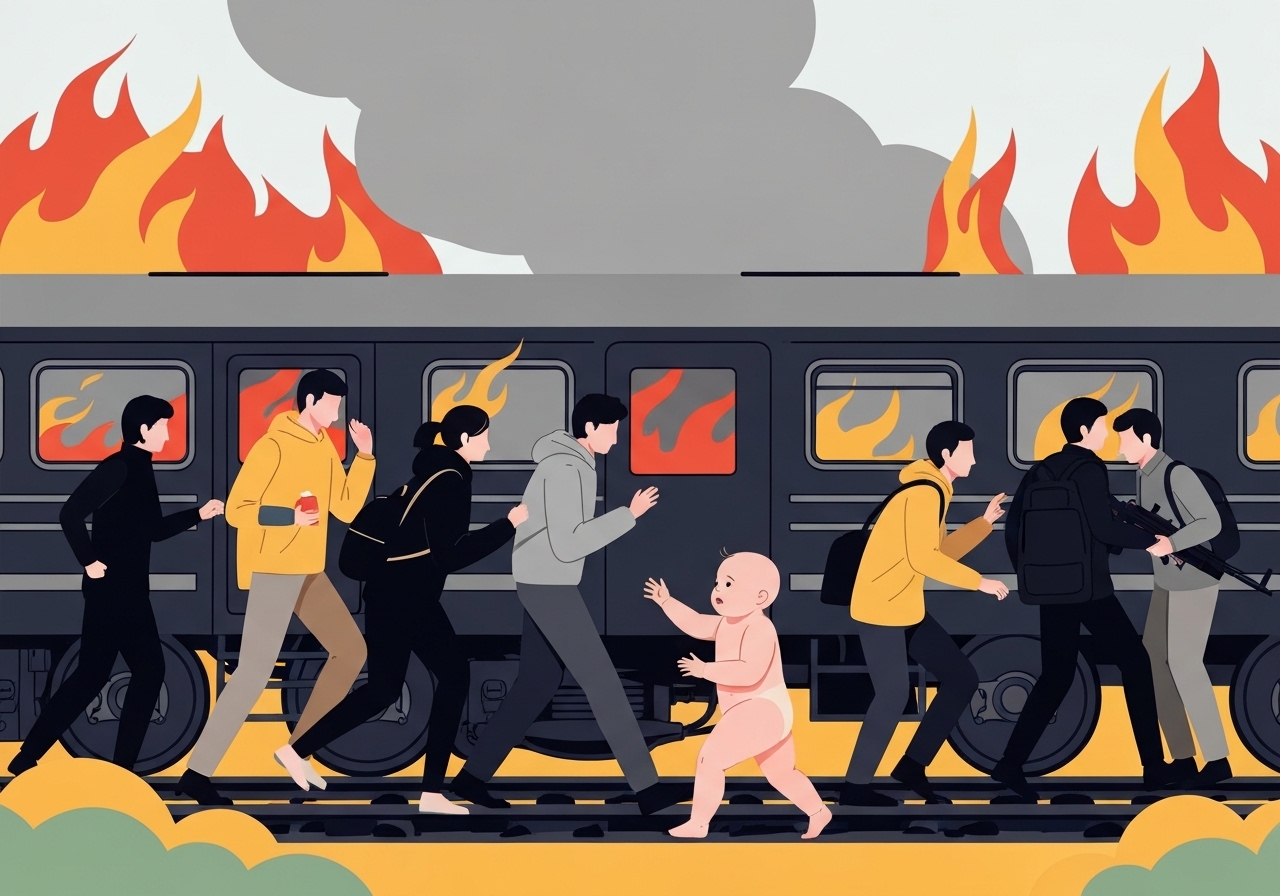
On Wednesday, graphic video verified by independent investigators showed passengers fleeing a burning long-distance passenger train after a drone strike in Kharkiv region, eastern Ukraine. The service had departed Chop and was bound for Barvinkove when a carriage was struck; President Volodymyr Zelensky said three drones were involved and called the attack an act of ‘terrorism’. Officials reported at least five people killed, about 200 passengers on board and 18 people inside the hit carriage. Emergency teams, a war crimes prosecutor and investigators were at the scene as footage circulated online.
Key takeaways
- At least five people were killed in the drone strike on a passenger train in Kharkiv region on Tuesday; casualty figures remain provisional pending investigation.
- About 200 people were on the train on the Barvinkove–Lviv–Chop route; President Zelensky said 18 people were inside the carriage that was hit.
- President Zelensky described the incident as ‘terrorism’ and said there was no ‘military justification’ for targeting civilians.
- Verified images and video show a carriage ablaze, blistered paint and smoke, and passengers evacuated into nearby woods in snow.
- Investigators and a war crimes prosecutor attended the scene; Ukrzaliznytsia branding identifies the train as part of Ukrainian Railways’ fleet.
- Russia has not issued a public comment on the strike as of the latest reporting; attribution remains subject to formal confirmation.
- BBC Verify teams confirmed the footage surfaced online yesterday and was not created using AI tools.
Background
Since the full-scale invasion of Ukraine in 2022, attacks on civilian infrastructure — including energy and transport nodes — have been a recurring feature of the conflict, particularly in eastern and southern regions. Rail services have been used throughout the war to move people and goods away from front lines, and long-distance routes linking western border towns such as Chop to interior destinations have remained important for evacuation and civilian mobility. Kharkiv region, situated near active front-line sectors, has seen heightened hostilities and periodic missile and drone strikes targeting both military and civilian sites.
The use of unmanned aerial vehicles and precision-guided munitions has expanded the footprint of strikes beyond traditional battlefields, increasing risks for passenger services that travel near contested areas. International humanitarian law prohibits deliberate attacks on civilians and civilian objects, and prosecutors have signaled that incidents affecting non-combatants will be examined under war crimes frameworks. Ukrainian authorities, railway operators and international monitoring groups have documented previous strikes affecting transport corridors and emphasised the challenge of protecting moving civilian targets.
Main event
Video that circulated online late on Tuesday shows a carriage of a crowded passenger train on fire, with passengers escaping into a nearby wooded area amid falling snow. In one clip visible to investigators, a woman carrying a baby is led away from the burning carriage, an image that has been widely shared by broadcasters and social platforms. The train reportedly originated in Chop and was travelling toward Barvinkove, approximately 65 km from the front line, when the strike occurred.
Local emergency services and rescuers arrived and worked to extinguish flames; later images released by regional authorities show blistered paint and heavy smoke damage on the affected carriage, suggesting exposure to very high temperatures. President Zelensky reported three drones were involved and said there was no military reason to target the service, while officials confirmed that at least five people had died and many more were injured or traumatised. Ukrzaliznytsia markings on the carriage indicate it is part of Ukraine’s state railway operator; investigators were able to confirm the footage was authentic and not AI-generated.
Russian authorities had not publicly commented on the incident at the time of reporting. A war crimes prosecutor was reported to be present at the scene to collect evidence, and regional investigators opened inquiries into the circumstances of the strike and casualty figures. Passengers continued to be assisted by emergency teams and local volunteers, and rail services in the corridor were disrupted as authorities secured the site and carried out initial forensic work.
Analysis & implications
The attack on a civilian passenger train amplifies concerns about the growing reach of aerial strikes into transport networks that serve non-combatants. Even where front lines are relatively distant, drones and loitering munitions can reach intercity services, complicating efforts to keep evacuation and civilian mobility routes safe. The presence of families and children on board underlines the humanitarian stakes and will likely increase international pressure for accountability and protective measures for civilian transport.
From a legal perspective, prosecutors attending the scene signal an intent to document evidence that could support future war crimes inquiries. Establishing responsibility and intent will depend on forensic analysis of munition fragments, flight paths and command-and-control data, which can be time-consuming and politically sensitive. Attribution matters not only for legal recourse but also for diplomatic and military responses; the absence of an immediate comment from the Russian side leaves a evidentiary gap that investigators will need to close.
Operationally, the strike may prompt Ukrainian rail authorities and civil protection agencies to review routing, detection and protection measures for passenger services in proximity to contested airspace. International actors providing air-defence or radar detection assistance could be asked to prioritise protection for civilian corridors. The attack also risks further eroding cross-border transit confidence and could have secondary effects on refugee movements and logistics in western and central Ukraine.
Comparison & data
| Metric | Reported value |
|---|---|
| Reported fatalities | At least 5 |
| Passengers on train | About 200 |
| People in hit carriage | 18 (per President Zelensky) |
| Distance from front line (Barvinkove) | Approximately 65 km |
These figures are those reported by Ukrainian authorities and by independent verification teams at the time of publication. Casualty and passenger counts often change as investigators complete searches, identify victims and cross-check manifests. Comparing this incident with earlier strikes on transport infrastructure shows a pattern of increased risk to civilian mobility when unmanned aerial systems are used in populated corridors.
Reactions & quotes
Ukrainian leadership framed the incident as an attack on civilians and demanded accountability while investigators documented the scene. The president’s office highlighted the lack of military targets on the train route and emphasised the humanitarian impact.
“There was no ‘military justification’ in targeting civilians.”
President Volodymyr Zelensky
Independent verification teams that examined the footage focused on authenticity and the origins of the clips. Their work aimed to confirm that the material circulating online reflected the actual event and had not been manipulated by synthetic media tools.
“We confirmed that the footage surfaced online yesterday and was not created using AI tools.”
BBC Verify team
Unconfirmed
- Attribution: no official Russian comment had been made; responsibility for the strike was not independently confirmed at the time of reporting.
- Exact location: while the train route and general area are known, the precise stop or coordinates where the carriage was hit have not been fully disclosed by investigators.
- Final casualty and identity lists: numbers of injured, missing or later-identified victims may change as authorities complete their inquiries.
Bottom line
The verified footage of passengers, including a woman with a baby, fleeing a burning carriage crystallises the human cost when aerial weapons strike civilian transport. Immediate forensic work and legal documentation are under way; investigators and a war crimes prosecutor attended the scene to gather evidence. The event underscores the vulnerability of civilian movement in conflict zones and will likely prompt calls for enhanced protection of transport corridors and for accountability.
For the public and policymakers, the priority is twofold: ensure timely care and support for victims and families, and secure rigorous, transparent investigations that can establish what happened and who is responsible. The broader implications extend to how states, international organisations and humanitarian actors adapt protections for civilian transport in an era of proliferating drone capabilities.
Sources
- BBC Live reporting — news media (live reporting and verification)