
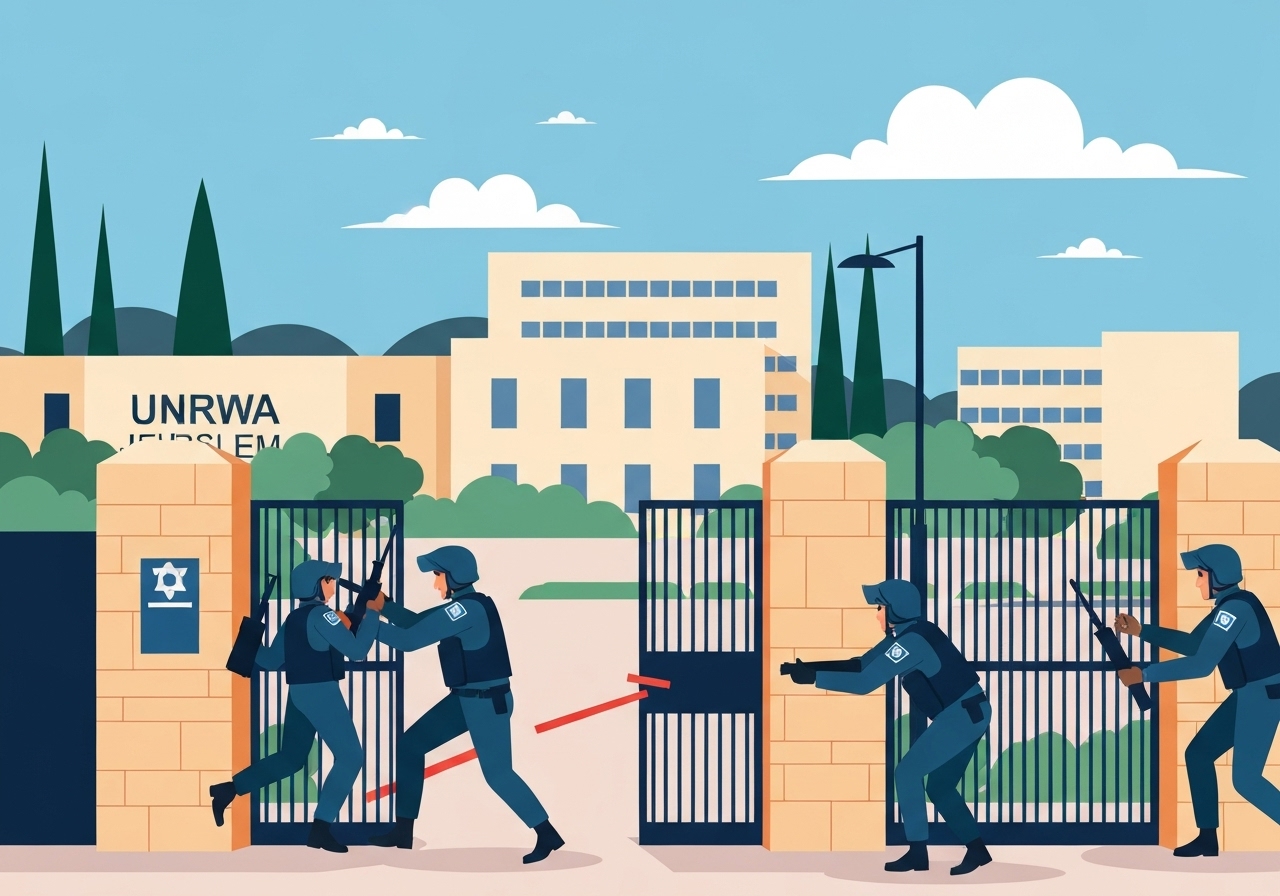
Early Monday in east Jerusalem, Israeli police entered the compound of the United Nations Relief and Works Agency for Palestinian Refugees (UNRWA) in the Sheikh Jarrah neighborhood, the agency said, escalating a months‑long campaign after Israel banned UNRWA from operating on its territory. UNRWA described the incursion as an unauthorized, forceful breach of the agency’s privileges and immunities; Israeli authorities said the action was linked to a municipal “debt‑collection procedure.” The episode comes as U.S. and Israeli officials meet to advance a U.S.‑drafted Gaza plan and as President Donald Trump is due to meet Prime Minister Benjamin Netanyahu on Dec. 29 to discuss next steps.
Key Takeaways
- UNRWA reported that “sizable numbers” of Israeli forces, including officers on motorcycles, trucks and forklifts, entered its east Jerusalem compound in Sheikh Jarrah early Monday.
- The agency serves roughly 2.5 million Palestinian refugees in Gaza, the occupied West Bank and east Jerusalem, plus about 3 million more in Syria, Jordan and Lebanon.
- Israel says it banned UNRWA from operating on Israeli territory in January (following the Oct. 7, 2023 conflict) and has accused the agency of links to militants; UNRWA and the U.N. deny systemic involvement.
- Photos from the scene show police vehicles and an Israeli flag erected on the compound; UNRWA staff provided images of officers inside the grounds.
- Israel described the entry as tied to a Jerusalem municipal debt‑collection action; the municipality did not immediately respond to requests for comment.
- The U.S. halted its major funding for UNRWA in early 2024; other U.N. agencies have filled some gaps for aid delivery in Gaza.
- Separately, Israel began construction of a 50‑mile (80‑km) barrier on the Jordan border; the broader eastern border project will cover about 310 miles (500 km) at an estimated cost of $1.7 billion.
Background
UNRWA was created to assist the roughly 700,000 Palestinians who fled or were displaced during the 1948 war surrounding the creation of the State of Israel; the agency’s mandate has since extended to their descendants across multiple countries. Over decades UNRWA has delivered education, health and social services across Gaza, the West Bank and refugee‑hosting states in the region, becoming a central institution for Palestinian displacement and humanitarian needs.
Following the Oct. 7, 2023 Hamas attack and Israel’s subsequent military campaign, UNRWA became a primary aid conduit for Palestinians in Gaza. Israeli officials have repeatedly accused the agency of being penetrated by militants and of misuse of facilities and aid—claims the U.N. and UNRWA have denied and which outside investigators have struggled to substantiate publicly. Israel’s domestic politics, in particular pressure from right‑wing figures, have intensified scrutiny of UNRWA and led to the January ban on its operations within Israel.
Main Event
UNRWA said early Monday that large numbers of Israeli police entered its compound in Sheikh Jarrah using motorcycles, trucks and forklifts; staff photos and an Associated Press photographer’s images showed police vehicles outside and an Israeli flag placed on the compound. The agency called the action an “unacceptable violation” of U.N. privileges and immunities and stressed that its personnel were carrying out humanitarian work when the incursion occurred.
Israeli police released a brief statement describing the entry as part of a “debt‑collection procedure” initiated by Jerusalem’s municipal government. The municipality did not immediately answer media requests for further explanation. UNRWA officials said they were not informed of any formal legal process authorizing such an entry and said the move hindered their ability to operate in the neighborhood.
The operation follows months of escalating Israeli measures against UNRWA, which culminated in a ban on its activity on Israeli territory. That ban and related funding cuts—including the U.S. suspension of major contributions in early 2024—have forced other U.N. agencies and international groups to attempt to plug gaps in Gaza aid delivery amid ongoing reconstruction and humanitarian needs.
Analysis & Implications
The forcible entry into UNRWA’s compound deepens a standoff with potential legal and diplomatic consequences. As a U.N. agency, UNRWA claims privileges and immunities under international practice; a forceful domestic intervention raises questions about Israel’s adherence to those protections and could prompt formal U.N. responses or legal challenges.
Operationally, the raid compounds an already severe capacity shortfall for Gaza aid. UNRWA’s resources and staff have been central to food, shelter and health services for millions; the U.S. funding freeze and Israel’s restrictions have forced reliance on the World Food Program, UNICEF and other actors, which have limited reach and different mandates.
Politically, the incident will reverberate in both Israeli domestic debates and international forums. Within Israel, hard‑line elements view curbs on UNRWA as part of long‑term policy to remove Palestinian refugee claims from Israeli responsibility; internationally, many governments and humanitarian organizations warn that dismantling UNRWA would create a service vacuum and complicate any stabilization plan for Gaza.
For ceasefire negotiations and the U.S.‑brokered Gaza plan, the episode raises the prospect that trust deficits and operational limitations could slow reconstruction and governance arrangements. If UNRWA is sidelined during a transition to new administrative structures in Gaza, planners will need explicit alternatives for education, health and registration services to avoid further destabilization among displaced populations.
Comparison & Data
| Item | Figure |
|---|---|
| Palestinians served by UNRWA (Gaza/West Bank/east Jerusalem) | ~2.5 million |
| Palestinians served by UNRWA (Syria, Jordan, Lebanon) | ~3 million |
| People killed in initial Hamas attack (Israel) | ~1,200 |
| People abducted on Oct. 7, 2023 | ~251 |
| Palestinians killed in Gaza (Gaza Health Ministry) | 70,360 |
| Border barrier initial segment | 50 miles / 80 km |
| Total eastern border upgrades planned | 310 miles / 500 km; est. $1.7 billion |
The table aggregates figures quoted by parties to the conflict and official statements in public briefings. Casualty counts for Gaza are reported by the Gaza Health Ministry and are treated here as the official local tally cited by international bodies; such figures do not differentiate civilians from combatants in the ministry’s reporting.
Reactions & Quotes
UNRWA condemned the action as a breach of its U.N. status and warned of operational disruption. The agency has repeatedly highlighted the scale of needs in Gaza and the risk of a service vacuum if it is prevented from operating.
“The unauthorized and forceful entry by Israeli security forces is an unacceptable violation of UNRWA’s privileges and immunities as a U.N. agency.”
UNRWA statement
Israeli officials characterized the entry differently and linked it to municipal procedures; they have publicly alleged security concerns involving the agency, though evidence provided publicly has been limited. The Israeli government has said it will press ahead with measures it deems necessary to address perceived threats.
“The operation related to a debt‑collection procedure initiated by Jerusalem’s municipal government,”
Israeli police statement
UNRWA’s director of external relations warned that sidelining the agency would leave a gap few organizations are equipped to fill quickly. International aid coordinators have already reported strain as U.N. agencies and NGOs redistribute resources in response to restrictions and funding shortfalls.
“If you squeeze UNRWA out, what other agency can fill that void?”
Tamara Alrifai, UNRWA
Unconfirmed
- Publicly released evidence substantiating Israel’s claims that UNRWA facilities were systematically used by Hamas is limited; those allegations remain contested and underreported by independent investigators.
- The exact legal basis, internal municipal documents or court orders authorizing the “debt‑collection procedure” and the scope of that authority have not been made public at the time of reporting.
- The reported meeting between President Trump and Prime Minister Netanyahu on Dec. 29 was announced without a confirmed venue; the meeting location had not been disclosed.
- Reports that remains of a specific hostage are to be returned have been described by Hamas and other officials as pending; independent confirmation is lacking at this stage.
Bottom Line
The forcible entry into UNRWA’s Sheikh Jarrah compound marks a significant escalation in Israel’s measures against the agency and raises immediate legal, operational and political questions. For the many Palestinians who rely on UNRWA for basic services, the incident heightens uncertainty about the continuity of aid during a fragile post‑conflict period.
Internationally, the move is likely to deepen diplomatic tensions: supporters of UNRWA warn of a humanitarian gap, while Israeli authorities argue national security and domestic policy imperatives justify tougher oversight. The coming weeks—shaped by U.S.‑brokered negotiations and the Dec. 29 meeting between U.S. and Israeli leaders—will be decisive for whether alternatives to UNRWA are formalized and how civilian assistance in Gaza is administered.