
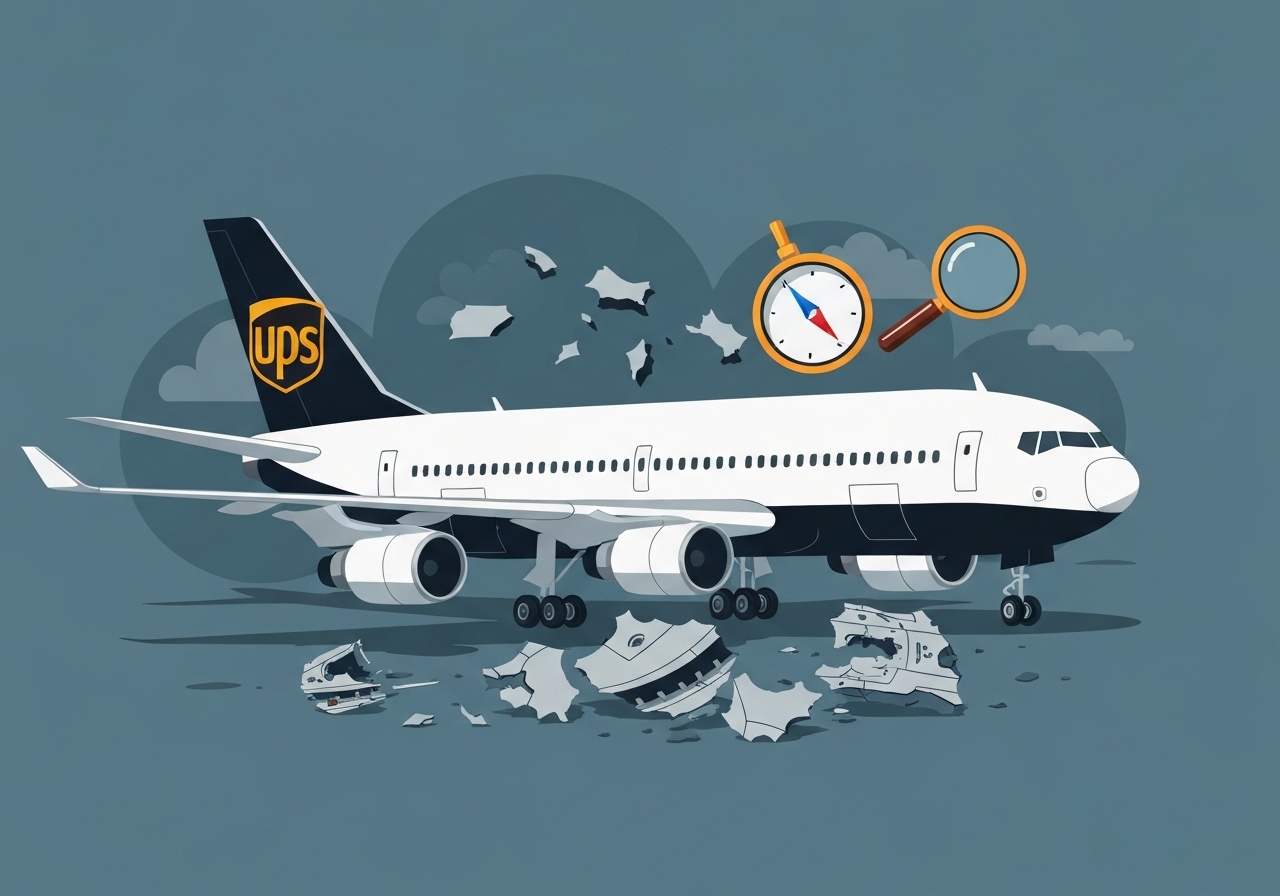
Lead: On Nov. 4, 2025, a UPS MD-11 cargo jet departing Louisville, Kentucky, lost its left engine shortly after rotation and crashed into nearby industrial buildings, killing 15 people. The National Transportation Safety Board (NTSB) said Boeing had documented in 2011 that the spherical bearing race used to secure MD-11 engines had failed on four prior occasions across three aircraft, but at that time Boeing did not classify the issue as a safety-of-flight condition. Investigators recovered a bearing broken into two pieces and found cracked lugs on the mount; the aircraft had last undergone a close inspection in October 2021 and was scheduled for its next detailed check after roughly 7,000 takeoffs and landings. The factual report released by the NTSB so far stops short of identifying a single cause and leaves final conclusions to the board’s forthcoming final report.
Key Takeaways
- The crash occurred Nov. 4, 2025, near Louisville’s Muhammad Ali International Airport and killed three crew members and 12 people on the ground, totaling 15 fatalities.
- NTSB records show Boeing documented four earlier failures of the MD-11 engine mount spherical bearing on three aircraft in 2011, but did not then call it a safety-of-flight condition.
- Investigators found the bearing fractured into two pieces and cracked lugs after the November accident; the aircraft’s last close inspection of those parts was October 2021.
- The MD-11 involved was 34 years old and reached only about 30 feet (9.1 meters) before crashing into industrial buildings, producing a large fireball visible for miles.
- Boeing’s 2011 service bulletin recommended a redesigned bearing but did not mandate replacement; the FAA did not issue an airworthiness directive requiring fixes.
- All active MD-11s and 10 related DC-10s were grounded following the crash; cargo carriers had continued to operate older MD-11 freighters because of cost factors.
- The incident echoes a 1979 DC-10 in Chicago where a left engine separated during takeoff and killed 273 people, underscoring long-standing concerns about this family of aircraft.
Background
The MD-11 traces its lineage to the McDonnell Douglas DC-10; many MD-11 fuselages and systems were carried over from earlier designs. McDonnell Douglas was acquired by Boeing in the late 1990s, and legacy service information from McDonnell Douglas has since been administered by Boeing. Cargo operators such as UPS and FedEx continued to use aging MD-11 freighters after passenger airlines retired them because the freighters remained economically useful despite lower fuel efficiency.
In 1979 an American Airlines DC-10 lost a left engine during takeoff in Chicago, killing 273 people and prompting the temporary worldwide grounding of DC-10s. Investigators later found maintenance damage had contributed to that crash, and the type returned to service after corrective steps. Over the decades, a series of incidents and service advisories have flagged vulnerabilities in the engine-mount and bearing systems on the DC-10/MD-11 family, but regulators and manufacturers have differed over whether issues rose to the level of mandatory repair directives.
Main Event
On Nov. 4, 2025, the UPS MD-11 accelerated, rotated and climbed to about 30 feet (9.1 meters) before the left engine separated and the aircraft rolled, ignited and struck industrial buildings just beyond the runway. NTSB photo releases show flames as the engine began to detach and then travel above the wing as the wing itself became engulfed in fire. Emergency response and recovery followed; companies and investigators worked at the scene while the NTSB secured wreckage for analysis.
NTSB investigators reported finding the spherical bearing race broken into two pieces and noted cracks in the lugs that carry load between engine and wing. Those cracks were not identified in routine maintenance inspections prior to the accident. The NTSB factual report states the agency is focusing on the bearing failure but does not assign a final probable cause pending the full investigation.
The 34-year-old freighter had last undergone a detailed inspection of the engine-mount area in October 2021. According to the factual report, the aircraft was not scheduled for another in-depth inspection of those components until after roughly 7,000 additional takeoff-and-landing cycles, raising questions about whether the inspection interval was adequate for older airframes.
The NTSB also noted Boeing had documented earlier failures of the same bearing in 2011 and had issued a service bulletin recommending a redesigned part; that bulletin did not require operators to replace older bearings with the redesign and the FAA did not issue a mandatory airworthiness directive in response.
Analysis & Implications
The 2011 Boeing documentation of four prior bearing failures creates a central line of inquiry: whether the manufacturer’s assessment and the regulatory response were sufficient to prevent catastrophic outcomes. Service bulletins are advisory and often rely on operators to assess risk and implement fixes; by contrast, an FAA airworthiness directive would compel compliance. The difference matters legally and operationally, and it will be a focal point in civil litigation already underway.
For regulators, the crash tests the balance between prescriptive mandates and operator discretion on aging fleets. If the NTSB and subsequent litigation establish that the bearing failures were a known systemic risk, the FAA may respond with expanded inspection requirements or directives for similar airframes worldwide. Airlines and cargo operators could face increased maintenance costs and operational disruptions if governing authorities shorten inspection intervals or require retrofits.
Economically, cargo carriers that relied on lower-cost older freighters may need to accelerate retirements or invest in retrofits. That would ripple into the cargo market through aircraft availability, lease rates and freight capacity. Internationally, regulators in other jurisdictions typically observe FAA actions; an FAA directive would likely prompt coordinated responses from EASA and other civil aviation authorities.
Comparison & Data
| Year | Model | Fatalities | Immediate Action |
|---|---|---|---|
| 1979 | DC-10 | 273 | Temporary worldwide grounding; review of maintenance practices |
| 2025 | MD-11 | 15 | Grounding of active MD-11s and 10 related DC-10s; NTSB investigation |
The two events are separated by decades but share a common mechanic: in both cases an engine separated during or shortly after takeoff. The 1979 DC-10 grounding followed maintenance findings; the 2025 MD-11 case revolves around whether earlier service guidance and inspection practices sufficiently addressed bearing vulnerability. The table above summarizes immediate regulatory and operational responses; any long-term policy changes will depend on the NTSB’s final determinations and potential FAA directives.
Reactions & Quotes
UPS expressed sorrow and said it was focused on recovery efforts; the company has limited public comment while the investigation continues. The statement underscores the operator’s constrained role during an active federal investigation.
“We remain profoundly saddened by the Flight 2976 accident.”
UPS spokesperson Jim Mayer
Legal advocates for crash victims have already asserted that warning signs existed well before the accident and that operators should have acted. Plaintiffs’ counsel argue earlier documentation and service recommendations should have prompted more definitive action.
“There were warning signs that predated the crash that any reasonable organization should have utilized to make sure the Louisville crash didn’t happen.”
Brad Cosgrove, attorney
Former investigators have questioned why a 1980 McDonnell Douglas service bulletin had previously characterized similar bearing failures as a safety-of-flight condition and why Boeing’s 2011 guidance did not. Those technical disagreements are central to both regulatory review and litigation strategy.
“It raises questions regarding the adequacy of the severity of the 2011 service letter, and how UPS incorporated that information and acted upon it.”
Jeff Guzzetti, former FAA/NTSB investigator
Unconfirmed
- Whether additional documented failures of the spherical bearing race occurred after 2011 but before the 2025 crash remains unspecified in the NTSB factual report.
- The precise moment cracks began developing in the bearing and lugs is not established; investigators have not yet reported a definitive initiation mechanism.
- It is not yet confirmed whether maintenance procedures available to UPS would have detected the specific crack pattern under routine checks prior to October 2021.
Bottom Line
The NTSB factual report highlights a fractured spherical bearing and previous manufacturer documentation of similar failures, but it stops short of a final causal finding. The 2011 Boeing bulletin that documented earlier failures without declaring a safety-of-flight condition, and the absence of an FAA airworthiness directive, will be scrutinized by investigators, regulators and courts.
Watch for the NTSB’s final probable-cause report, anticipated more than a year after the accident, and possible FAA actions that could include mandatory inspections or retrofits for related airframes. Meanwhile, litigation and regulatory reviews are likely to accelerate policy debates over the continued use and maintenance standards for aging cargo aircraft.
Sources
- AP News (news report summarizing NTSB factual release)
- National Transportation Safety Board (NTSB) (federal investigative agency)
- Boeing (aircraft manufacturer)
- Federal Aviation Administration (FAA) (U.S. regulator)
- UPS Pressroom (operator statements)