
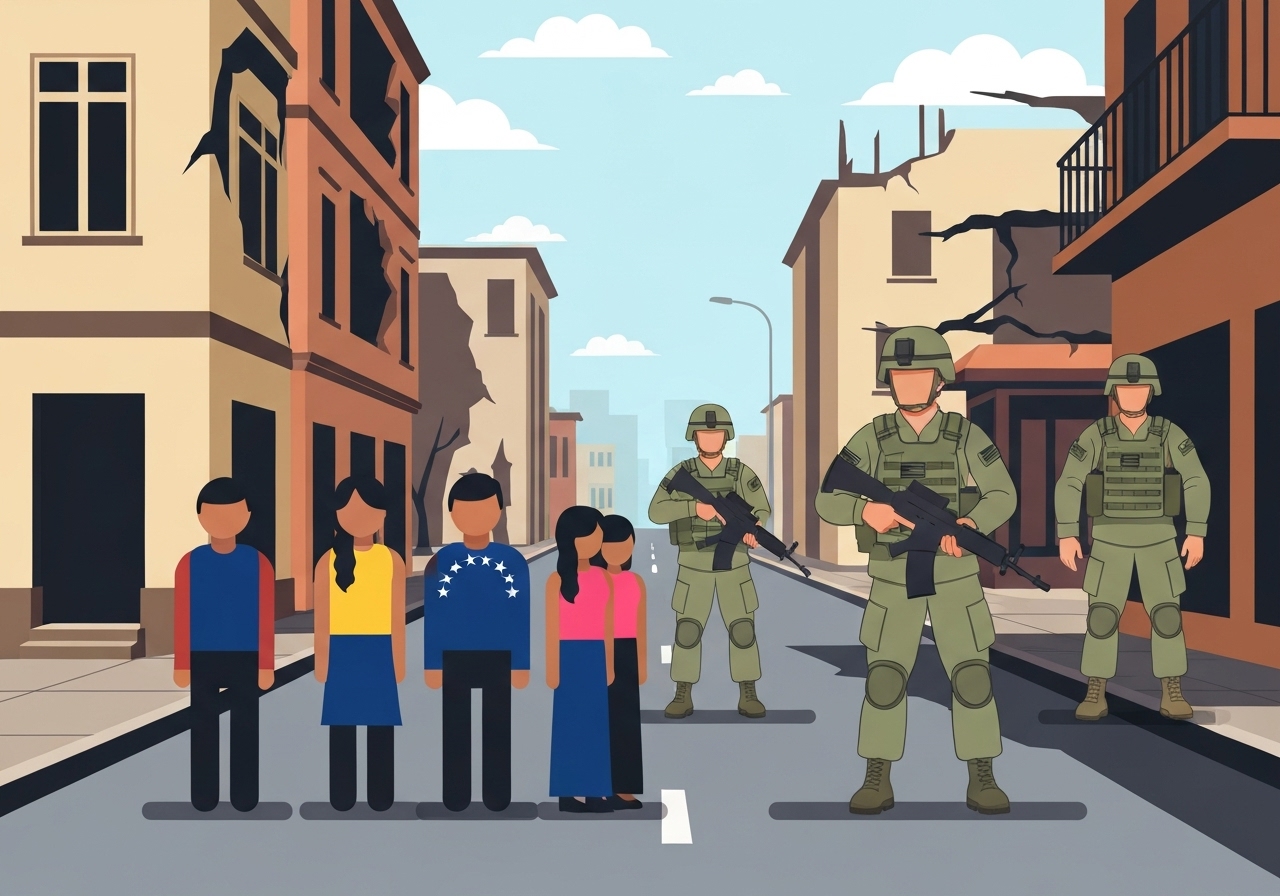
Lead: On January 3, 2026, President Donald Trump announced that U.S. forces had executed a “large-scale strike” in Venezuela and captured President Nicolás Maduro and his wife, Cilia Flores. The claim followed early-morning explosions in Caracas and images of smoke and fire in the night sky. Trump and U.S. officials said the operation relied on intelligence from the CIA and was supported on the ground by elite U.S. units; some Americans were reported wounded but U.S. leaders said there were no U.S. deaths. Authorities also unsealed a New York indictment accusing Maduro of leading a narco-terrorism conspiracy.
Key Takeaways
- On January 3, 2026, explosions were reported in Caracas around 2:00 a.m. local time; President Trump announced the capture at about 4:30 a.m. on his social platform.
- Trump said the operation involved large numbers of aircraft and helicopters and that Maduro and his wife were captured and flown out of Venezuela; ABC News sources reported Maduro was being flown toward New York.
- A federal indictment unsealed the same day charges Maduro and others with narco-terrorism conspiracy, cocaine importation conspiracy and weapons offenses; six defendants were named in the indictment.
- U.S. officials said the Army’s Delta Force carried out the capture after CIA intelligence pinpointed Maduro’s location; the CIA reportedly had a clandestine team on the ground since August 2025.
- Sen. Tom Cotton and President Trump said some Americans were wounded; Cotton said there were no U.S. fatalities. A precise casualty count for U.S. personnel was not released.
- About 15,000 U.S. military personnel were reported in the Caribbean region, and the USS Gerald R. Ford carrier strike group was in the area at the time of the operation.
- International reactions were mixed: Russia condemned the action as armed aggression, Colombia’s president warned of an attack on Venezuela, while Argentina’s Javier Milei praised the move.
Background
Tensions between the United States and Venezuela intensified under the Trump administration’s hard-line policy toward President Nicolás Maduro. In November 2025 the U.S. designated Maduro as the head of a foreign terrorist organization, citing alleged ties to drug-trafficking networks; he has faced narcotics-related charges in U.S. courts since 2020. That designation increased legal and political pressure on Maduro and raised the stakes for any kinetic action.
Since 2024, the region has seen escalations including disputed Venezuelan elections, U.S. deployments to the Caribbean and targeted actions against vessels the U.S. says carried drugs. U.S. law enforcement and intelligence agencies have pursued long-running investigations into alleged state involvement in narcotics networks tied to high-level Venezuelan officials, and U.S. prosecutors in New York brought cases alleging a multi-decade criminal enterprise.
Main Event
Witnesses and journalists reported a series of loud explosions over Caracas around 2:00 a.m. on January 3, 2026, followed by images of smoke plumes and a large fireball. A few hours later, President Trump posted that U.S. forces had successfully carried out a “large scale strike” and that Maduro and his wife had been captured and flown out of the country. Trump later described the operation on Fox News as “extremely complex” with “speed and violence.”
U.S. and media sources told ABC News that the capture owed to CIA intelligence identifying Maduro’s exact location and that Army Delta Force operators executed the ground seizure. The president said U.S. forces had trained on a replica of the target compound and that special operations troops broke through reinforced doors to seize the leader in seconds.
Officials said helicopters transported Maduro to the amphibious assault ship USS Iwo Jima; Trump said Maduro would be taken to New York. Attorney General Pam Bondi said Maduro and Cilia Flores will face charges on U.S. soil, including narco-terrorism and cocaine importation counts. ABC News sources noted that defendants awaiting trial in Manhattan are commonly held at MDC-Brooklyn, though authorities did not specify Maduro’s detention location.
Analysis & Implications
Legally, bringing a foreign head of state to the United States for prosecution raises novel questions about jurisdiction, sovereign immunity defenses, and the process for trying a former sitting president in U.S. federal courts. Prosecutors will press existing indictments alleging Maduro led a narcotics enterprise; defense teams and Venezuela’s government are likely to challenge the legitimacy of both the capture and the charges.
Politically and diplomatically, the operation risks deepening rifts across the hemisphere. Russia and Caracas condemned the action as aggression, while some Latin American leaders signaled alarm about sovereignty and escalation. The unilateral seizure of a foreign leader—if confirmed as conducted by U.S. forces on Venezuelan soil—could prompt diplomatic fallout, reciprocal measures, or new alignments among regional partners.
From a security perspective, the use of elite U.S. special operators supported by clandestine CIA teams underscores a blending of law enforcement aims and military means. That approach can achieve high-value captures but carries risks: retaliatory attacks, disruption to energy and migration dynamics, and operational blowback if civilian casualties or intelligence errors emerge.
Comparison & Data
| Metric | Reported Value |
|---|---|
| U.S. personnel in region | ~15,000 |
| Reward increased for Maduro | $50 million (Aug 2025) |
| Indictment defendants named | 6 charged in narco-terrorism case |
| Reported early-morning explosions | Around 2:00 a.m. local time, Jan 3, 2026 |
The table places the operation’s reported scale alongside concrete legal and force-posture figures mentioned by U.S. officials and media sources. Those numbers help frame both operational requirements and the domestic legal pathway now likely to follow.
Reactions & Quotes
U.S. officials and lawmakers offered contrasting appraisals immediately after the news broke. House and Senate Republicans hailed the seizure as decisive, while many Democrats raised legal and constitutional concerns about authorization and precedent.
“We did have wounded personnel, but no killed,”
Sen. Tom Cotton (Senate Intelligence Committee chair)
Context: Cotton told Fox News there were casualties among Americans but, according to him, no deaths. He spoke after Trump’s early-morning announcement and framed the operation as successful despite injuries.
“They just broke in … and they got taken out in a matter of seconds,”
President Donald Trump
Context: In a Fox News interview, Trump described the assault as fast and heavily supported by air assets, emphasizing U.S. planning and training prior to the raid.
“[Maduro and Flores] will soon face the full wrath of American justice on American soil,”
Attorney General Pam Bondi
Context: Bondi said federal criminal charges will be prosecuted in the United States, pointing to the unsealed indictment that accuses Maduro of leading a narcotics conspiracy.
Unconfirmed
- Exact custody and transit route for Nicolás Maduro: U.S. officials and sources differed on whether Maduro was already in U.S. custody onshore or en route to New York; formal confirmation from Justice or the Department of Defense was not published at the time.
- Precise U.S. casualty tally and nature of injuries: officials reported wounded personnel but did not release verified numbers or details about their conditions.
- Full composition of the task force: reporting names Delta Force and CIA support, but the presence and roles of other units have not been independently verified.
- Whether explicit congressional authorization was obtained prior to the operation: lawmakers reported conversations about justification, but no public authorization document was cited.
Bottom Line
The reported capture of Nicolás Maduro marks an extraordinary moment with legal, diplomatic and security ramifications. If confirmed, the operation merges criminal prosecution aims with a high-risk kinetic seizure of a sitting head of state—an act that will be scrutinized in courts, capitals and international fora.
Key near-term developments to watch: official U.S. confirmation of custody and detention location, DOJ filings and arraignment plans in New York, responses from Venezuelan institutions and allied states (notably Russia and regional governments), and congressional scrutiny over authorization and oversight. Each will shape whether the event moves toward expedited prosecution and de-escalation or fuels broader geopolitical fallout.
Sources
- ABC News — U.S. mainstream media report detailing explosions, claims of capture and sourcing to U.S. officials (media).
- The New York Times — Reported interviews and presidential comments cited by U.S. officials (media).
- Reuters — International wire service referenced for imagery and attributions in coverage (news agency).
- Agence France-Presse (AFP) — Photo and field reporting on explosions in Caracas referenced in contemporaneous coverage (news agency).