
Lead
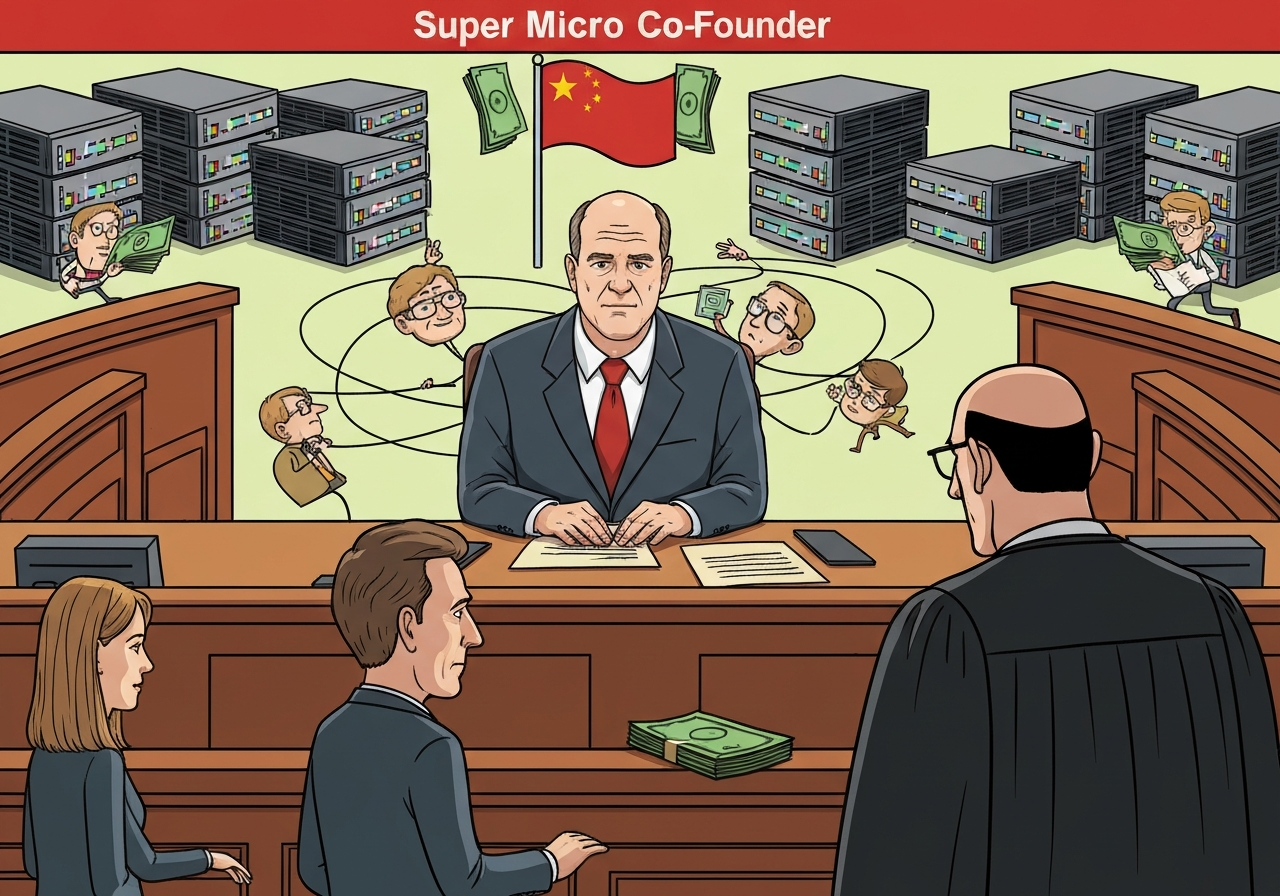
On March 19, 2026, U.S. prosecutors announced criminal charges against Yih‑Shyan “Wally” Liaw, a co‑founder of Super Micro Computer Inc., accusing him and two associates of diverting billions of dollars’ worth of Nvidia‑powered servers to China. The charges mark the most prominent U.S. enforcement action to date alleging illegal export of restricted artificial‑intelligence hardware. Super Micro shares plunged more than 20% in pre‑market trading after the charges were reported. Authorities say the equipment was routed through a Southeast Asian intermediary company before reaching China.
Key Takeaways
- The Department of Justice filed charges on March 19, 2026, against Yih‑Shyan “Wally” Liaw and two others for allegedly diverting U.S.‑assembled servers to China.
- The servers at issue were built with Nvidia chips and are described in court papers as containing advanced AI‑capable processors worth “billions of dollars.”
- Prosecutors say the defendants used a Southeast Asia company to obscure shipments that were ultimately sent to China.
- Super Micro’s stock dropped over 20% in pre‑market trading immediately after the news was reported on March 19; the report was updated on March 20, 2026.
- This case is presented by U.S. authorities as their highest‑profile prosecution targeting alleged smuggling of restricted AI technology to China.
Background
Export controls on advanced semiconductors and AI hardware have tightened in recent years as the U.S. government seeks to limit the flow of high‑performance chips and related systems to potential military end users. Nvidia GPUs and server platforms that accelerate large‑scale AI workloads have become a focal point of those controls because of their dual civilian and defense‑relevant capabilities. Companies that assemble servers in the United States are subject to export licensing and reexport rules intended to prevent the transfer of controlled technology to sanctioned destinations.
Previous enforcement actions have targeted complex supply‑chain arrangements and intermediaries in third countries used to disguise final destinations. Regulators and prosecutors have said that sophisticated routing—frequent use of shell companies, intermediaries, and reexport through friendly jurisdictions—has been a recurring method to evade controls. Manufacturers, resellers and logistics firms now face greater scrutiny, and firms operating globally must maintain robust compliance programs to identify potential diversion.
Main Event
According to the charging documents made public on March 19, 2026, Liaw and two associates allegedly sold servers assembled in the United States that contained Nvidia processors and then arranged for them to be routed through a Southeast Asian company. Prosecutors allege the defendants knew the equipment would be forwarded on to China, in contravention of U.S. export restrictions. The indictment frames the activity as an organized effort to move controlled computing power to a prohibited end user.
The filing does not specify a single final recipient in China but alleges a pattern of shipments that ultimately delivered advanced AI capability into the Chinese market. U.S. authorities highlighted the monetary scale by referencing “billions of dollars” in value tied to the diverted servers, though the indictment stops short of providing a precise aggregated dollar figure in the public summary. The case documents emphasize both the technical sensitivity of the Nvidia chips and the alleged intent to circumvent legal controls.
Market reaction was immediate: Super Micro’s shares plunged more than 20% before the market opened on March 19, reflecting investor concern over potential legal exposure and lost business. Company trading volumes spiked and sector peers briefly saw share‑price volatility as market participants reassessed supply‑chain and compliance risks tied to AI hardware sales to Asia.
Analysis & Implications
If sustained and expanded, this prosecution could raise compliance costs for server builders, resellers and logistics providers that handle GPU‑heavy platforms. Firms that assemble or integrate Nvidia‑based systems in the U.S. will likely reassess vetting, recordkeeping and end‑use checks to avoid potential criminal exposure. The case signals that the U.S. government is willing to pursue high‑profile targets when it believes controlled hardware has been diverted to restricted destinations.
For U.S. export‑control policy, the case may serve both as a deterrent and a precedent. Prosecutors are using criminal charges to underscore the seriousness of alleged circumvention; civil penalties and administrative restrictions have been the more common enforcement tools historically. A successful criminal prosecution could encourage more aggressive investigations and heighten coordination between Customs, Commerce and Justice Department units.
Geopolitically, the charges could add friction to U.S.–China technology relations and complicate supply‑chain arrangements in Asia. Companies operating across multiple jurisdictions may face conflicting commercial incentives and regulatory obligations, increasing the likelihood that intermediaries become focal points in enforcement. Over the medium term, buyers in China may seek alternate suppliers or domestically produced alternatives, accelerating efforts to indigenize certain AI hardware capabilities.
Reactions & Quotes
“The indictment alleges the defendants arranged to divert U.S.‑assembled servers with advanced chips to China by routing them through a Southeast Asian intermediary.”
U.S. prosecutors (charging documents, reported)
“Markets reacted swiftly; Super Micro’s pre‑market share drop reflected investor concern about legal exposure and future sales disruption.”
Market analysts (reported)
“The filing describes alleged schemes to obscure ultimate destinations, underscoring the enforcement focus on reexport and end‑use compliance.”
Export‑control specialist (industry commentary)
Comparison & Data
| Case | Alleged Value | Target | Status |
|---|---|---|---|
| Super Micro (Mar 19, 2026) | Billions (unspecified) | China | Criminal charges filed |
The public materials around this case emphasize the scale (described as “billions”) and the involvement of Nvidia‑powered systems. While past enforcement has produced both civil fines and criminal referrals, prosecutors here have advanced a high‑visibility criminal indictment, signaling heightened enforcement intensity.
Unconfirmed
- The exact aggregated dollar amount described as “billions” has not been specified in the public charging summary.
- Precise identities and roles of the two other charged associates beyond their association with the company are limited in publicly available documents.
- Whether any of the diverted systems were used for specific classified or military projects in China is not detailed in the charging documents available to the public.
Bottom Line
The March 19, 2026 charges against Super Micro co‑founder Yih‑Shyan “Wally” Liaw represent a landmark U.S. enforcement action alleging intentional diversion of advanced Nvidia‑based servers to China via third‑country intermediaries. The case underscores growing U.S. scrutiny of high‑performance AI hardware flows and will likely prompt companies to tighten compliance, documentation and end‑use checks.
Investors and global supply‑chain participants should expect increased enforcement attention and potential operational disruption for firms tied to GPU‑heavy server production and distribution. Over the coming months, the case’s legal developments and any sentencing or civil follow‑on actions will shape industry practice and may influence policy debates about export control scope and enforcement mechanisms.
Sources
- Bloomberg — Media: news report (March 19–20, 2026)