
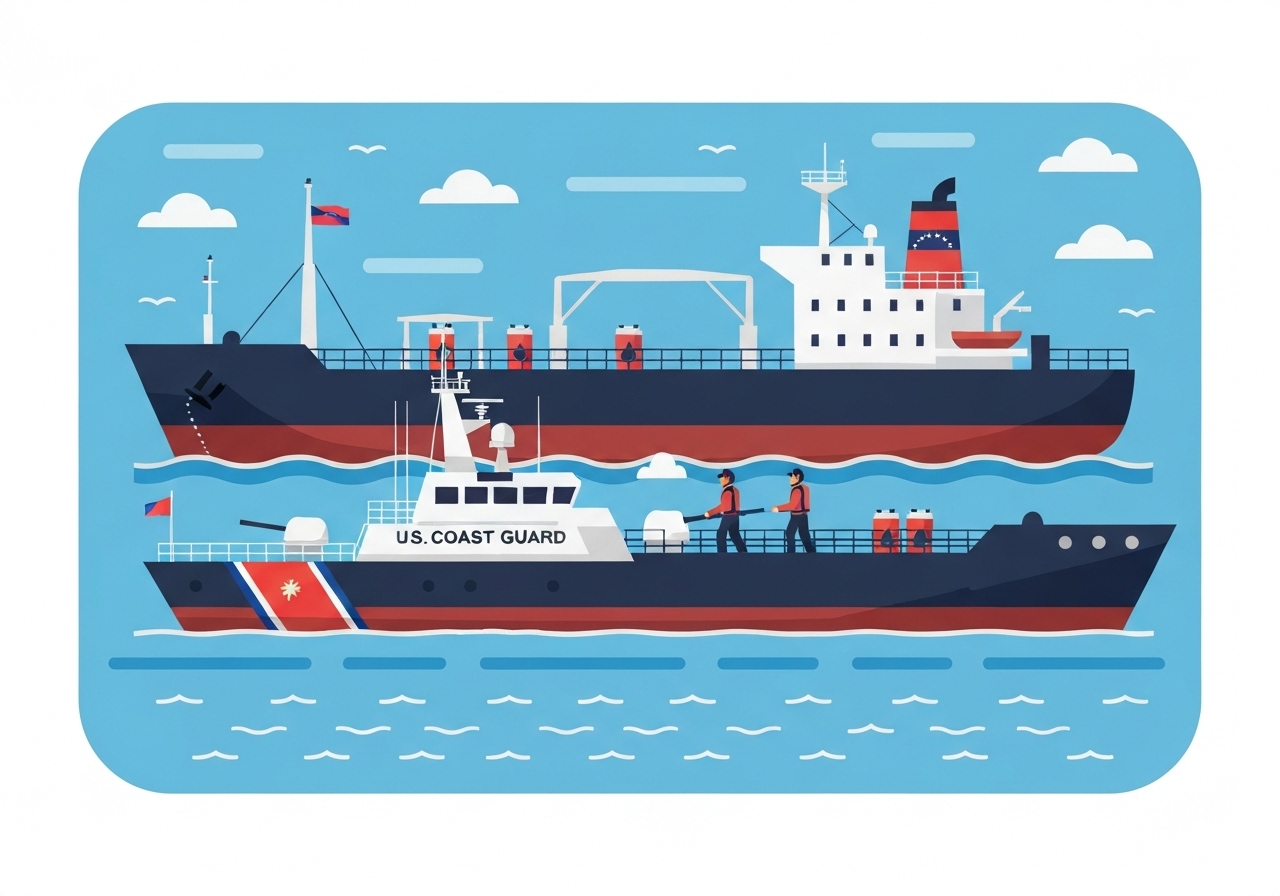
Lead: The US Coast Guard boarded a commercial tanker carrying Venezuelan crude in the eastern Caribbean this week, according to reporting by the Financial Times. The boarding team inspected the vessel, reviewed documentation and interviewed crew as part of a maritime compliance check. US authorities described the action as an enforcement operation under maritime and sanctions-related statutes. No official statement indicated that cargo was seized during the boarding.
Key Takeaways
- The operation involved a US Coast Guard boarding of a tanker in the eastern Caribbean, reported by the Financial Times.
- The vessel was carrying crude identified as Venezuelan oil, according to the same report.
- The boardings were described as an inspection of papers, crew and compliance; there was no immediate public confirmation of a seizure.
- The action fits into an increased pattern of maritime checks targeting possible sanctions evasion and irregular ship-to-ship transfers.
- Ownership, beneficial owners and the vessel’s ultimate destination were not publicly confirmed in initial reporting.
- The boarding highlights enforcement challenges for US authorities operating in international waters and regionally sensitive sea lanes.
Background
US restrictions on Venezuela’s state oil company, and related measures, have framed maritime enforcement in the region since the US first imposed major sanctions on parts of Venezuela’s oil sector in 2019. Sanctions, secondary restrictions and licensing regimes aim to curtail revenue flows to sanctioned entities while allowing limited humanitarian exceptions. Over the same period, shipping practices evolved to include more frequent ship-to-ship transfers, reflagging, opaque ownership and use of intermediaries, complicating monitoring and compliance efforts.
The Caribbean remains a transit zone for tankers linking Venezuelan export terminals with buyers globally, often involving complex logistics to avoid detection or regulatory scrutiny. Regional governments, naval forces and international insurers all face tradeoffs between commercial traffic, maritime safety and enforcement of sanctions. Boarding operations by the US Coast Guard and partners are one instrument in a wider toolkit that includes intelligence-sharing, port controls and economic penalties.
Main Event
According to the Financial Times, a US Coast Guard team approached and boarded the tanker while it was transiting the eastern Caribbean. Teams conducted standard inspection activities, including verification of the vessel’s registration, cargo paperwork and crew identity records. Reporters said officials questioned crew members and reviewed manifest and ownership documentation to establish the chain of custody for the oil on board.
FT reporting indicated the boarding was carried out under maritime enforcement authorities that can encompass safety, customs and, where applicable, sanctions compliance. The public record in initial reports did not include the vessel’s name, flag state, owning company or the buyer awaiting the cargo. There was also no immediate public disclosure of any enforcement action such as detention or seizure of oil, which would typically require additional legal and operational steps.
Boardings of this type are often coordinated with shore-based legal teams and may lead to further inquiries by Treasury, Justice or other agencies when evidence suggests sanctions evasion or illicit finance links. In this instance, reporting says US personnel treated the operation as an investigatory inspection rather than an immediate interdiction with cargo forfeiture.
Analysis & Implications
The boarding underscores persistent enforcement challenges when commercial shipping intersects with geopolitically sensitive commodities. Venezuelan crude has been subject to restrictions and licensing regimes that create incentives for some traders to use complex logistics to obscure origin. Each boarding yields intelligence that can improve targeting, but acting on that intelligence involves diplomatic, legal and commercial costs.
For shipowners and insurers, increased US operational activity raises compliance burdens and potential underwriting implications. Firms must strengthen know-your-cargo and know-your-customer checks, and insurers may add clauses or premium surcharges for voyages through enforcement-prone corridors. These shifts can raise transport costs and influence routing decisions for crude shipments from the region.
Politically, such boardings can strain relations with flag states and coastal nations if perceived as unilateral enforcement in international waters. Governments that host or register vessels have reputational and regulatory incentives to cooperate, but also domestic political considerations when enforcement targets commercial actors tied to sanctioned regimes. The net effect may be a ratcheting of informal deterrents even where formal penalties are not imposed.
Comparison & Data
A direct numerical comparison of enforcement actions is limited in public records, which typically report individual high-profile boardings rather than a comprehensive tally. Nevertheless, public reporting since 2019 shows a rise in targeted maritime inspections linked to Venezuelan crude flows and associated ship-to-ship transfers. The trend reflects the combined effect of sanctions policy, intelligence investments and commercial reactions to perceived enforcement risk.
Reactions & Quotes
The Financial Times reported that US Coast Guard personnel boarded the tanker to inspect documentation and interview crew as part of a maritime enforcement action.
Financial Times (media)
Initial reporting described the boarding as an investigatory check rather than an immediate seizure of cargo or detention of the vessel.
Financial Times reporting summary
Industry analysts said the operation is consistent with broader efforts to track potentially sanctioned oil shipments and to gather intelligence for follow-up legal steps.
Maritime compliance analyst (quoted in coverage)
Unconfirmed
- The vessel’s name, flag state and registered owner were not publicly confirmed in initial reporting.
- It is not publicly confirmed whether any portion of the cargo was seized or detained following the boarding.
- Links between the vessel or its beneficial owners and sanctioned Venezuelan entities remain unverified in open sources.
Bottom Line
This boarding signals continuing US operational focus on maritime routes used to move Venezuelan crude, and it reflects broader efforts to enforce sanctions and improve maritime transparency. While a single boarding may not lead to immediate enforcement actions like seizure, it can generate intelligence that prompts downstream investigations and legal measures.
For commercial actors, the incident reinforces the need for robust compliance systems and transparent documentation. For policymakers, it highlights the limits of unilateral enforcement at sea and the importance of international cooperation to close regulatory gaps that enable evasion.
Sources
- Financial Times – Media report