
Lead
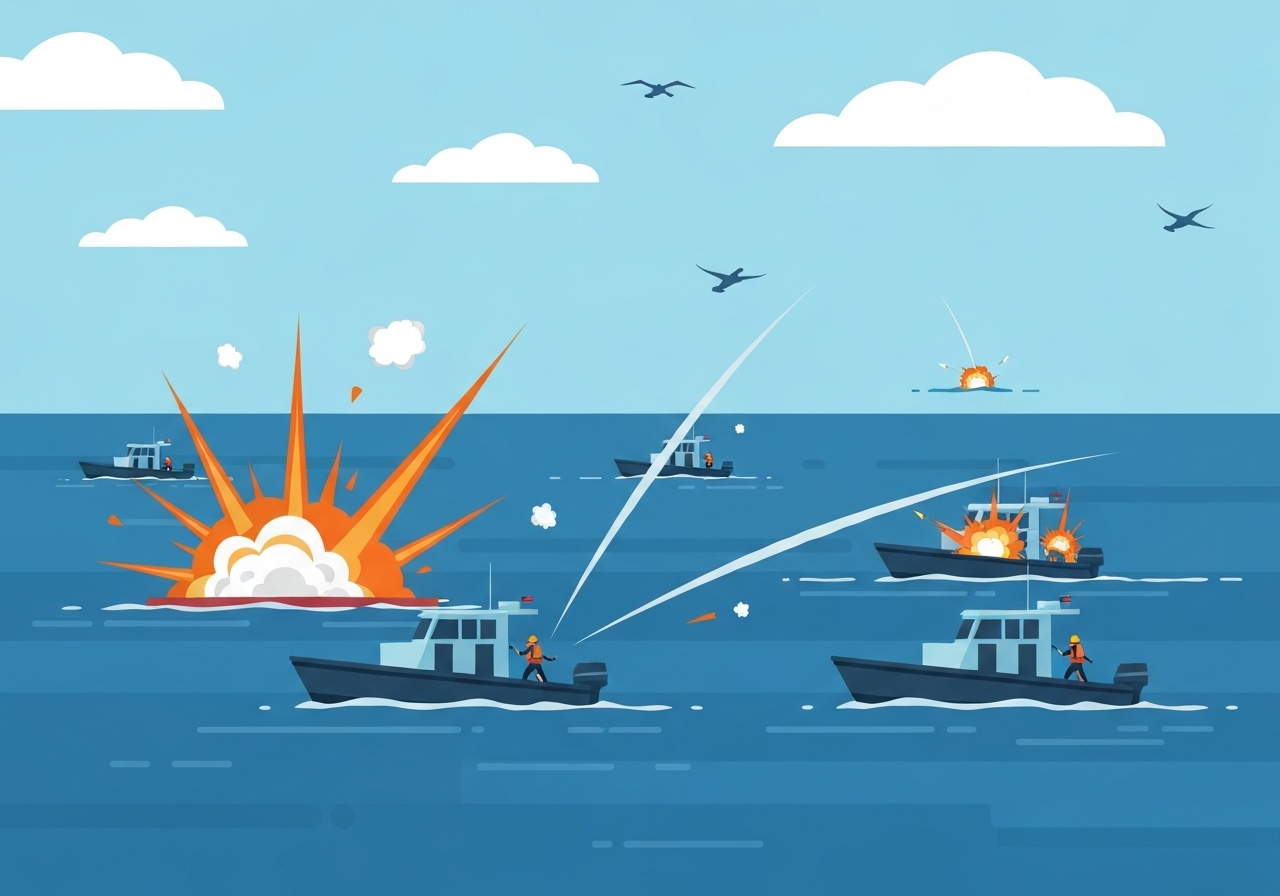
On December 16, 2025, U.S. Southern Command announced that U.S. forces struck three suspected drug-trafficking vessels in the Eastern Pacific, resulting in eight fatalities. The action, the command said, was carried out at the direction of Secretary of War Pete Hegseth and executed by Joint Task Force Southern Spear. Southern Command posted a video of the engagement on X and said intelligence indicated the vessels were on known narco-trafficking routes. The strikes add to a sequence of deadly maritime actions the U.S. has conducted in recent years.
Key Takeaways
- Three vessels in the Eastern Pacific were targeted on December 16, 2025; U.S. officials reported eight deaths (three on the first boat, two on the second, three on the third).
- SOUTHCOM said the strikes were ordered by Secretary of War Pete Hegseth and carried out by Joint Task Force Southern Spear based on intelligence assessments.
- SOUTHCOM published a video on X showing parts of the engagement; the command described the vessels as transiting known narcotrafficking routes.
- Officials labeled the eight dead as male narco-terrorists; the claim and identities have not been independently verified at this time.
- The incident continues a pattern of U.S. maritime strikes in the Pacific; reporting notes the Trump administration previously conducted 25 strikes that left at least 95 dead.
Background
U.S. maritime operations against suspected drug shipments in the Eastern Pacific have increased over the last decade as traffickers move larger shipments farther from shore. The Eastern Pacific sea lanes off Central and South America are established transit corridors for cocaine and other narcotics bound for North America and beyond. U.S. Southern Command has conducted interdiction and strike operations at sea under various authorities, citing the need to disrupt transnational criminal organizations that use fast boats and semi-submersibles.
Operational oversight for recent actions has included Joint Task Force Southern Spear, a unit focused on counter-narcotics and regional security operations. The involvement of a senior civilian official identified as Secretary of War Pete Hegseth in authorizing the strikes signals central direction for these missions. Past incidents and domestic political debate have made such maritime strikes politically sensitive, especially when questions arise about target identification and potential civilian harm.
Main Event
SOUTHCOM posted a message on X on December 16, 2025, saying intelligence confirmed the vessels were traversing known narcotrafficking routes in the Eastern Pacific and were engaged in narcotrafficking. According to the command, three separate engagements produced eight fatalities: three aboard the first vessel, two aboard the second, and three aboard the third. The statement identified those killed as male narco-terrorists; no names or nationalities were provided in the initial release.
The command released a short video clip purportedly showing the strikes, which appeared to depict small, fast-moving craft in open water. SOUTHCOM did not provide detailed location coordinates in its post, saying only that the incidents occurred in the Eastern Pacific. Officials told reporters that actions were taken after positive intelligence and targeting processes, but they did not release a full legal or forensic accounting at the time of the announcement.
U.S. forces have in prior operations reported engaging vessels after assessing they posed a threat or were actively moving contraband. In this case, Southern Command emphasized the trafficker designation and the route information used to justify engagement. Local governments and maritime authorities in coastal states were not identified in the initial statement as participating in the strikes.
Analysis & Implications
The strikes reflect an operational emphasis on denying seaborne transit routes to drug trafficking networks that have adapted to enforcement pressure by using more distant maritime corridors. By targeting small, fast boats, U.S. forces aim to interrupt shipments before they reach transshipment points along Central and South American coasts. Such actions can be tactically effective at reducing individual loads but have historically had limited long-term impact on overall trafficking volumes unless accompanied by broader regional interdiction and demand-reduction strategies.
There are significant legal and diplomatic implications. Strikes at sea raise questions about applicable use-of-force authorities, the rules of engagement used to determine hostile intent, and the burden of proof for labeling individuals as combatants or narco-terrorists. Regional governments often expect consultation on operations within or near their maritime zones; unilateral actions can strain bilateral relations even where there is shared interest in countering trafficking.
The political framing of these operations also matters domestically. The explicit naming of Secretary of War Pete Hegseth as the official who directed the strikes aligns them with high-level civilian policy, which can shield military actors legally but also invites political scrutiny. Comparisons to previous administrations’ maritime strike campaigns will likely fuel debate about oversight, transparency, and measures to prevent civilian harm.
Comparison & Data
| Event | Reported strikes | Reported deaths |
|---|---|---|
| December 16, 2025 Eastern Pacific action | 3 | 8 |
| Trump administration campaign (reported) | 25 | 95+ |
The table places this single-day action alongside previously reported maritime strikes attributed to the Trump administration, which reporting has said involved 25 strikes and at least 95 deaths. The new strikes are smaller in scale numerically but continue a pattern of lethal maritime interdictions. Quantitative comparisons underline that episodic strikes, while immediately disruptive, represent only one element of a broader counter-narcotics posture.
Reactions & Quotes
SOUTHCOM framed the action as an intelligence-driven interdiction aimed at disrupting narcotics movement. The command released a terse message and video on X, which has become the primary venue for rapid public updates about such operations.
Intelligence confirmed that the vessels were transiting along known narco-trafficking routes in the Eastern Pacific and were engaged in narco-trafficking.
U.S. Southern Command (official X post)
National media outlets quickly reported the command’s account and highlighted the casualty numbers, while observers noted the repetition of maritime strike tactics. Reporting also referenced earlier strike campaigns that produced higher cumulative casualty figures.
The U.S. military said on Monday it struck three more alleged drug boats in the Eastern Pacific, leaving eight dead.
ABC News (media report)
Regional governments and independent watchdogs have not yet issued detailed statements about the December 16 action; human rights and maritime safety groups typically press for independent investigations after lethal interdictions. Analysts caution that without open forensic reporting, questions about combatant status and possible noncombatant harm tend to persist.
Unconfirmed
- Whether any of the occupants of the three vessels fired on U.S. forces or otherwise posed an immediate kinetic threat is not confirmed in public statements.
- The identities, nationalities and organizational affiliations of the eight killed have not been independently verified.
- Specific legal authorities and the full rules of engagement used to approve the strikes have not been released publicly.
Bottom Line
The December 16 strikes represent another instance of lethal U.S. maritime action against suspected narcotics shipments in the Eastern Pacific, authorized at a high civilian level and presented by Southern Command as intelligence-driven. While such strikes can disrupt individual transits, their broader deterrent effect on established trafficking networks is uncertain without parallel regional cooperation and follow-up law-enforcement actions.
Key unanswered questions — including the identity of those killed, the procedural legal basis for the use of lethal force, and the level of host-nation coordination — mean scrutiny and calls for transparency are likely to grow. Observers and policymakers will be watching for additional official reporting, independent verification, and diplomatic responses from countries whose maritime zones or citizens may be affected.
Sources
- ABC News (media report)
- U.S. Southern Command (official X social post)
- U.S. Department of Defense (official)