
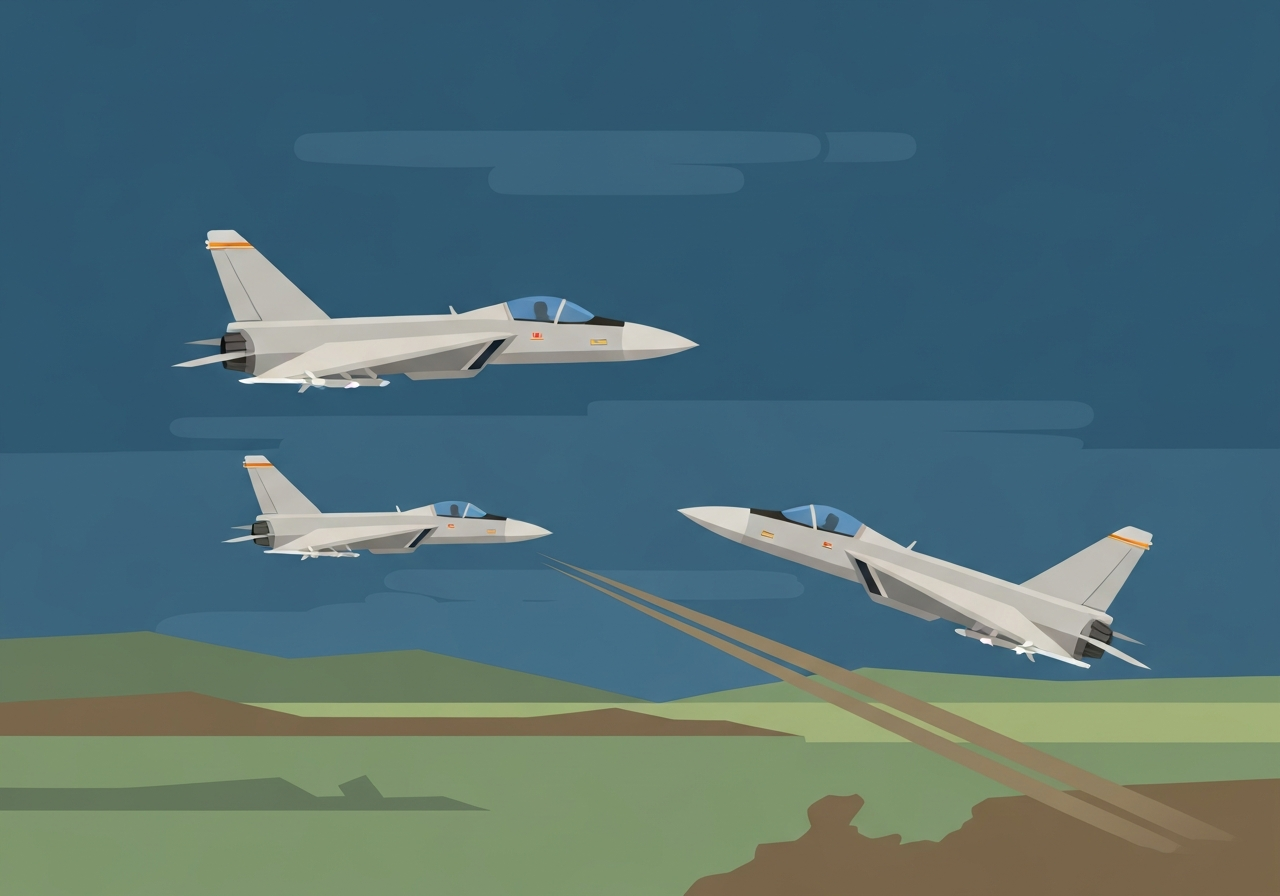
Early Monday, three US F-15E Strike Eagle fighter jets were mistakenly shot down over Kuwait during the third day of a wider regional air campaign, US Central Command (Centcom) said. The incident occurred at 11:03 p.m. ET on Sunday; all six aircrew ejected and were recovered and are in stable condition, Centcom added. Kuwaiti air-defence units have acknowledged firing on the jets and have opened an investigation. The episode unfolded amid fast-moving strikes and counterstrikes across the Middle East following the US-Israeli air campaign against Iran that began Saturday.
Key Takeaways
- Three US F-15E Strike Eagle aircraft were downed over Kuwait in an apparent friendly-fire incident, Centcom said; the event occurred at 11:03 p.m. ET on Sunday.
- All six crew members ejected and were recovered; Centcom reports they are in “stable condition.”
- Kuwaiti air-defence systems fired on the US jets during active combat that included attacks by Iranian aircraft, ballistic missiles and drones, according to Centcom.
- Kuwait has acknowledged the strike on the US aircraft and launched a formal investigation into the engagement.
- Video verified by Reuters showed at least one jet falling near Al Jahra, Kuwait, and clips circulated showing rescued aircrew in local vehicles.
- The incident occurred amid a larger escalation after US-ordered airstrikes on Iran—Operation Epic Fury—prompted missile and drone responses across the region.
- Regional disruption extended to civil aviation: Turkey suspended flights to Qatar, Kuwait, Bahrain and the UAE, adding to widespread cancellations and passenger disruption.
- Centcom earlier confirmed US service-member casualties in the campaign; officials raised the regional US death toll to four on Monday.
Background
The shoot-down came on the third day of a rapid escalation that began when the US launched airstrikes against Iran in an operation publicly described by the White House as Operation Epic Fury. The strikes were ordered by President Donald Trump, the White House said, without seeking a congressional vote. Iran and its proxies then launched missiles, drones and aircraft into multiple countries in the region, targeting military bases and, in some cases, civilian areas.
Kuwait, which hosts regional airspace and has defensive systems positioned to protect its territory, issued a statement condemning indiscriminate attacks on sovereign territory and signaling concern for civilian safety. The country has opened an internal probe after Centcom reported its air defenses fired on the US jets. Neighboring states and global carriers also reacted: Turkey temporarily halted flights to several Gulf destinations, and thousands of commercial flights were disrupted worldwide.
Main Event
According to a Centcom statement, the three F-15E aircraft were engaged in combat operations in airspace where Iranian aircraft, ballistic missiles and unmanned aerial systems were active. During that engagement, Kuwaiti air-defence batteries fired on the US jets, which were subsequently lost. Centcom said the downings were not the result of hostile enemy fire and characterized them as a mistaken engagement by allied air defenses.
Video widely shared on social platforms showed one jet trailing smoke and falling toward the Al Jahra area of Kuwait; Reuters verified the location. Footage also circulated showing an airman in a flight suit receiving assistance in the back of a vehicle, with posts saying local Kuwaitis were aiding the recovered crew. Centcom reported the six crew members ejected and were recovered; it later confirmed that US personnel in the broader campaign had suffered deaths and injuries.
Gen Dan Caine, chairman of the Joint Chiefs of Staff, addressed the loss briefly at a Pentagon briefing, expressing gratitude for the crew’s safety and noting the matter is under investigation. Secretary of Defense Pete Hegseth did not mention the incident in extended remarks that morning. Kuwait’s government condemned attacks across the region and affirmed an inquiry into the engagement that led to the jet losses.
Analysis & Implications
The episode underscores the hazards of conducting high-tempo air operations in congested, contested airspace where multiple friendly, adversary and partner systems operate simultaneously. Identification and deconfliction procedures are strained in environments with missile salvos, drone swarms and fast-moving fighter activity; a single misidentification can produce strategic consequences and diplomatic friction between partners.
Politically, the incident complicates US-Kuwait relations at a sensitive moment. Kuwait’s acknowledgment and initiation of an investigation aim to manage domestic and regional expectations, but Washington will press for a transparent review to determine procedural failures and whether changes to rules of engagement, identification friend-or-foe (IFF) protocols, or communications links are required.
Operationally, the loss of three F-15E airframes in one night reduces available strike and escort capacity for US forces in the short term and may force a reallocation of air assets across the theater. It also raises questions about readiness of regional partner air-defense training, the robustness of shared situational awareness systems, and command-and-control redundancies during multi-domain combat operations.
Comparison & Data
| Item | Value | Source |
|---|---|---|
| Aircraft lost | 3 F-15E | Centcom |
| Crew ejected/recovered | 6, stable condition | Centcom |
| Incident time | 11:03 p.m. ET, Sunday | Centcom post |
| US campaign deaths (to date) | 3 confirmed, later reported 4 | Centcom / Officials |
| Flight suspensions (Turkey) | Flights to Qatar, Kuwait, Bahrain, UAE suspended | Turkish Transport Ministry |
The table summarizes official counts and verifiable timestamps published by Centcom and reporting agencies. While aircraft counts and recovery status are firm in official statements, casualty tallies for the broader campaign have changed as additional reports emerged; analysts caution that early counts in fast-moving conflicts often shift as more information is confirmed.
Reactions & Quotes
US military and Kuwaiti reactions were swift but measured as investigations began. Officials stressed accountability and the need to avoid escalation while inquiries continue.
“I am aware of the loss of three US Air Force F-15Es overnight in the region. I am grateful for the safety of the crews, and we know that this was not from hostile enemy fire.”
Gen Dan Caine, Chairman of the Joint Chiefs of Staff (Pentagon briefing)
Gen Caine framed the event as non-hostile in origin, emphasizing ongoing investigation efforts. Kuwaiti government statements condemned indiscriminate regional strikes and announced an investigation into its air-defense actions.
“Indiscriminate and reckless attacks with missiles and drones against sovereign territories across the region represent a dangerous escalation.”
Kuwaiti government statement
Regional civil aviation authorities and airlines responded to the broader security disruption by altering flight schedules; Turkey’s transport ministry publicly suspended specific routes as a precaution. Iranian state media, citing the Islamic Revolutionary Guard Corps, claimed responsibility for hitting a US plane that crashed in Kuwait—an assertion reported by Reuters but not corroborated by US officials as the cause of these specific shoot-downs.
Unconfirmed
- Iranian claims of responsibility for specifically downing these three jets were reported by Iranian state media citing the IRGC; US officials have not corroborated that attribution for the friendly-fire shoot-downs.
- Some social-media clips purportedly showing aircrew being aided by local civilians are consistent with verified location data, but full chain-of-custody and identification of all individuals in clips remain unverified.
- Attribution of particular warheads or radar tracks to either Kuwaiti systems or other regional batteries is still under investigation and has not been publicly validated.
Bottom Line
The accidental downing of three US F-15E jets over Kuwait highlights the acute dangers of conducting dense, multinational air operations amid an expanding regional conflict. Although the immediate human toll among those ejected was limited by successful recoveries and Centcom reports of stable conditions, the material losses and diplomatic fallout could have lasting operational and political effects.
Key near-term priorities will be a transparent, joint investigation to establish sequence and cause, adjustments to identification and deconfliction protocols, and careful diplomacy to prevent further unintended incidents. For observers, this event is a reminder that even well-equipped forces face heightened risks when multiple actors, rapidly shifting tactics, and high-tempo strikes converge in shared airspace.
Sources
- The Guardian (International news outlet)
- US Central Command (Centcom) post (Official military statement)
- Reuters (International news agency; location verification)
- Barron’s profile of the F-15 (Business press; technical profile)
- Kuwaiti government statements and local reporting (Government/media sources)