
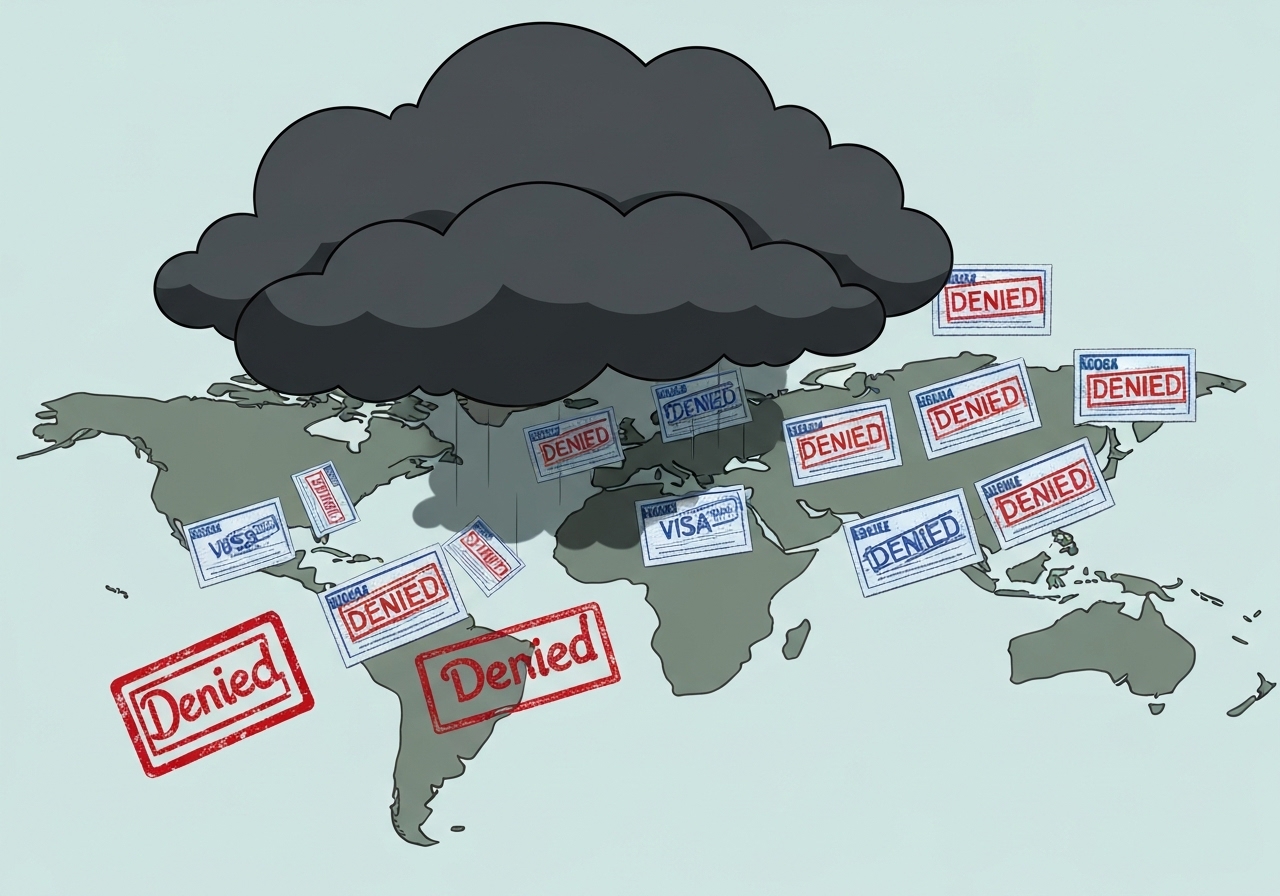
The United States will indefinitely pause immigrant visa processing for nationals of 75 countries, a move the State Department says is intended to reduce entry by people likely to rely on public benefits. The freeze is to take effect on January 21, according to a US official, and applies to immigrant visas such as employment-based permanent residency. Officials say non-immigrant visas, including tourist and student visas, are not affected, meaning short-term travel to events such as this summer’s World Cup would remain possible. The department ties the action to expanded scrutiny under the ‘public charge’ standard introduced last year.
Key Takeaways
- The State Department announced an indefinite pause in immigrant visa processing for 75 countries, effective January 21, per a US official.
- Named examples include Brazil, Colombia, Egypt, Haiti, Somalia and Russia; the full 75-country list has not been published in the statement.
- The suspension targets immigrant visas (including employment-based immigrant categories) and does not cover non-immigrant visas such as tourist or student visas.
- Officials link the measure to heightened enforcement of the ‘public charge’ provision first emphasized in 2025, aimed at applicants deemed likely to use welfare.
- Some affected nations overlap with those already on the administration’s expanded travel ban lists, compounding restrictions for certain travelers.
- The State Department framed the pause as a procedural reassessment rather than an immediate permanent ban, but no timeline for lifting the pause was announced.
Background
The action follows a broader shift in US immigration policy that began to accelerate in 2025, when the administration expanded use of the ‘public charge’ standard to judge admissibility. That provision allows consular officers to deny immigrant status to applicants judged likely to become dependent on government assistance. The change has already led to longer vetting, additional document requests and, in some cases, denials for applicants deemed higher risk.
Separately, the administration has updated the travel ban and visa-restriction lists in recent years to include a number of countries cited for security or immigration concerns. Advocates and foreign governments have criticized some of those moves as broad and disruptive; the government argues they protect public resources and national security. Stakeholders affected include migrant families seeking reunification, employers sponsoring foreign workers, and consular offices that must implement new screening procedures.
Main Event
On Wednesday the State Department announced it will pause immigrant visa processing from 75 countries while it reevaluates procedures to prevent admission of individuals judged likely to rely on public benefits. A US official confirmed the pause would begin on January 21. The department said the measure targets immigrant visas and explicitly exempts temporary, non-immigrant categories such as tourist and student travel.
The department’s public statement framed the move as enforcement of long-standing authority to deny admission to applicants who may become public charges. Department officials described the action as a procedural reassessment rather than an immediate expansion of permanent exclusions, but they did not provide a date for resuming processing for the affected countries.
Government representatives said the pause will apply broadly to immigrant visa categories, including employment-based pathways, meaning employers and family sponsors could see longer delays or suspension of case adjudication for citizens of the impacted countries. Several of the countries named in media reports — Brazil, Colombia, Egypt, Haiti, Somalia and Russia — were cited as examples but the administration did not publish a complete country-by-country breakdown in its initial announcement.
Analysis & Implications
Policy-wise, the decision tightens an already stricter framework for who may be allowed to immigrate on the grounds of potential future public benefit use. For applicants from the 75 countries, the pause creates legal and logistical uncertainty: ongoing cases may be delayed, and prospective migrants will lack a clear timeline for adjudication. Employers who sponsor immigrant workers could face shortages or staffing gaps if approvals stop for nationals of those countries.
Diplomatically, affected governments are likely to seek clarification and may lodge formal inquiries or protests. Some countries already subject to travel restrictions could see bilateral relations fray further if their citizens experience new administrative barriers. The lack of a published list or detailed selection criteria also raises transparency concerns that could spur legal challenges or diplomatic disputes.
Economically, the pause could have modest sectoral impacts depending on the makeup of immigrant flows from the affected states. Industries reliant on foreign-born workers, including certain technology, healthcare and agricultural segments, may encounter recruitment delays. At the same time, because non-immigrant visas remain available, short-term business travel and tourism — including events like the World Cup scheduled for the summer — should not be directly curtailed by this particular pause.
Comparison & Data
| Visa category | Processing impact |
|---|---|
| Immigrant visas (e.g., employment-based, family-based) | Processing paused for nationals of 75 countries |
| Non-immigrant visas (tourist, student, short-term business) | Unaffected by this pause; normal processing continues |
The table above summarizes the immediate operational distinction the State Department announced. Historically, restrictions that affect immigrant visas have greater long-term consequences for residency and labor-market participation than temporary travel curbs. Because the department described the action as a reassessment, the practical length and scope of the pause will determine whether its effects are short-lived administrative delays or a more sustained barrier to legal immigration for the named countries.
Reactions & Quotes
The department said it will use its authority to deny admission to applicants who would likely become public charges and that processing will be paused while procedures are reassessed.
State Department spokesperson Tommy Pigott (paraphrased)
An immigration advocate described the measure as adding uncertainty for families and employers who rely on predictable processing timelines, urging transparency on how countries were selected.
Immigrant rights organization (statement, paraphrased)
A policy analyst noted the practical difference between pausing immigrant visa adjudications and blocking short-term travel, saying this step targets longer-term settlement rather than temporary visitors.
Independent immigration policy analyst (paraphrased)
Unconfirmed
- The complete list of the 75 countries and the specific criteria used for selection was not included in the initial announcement and has not been publicly released.
- Officials have not provided a timeline for when processing might resume, so the duration of the pause remains unclear.
- The announcement did not specify how pending immigrant visa cases, such as family reunification petitions already in process, will be handled.
Bottom Line
The administration’s pause on immigrant visa processing for 75 countries, effective January 21, represents a significant administrative tightening tied to enforcement of the ‘public charge’ standard. While non-immigrant travel remains permitted, the move increases uncertainty for immigrants, families and employers reliant on predictable adjudication of long-term admission requests.
Key developments to watch include release of the full country list, any legal challenges to the pause or its selection criteria, and diplomatic responses from affected governments. How long the reassessment lasts will determine whether this measure produces temporary disruption or a more durable reshaping of certain migration pathways.
Sources
- CNN — news report