
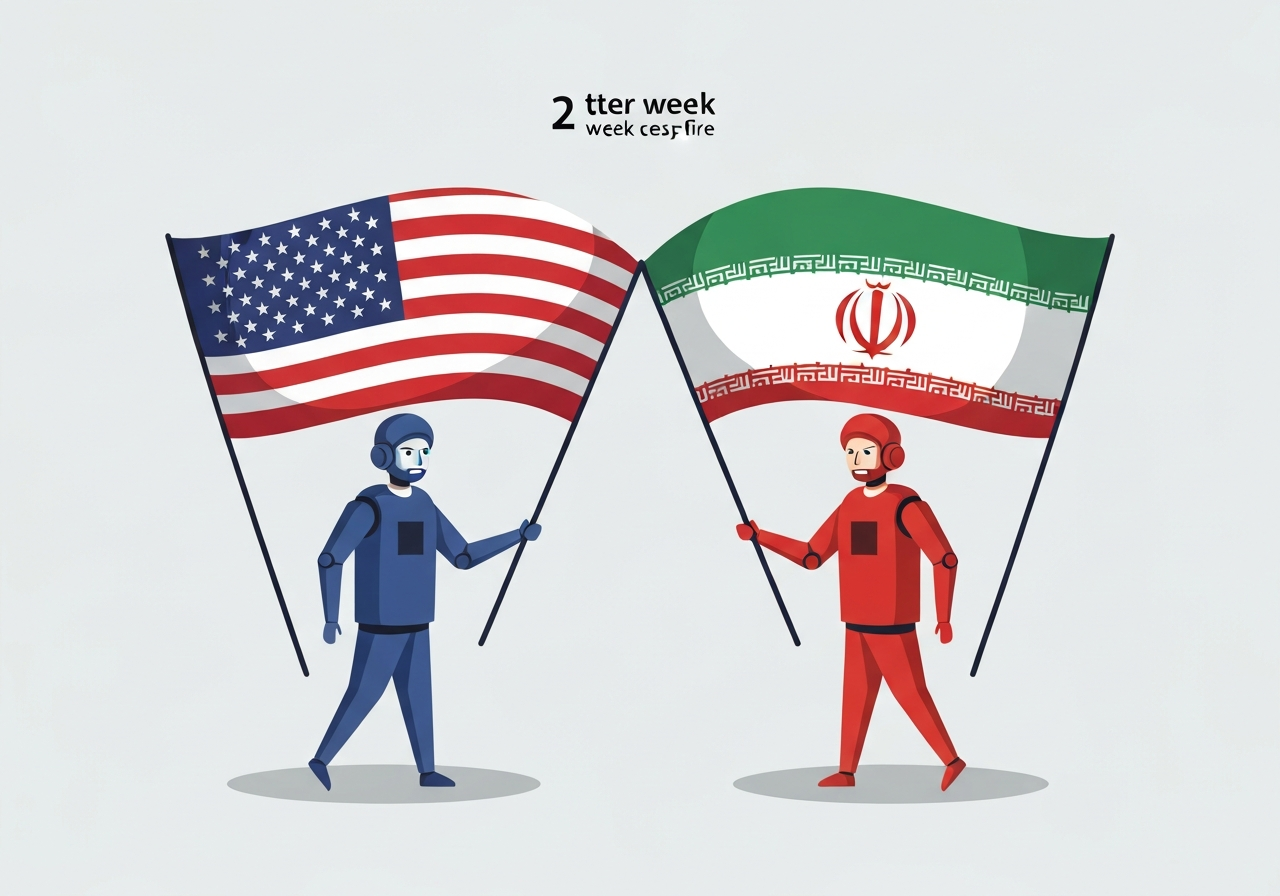
In a late-night announcement, the United States and Iran each framed a newly agreed two-week ceasefire as a strategic win, suspending more than five weeks of fighting that spread across the Middle East. The temporary truce pauses active strikes and opens the door to talks in Islamabad this Friday, though disagreements remain over whether Lebanon is included. The halt coincided with sharp market moves — oil prices fell and global stocks rallied — while military and political actors cautioned the truce could be fragile. Diplomatic, security and commercial questions about implementation, especially transit through the Strait of Hormuz, remain unresolved.
Key takeaways
- Two-week ceasefire: The United States and Iran announced a bilateral ceasefire after five-plus weeks of regional conflict; both sides publicly described the deal as a victory.
- Talks set for Islamabad: Pakistan has invited delegations from the US and Iran to meet on Friday; US attendees are expected to include a presidential special envoy, Jared Kushner and Vice President JD Vance.
- Strait of Hormuz terms: Iran agreed to coordinate vessel passage through the Strait during the pause; experts say the backlog of roughly 1,000 ships will not clear quickly.
- Lebanon dispute: Pakistan’s prime minister said the ceasefire covers Lebanon, while Israeli officials and Prime Minister Benjamin Netanyahu’s office said Lebanon is excluded.
- On-the-ground violence: The Israel Defense Forces reported large-scale strikes in Lebanon and said it completed an extensive wave of operations inside Lebanon and earlier against Iran.
- Economic reaction: WTI fell about 16% to just below $95 a barrel and Brent slipped roughly 13.5% to $94; major stock indices posted double-digit percentage rebounds in some markets.
- IRGC posture: Iran’s Revolutionary Guards said they would observe the truce but warned they remain ready to resume fighting if provoked.
Background
Hostilities escalated over more than five weeks after a series of strikes, counterstrikes and attacks across the region that disrupted trade, damaged energy infrastructure and raised the prospect of broader war. Early strikes hit key Iranian facilities and prompted Iranian missile and drone responses — incidents that in turn drew US and allied reprisals. The conflict severely affected global energy markets because nearly 20% of the world’s oil normally transits the Strait of Hormuz, turning the waterway into a focal point for diplomacy and security planning.
Diplomacy intensified as economic shock and mounting casualties increased pressure on middle powers to mediate. Pakistan took a central role in proposing and brokering the short-term cessation that led to the agreement announced by President Trump. Tehran has presented multi-point proposals during negotiations; US officials say subsequent discussions will refine terms including sanctions relief and operational details like the opening of the strait.
Main event
The ceasefire was announced late Tuesday, roughly 90 minutes before a deadline set by President Trump. The US president said the deal included a “complete, immediate, and safe opening” of the Strait of Hormuz and that tariff and sanctions relief would be discussed; he also posted a warning that anyone supplying weapons to Iran could face 50% tariffs on US imports. Iran’s state channels said the supreme leader ordered units to stop firing, and Tehran characterized the agreement as reflecting key principles it had sought.
Within hours the situation remained unsettled. Airstrike activity was reported in Lebanon as the Israel Defense Forces said it executed a large coordinated wave of strikes targeting Hezbollah sites, while Israeli officials asserted Lebanon was not covered by the ceasefire. Pakistan’s prime minister publicly said Lebanon was included, creating a sharp and immediate discrepancy between mediators and a principal regional belligerent.
In the Gulf, Iranian forces or proxies were reported launching drone-and-missile attacks on Kuwait and the United Arab Emirates, with those states reporting damage to energy facilities and defensive engagements. Iran’s Revolutionary Guards signaled they would honor the truce but cautioned their readiness to return to action if the other side “miscalculates.” Meanwhile, shipping trackers recorded only a handful of transits through the Strait of Hormuz in the first hours after the announcement.
Preparations for the Islamabad talks accelerated: Pakistani officials said Iran would send a delegation and US representatives including a special envoy, Jared Kushner and Vice President Vance were expected. The talks are intended to translate the ceasefire’s broad commitments into operational steps and to address contentious items such as sanctions relief, verification measures and maritime coordination.
Analysis & implications
Short-term stability: The pause reduces immediate kinetic risk and eases the most acute market anxiety, as shown by the sharp drop in oil prices and a global equity rebound. However, markets reacted to the possibility of a temporary halt rather than a guaranteed, durable settlement; traders and insurers remain focused on concrete verification of strait opening and freedom of navigation.
Diplomatic trajectories: Islamabad’s mediating role elevates Pakistan’s diplomatic profile and demonstrates how third-party actors can shape urgent crisis management. The inclusion of high-profile US envoys indicates a push to convert the tactical pause into negotiations over longer-term terms, including the scope and sequencing of sanctions relief and security assurances.
Military and regional risk: The Lebanon dispute highlights the limits of bilateral deals to contain multidimensional conflicts. Israel’s insistence that Lebanon is excluded and its continuation of strikes there risks sustaining a separate, intense front. If Hezbollah remains engaged and Israel continues operations, the ceasefire’s stabilizing effect could be uneven and localized rather than regionwide.
Comparison & data
| Metric | Reported figure |
|---|---|
| Lebanon deaths reported | 1,530 (including 130 children) |
| Backlog at Strait of Hormuz | ~1,000 ships (≈80% inside Persian Gulf) |
| Vessels listed in region | 426 tankers, 34 LPG carriers, 19 LNG carriers |
| Oil price moves (WTI / Brent) | WTI down ~16% to just below $95; Brent down ~13.5% to $94 |
The table summarizes the most widely reported numeric indicators from the initial hours after the truce: the human cost in Lebanon, the extent of the stranded commercial fleet, and market reactions. Analysts warn that clearance of the shipping backlog will be constrained by the operational regime Iran imposes on transits — pre-vetting and limited daily allowances could mean only 10–15 ships transit per day, leaving most of the backlog after two weeks.
Reactions & quotes
Pakistani officials framed the agreement as a mediation success and said the talks will include Lebanon; the claim produced immediate pushback from Israeli authorities, leaving regional observers to reconcile competing versions.
“The agreement includes Lebanon and aims to prevent further regional escalation.”
Shehbaz Sharif / Pakistan Prime Minister (office statement)
Iranian military spokespeople struck a cautious tone: they called for vigilance while committing to the pause, underscoring that the Revolutionary Guards remain prepared to respond to future attacks.
“We will honor the truce, but our finger remains on the trigger if the enemy miscalculates.”
Islamic Revolutionary Guard Corps (IRGC)
US officials described the truce as fragile and emphasized verification. Vice President Vance, who helped negotiations in final hours, said the deal will be tested by Iran’s actions in the coming days.
“It’s a fragile truce — if Iran acts in good faith we can make progress; if not, other options remain on the table.”
Vice President JD Vance
Unconfirmed
- The precise mechanics and schedule for reopening the Strait of Hormuz have not been published by Iranian or US authorities.
- Responsibility for the reported overnight damage to Lavan Island energy facilities has not been independently verified.
- Details on any agreed sanctions relief and its timing remain provisional until written terms are exchanged in Islamabad.
Bottom line
The two-week ceasefire reduces the immediate risk of wider conventional warfare and produced a rapid market relief rally, but it is a short window rather than a final settlement. Key operational questions — who controls and vets ship transits, whether Lebanon is covered, and the sequencing of any sanctions relief — must be resolved quickly to sustain the pause.
If stakeholders translate the truce into verifiable procedures and meaningful confidence-building steps, the pause could become a foothold for longer negotiations. Conversely, unresolved disputes, particularly the Lebanon carve-out and continued Israeli strikes there, could fracture the agreement and return the region to high-intensity conflict.