
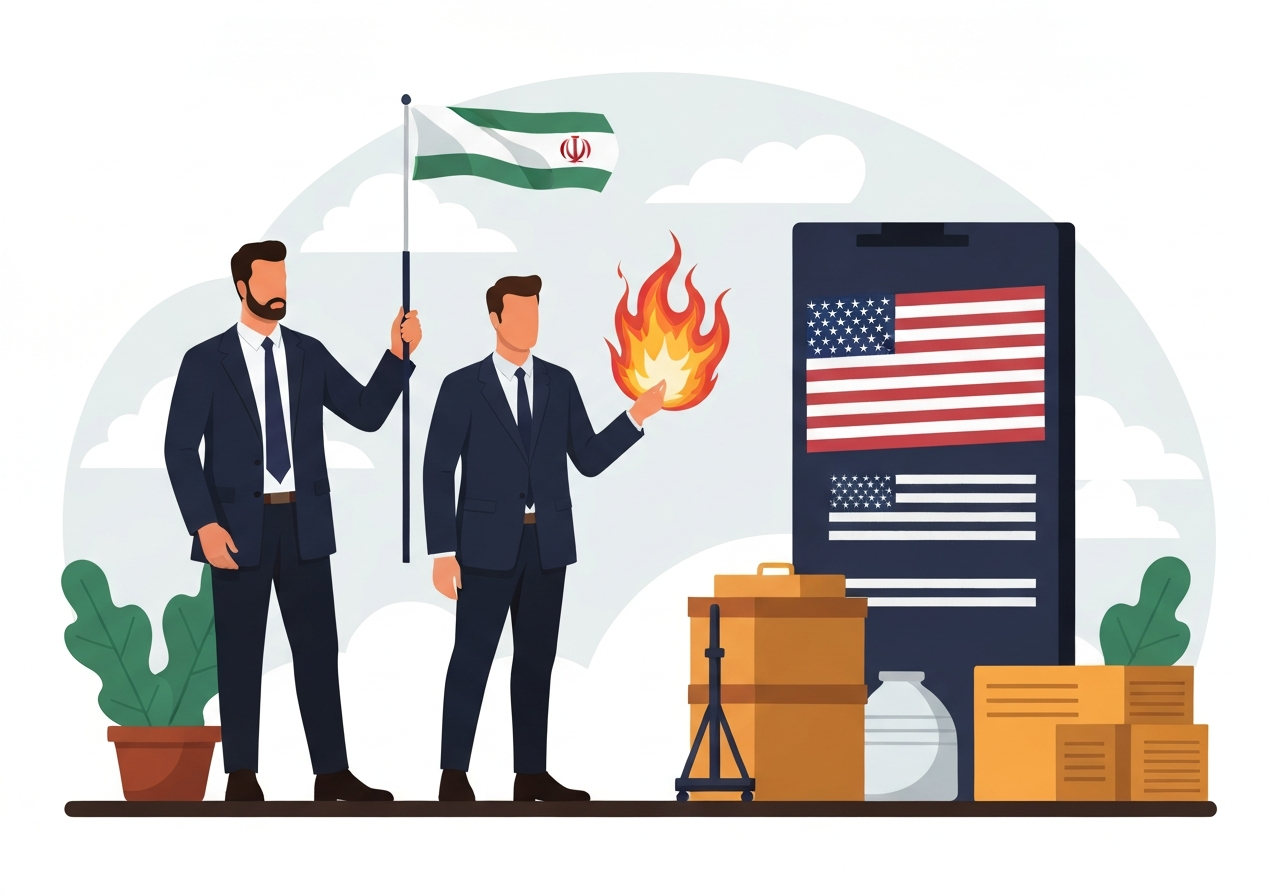
Who: Indirect negotiators from the United States and Iran, mediated by Oman’s foreign minister, met in Geneva. When/Where: The talks took place on Thursday in Geneva and lasted several hours, with technical follow-ups planned in Vienna next week. What/Result: Negotiators left without an agreement after Iran rejected proposals to ship enriched uranium abroad and insisted on lifting sanctions, while the U.S. pressed for limits on enrichment and related programs. The absence of a deal coincides with a large U.S. military buildup in the region, elevating fears of a wider Middle East conflict.
- Talk duration: Negotiators met for roughly three hours in Geneva and reconvened later the same day; lower-level technical talks are scheduled in Vienna next week.
- Enrichment stance: Iran reiterated it will continue uranium enrichment and rejected proposals to transfer enriched material overseas; it previously raised enrichment to 60% purity after the 2018 U.S. withdrawal from the 2015 deal.
- U.S. posture: Washington assembled a large fleet of aircraft and warships in the region while envoys led by Steve Witkoff and Jared Kushner engaged indirectly with Iran’s team.
- Regional risk: Iranian officials warned U.S. bases and Israel could be considered legitimate targets if attacked, raising the prospect of broader conflict across the Middle East.
- Inspection access: Iran has blocked IAEA inspectors from some sites damaged in prior strikes, while satellite imagery suggests activity at two targeted facilities.
- Economic signal: Brent crude has climbed in recent days, with benchmark prices around $70 a barrel amid heightened tension.
- Diplomatic channel: Oman’s mediation produced what its foreign minister called “significant progress,” though Tehran and Washington still differ on core demands.
Background
The Geneva meetings followed multiple previous rounds of indirect discussion. Those earlier talks unraveled last year after a June confrontation—when Israel launched a 12-day conflict and the U.S. conducted strikes on Iranian nuclear sites—leaving parts of Iran’s program damaged and the status of that damage contested. Washington demands strict limits on Iran’s enrichment activities, a rollback of long-range missile development, and a halt to support for armed regional groups; Iran insists talks be confined to nuclear issues and maintains its program is peaceful.
Diplomatic mediation by Oman draws on a long history of Gulf-state back-channel diplomacy; Muscat has served as an intermediary between Tehran and Western capitals for years. The International Atomic Energy Agency (IAEA) stands to play a key verification role in any agreement, but Tehran’s recent restrictions on inspector access complicate standard monitoring. Domestic politics in both countries also shape negotiators’ room for maneuver: Iran faces nationwide dissent at home, and U.S. leaders are signaling firm pressure while pursuing a diplomatic opening.
Main Event
The Geneva session was convened as indirect talks, with Oman’s Foreign Minister Badr al-Busaidi serving as mediator. Iranian deputy foreign minister Abbas Araghchi described the meetings as among Tehran’s “most intense and longest rounds of negotiations” in remarks to state television, but provided few details. According to Iranian state media, Tehran reiterated its refusal to ship enriched uranium abroad and demanded sanctions relief as a precondition for concessions.
On the U.S. side, the delegation was led by real-estate executive Steve Witkoff, designated a special Middle East envoy, and included Jared Kushner. U.S. officials framed their aims around constraining enrichment and related programs; they also said progress required Iran accepting limits beyond purely civilian nuclear activity. The two sides paused after roughly three hours, resumed later, and agreed technical teams would continue discussions in Vienna, the IAEA’s headquarters.
During a break in Geneva, Iran’s Foreign Ministry spokesperson Esmail Baghaei described proposals as “constructive” on both nuclear issues and sanctions relief, though Tehran’s public statements showed persistent gaps with Washington. Analysts noted that the fact parties returned to the table indicated some common ground, even if core demands remain unresolved. With U.S. forces massed in the region and Iran publicly refusing key U.S. demands, negotiators left without a compromise to remove the immediate risk of escalation.
Analysis & Implications
Failure to reach a deal preserves multiple contingency paths: continued diplomacy, stepped-up sanctions, or potential military action. Military options carry high risk; Iranian officials have warned that U.S. bases across the region and Israeli territory could be targeted in retaliation, raising the possibility of a multi-front conflict with heavy civilian and military casualties. Analysts caution that limited strikes intended to coerce concessions may not achieve diplomatic aims and could entangle the U.S. in a protracted campaign.
Economically, renewed hostilities would likely push oil prices higher and disrupt shipping through chokepoints such as the Strait of Hormuz, which handles about one-fifth of world-traded oil. Financial sanctions and the specter of conflict also deepen uncertainty for investors and regional partners. Diplomatically, any deal would require robust verification by the IAEA; Tehran’s restrictions on inspectors and ambiguity around damaged sites make credible verification more difficult and reduce Washington’s confidence in compliance claims.
Domestically in Iran, leaders balance deterrence and nationalist appeals with pressure to avoid a war that could further destabilize the country amid protests. For U.S. policymakers, the calculus weighs the political costs of perceived inaction against the risks of military escalation. The scheduled technical talks in Vienna provide a narrow window for negotiating modalities for monitoring and potential compromises, but major policy gaps—especially over enrichment and regional proxies—remain unresolved.
Comparison & Data
| Indicator | Recent Value / Note |
|---|---|
| Iran enrichment level (recent peak) | 60% uranium purity (post-2018 increase) |
| Weapons-grade threshold | ~90% purity |
| Brent crude benchmark | Around $70 per barrel |
| Strait of Hormuz share | ~20% of traded oil passes through |
| Geneva talks (session length) | About 3 hours, with later resumption |
These figures underscore the technical and strategic gaps at stake: 60% enrichment is a short technical step from weapon-grade levels but still below 90%. Market sensitivity to disruptions in the Strait of Hormuz makes even limited military exchanges economically meaningful. Verification metrics (inspector access, site activity) will be decisive in any durable agreement and remain points of contention.
Reactions & Quotes
Oman framed the conversations as forward-moving yet nonconclusive, reflecting its role as mediator. The mediation helped keep diplomacy alive even as the two capitals publicly restated core red lines.
“There had been significant progress in the negotiation,”
Badr al-Busaidi, Omani Foreign Minister (mediator)
Iran’s negotiators portrayed their stance as firm on sovereignty and enrichment rights, warning that military confrontation would be catastrophic for the region. Tehran emphasized that nuclear discussions must remain focused on enrichment and sanctions relief.
“What needs to happen has been clearly spelled out from our side,”
Abbas Araghchi, Iranian negotiator
Outside analysts noted the significance of continuing talks even without a breakthrough: returning delegations suggests negotiators see negotiable elements despite public stances. The International Crisis Group’s Iran expert said the U.S. team’s return to talks indicated some shared ground remained.
“The very fact that the U.S. team is returning shows that there is enough common ground,”
Ali Vaez, International Crisis Group (analyst)
Unconfirmed
- The full extent of damage to Iran’s nuclear facilities from prior strikes remains unclear and has not been independently verified in all cases.
- Whether Iran has resumed enrichment activity at specific damaged sites is not fully confirmed; satellite imagery shows activity but does not prove weapons-related work.
- There is no public, detailed U.S. plan for the timing or scope of any potential military strikes, and reported preparations do not confirm operational orders.
Bottom Line
The Geneva talks kept a diplomatic channel open but failed to bridge central disagreements: Iran insists on its right to enrich uranium and demands sanctions relief, while the U.S. seeks strict curbs on enrichment and related programs. With U.S. military forces positioned in the region, the diplomatic impasse preserves a nontrivial risk of escalation that could draw in regional partners and affect global markets.
Technical follow-ups in Vienna and the IAEA’s role in verification will be critical to whether negotiations can move beyond face-saving statements. Absent a credible verification framework and compromise, policymakers face a stark set of choices between constrained diplomacy, intensified economic pressure, or actions that risk wider conflict.
Sources
- Associated Press — news report on Geneva talks (journalism)
- International Atomic Energy Agency (IAEA) — international nuclear watchdog (official/verification)
- International Crisis Group — analysis and expert commentary (think tank)
- Oman Ministry of Foreign Affairs — mediator statements (official)