
Lead
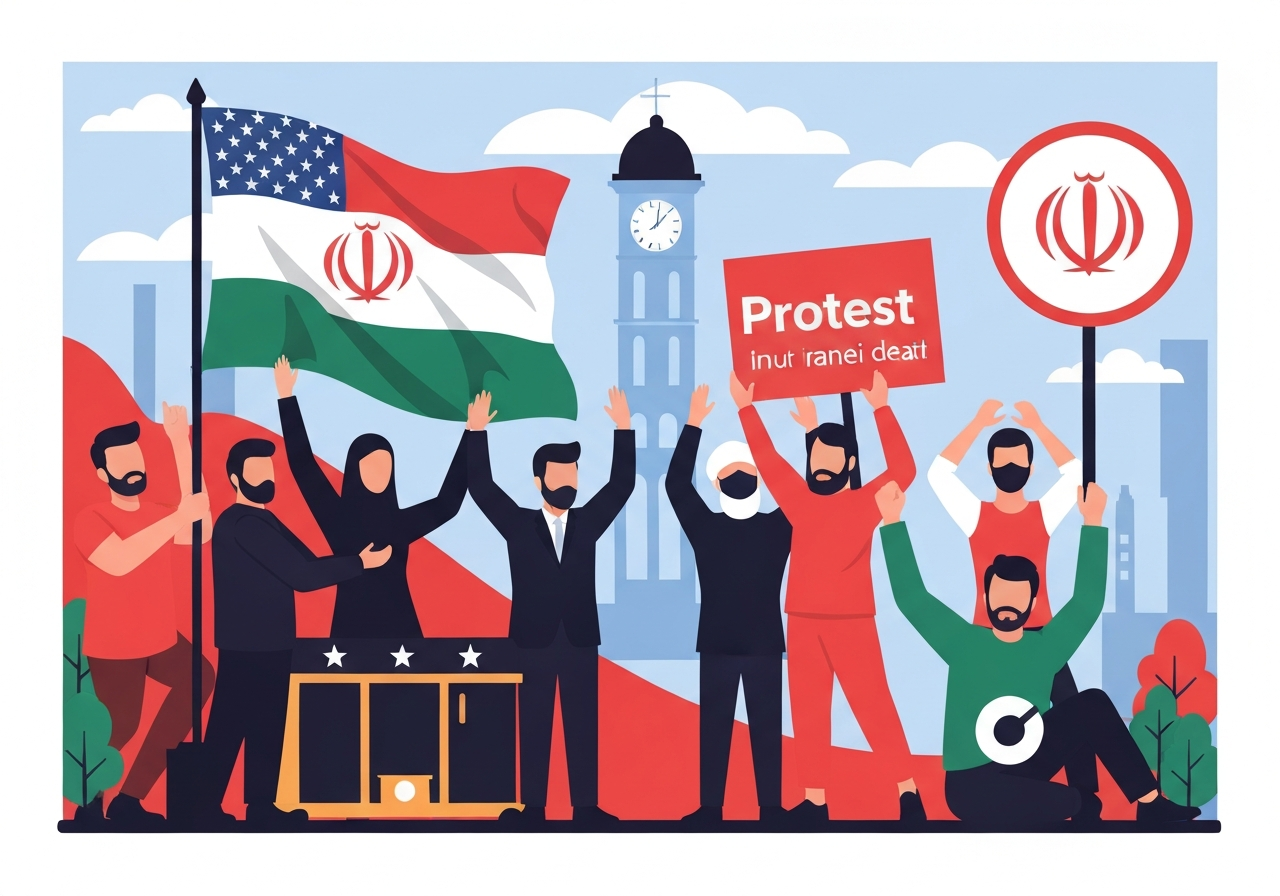
Anti-war demonstrations spread across the United States on Saturday after news outlets reported that Iran’s supreme leader, Ali Khamenei, had been killed in strikes on Tehran attributed to U.S. and Israeli forces. Protesters gathered outside the White House and in New York’s Times Square to oppose further U.S. military involvement in the region and to demand Congress assert its constitutional role. Organizers said hundreds rallied in New York while coordinated actions and smaller gatherings were held in dozens of cities nationwide. Authorities placed counterterror and counterintelligence units on heightened alert amid the unrest.
Key Takeaways
- Reports circulated that Iran’s supreme leader Ali Khamenei was killed in strikes on Tehran; the claim prompted nationwide demonstrations (status: widely reported but contested).
- Several hundred people assembled in New York’s Times Square; other major demonstrations took place outside the White House and in cities including Atlanta, Boston, Chicago and Los Angeles.
- A coalition of left-wing and advocacy groups — including ANSWER Coalition, National Iranian American Council, American Muslims for Palestine, CodePink and the Democratic Socialists of America — coordinated many of the protests.
- Organizers described the strikes as an “unprovoked, illegal attack” and warned of escalating civilian casualties and regional war risks.
- The ACLU and multiple Democratic lawmakers demanded immediate congressional action to check what they called unconstitutional use of military force.
- Federal law-enforcement agencies raised counterterrorism and counterintelligence alerts nationwide in response to the strikes and the protests.
- Protesters voiced a mix of positions: opposition to U.S. bombing, support for Iranian protesters against their regime, and criticism of successive U.S. administrations’ foreign-policy patterns.
Background
Tensions between the United States and Iran have surged following a series of military actions attributed to both U.S. and Israeli forces. In the days leading up to the protests, multiple outlets reported strikes on Tehran and circulated claims that Iran’s supreme leader, Ali Khamenei, had been killed. Those reports, whether confirmed or not, triggered immediate public response at home and drew renewed debate about presidential authority to use force without explicit congressional authorization.
The demonstrations fit into a longer pattern of U.S. domestic contention over military interventions abroad. Recent years have seen polarized reactions to U.S. operations in the Middle East, from the 2003 Iraq invasion through later campaigns in Syria, Libya and Yemen. Civil liberties groups and some lawmakers routinely invoke the Constitution’s allocation of war powers to Congress when opposing executive-directed strikes.
Main Event
Early on the day of the protests, crowds gathered in central public spaces. In New York’s Times Square organizers reported several hundred participants; in Washington demonstrators assembled near the White House perimeter. Many carried signs denouncing a perceived unilateral decision to strike and calling for the protection of civilian lives in the region.
A coalition of left-leaning organizations publicized a list of “emergency protests” for Saturday, naming cities that included Atlanta, Baltimore, Boston, Chicago, Cincinnati, Denver, Las Vegas, Los Angeles, Miami and Minneapolis. Organizers also planned smaller Sunday actions in towns such as Albany, Ellensburg (Virginia), Chattanooga, Decorah, Gainesville and Springfield (Missouri).
Speakers at the New York demonstration criticized what they described as a pattern of covert or unilateral foreign-policy moves by the administration, citing recent high-profile actions including the capture of Nicolás Maduro and other extraterritorial operations. Protesters emphasized that military action without explicit congressional authorization undermines constitutional checks and risks sparking broader conflict.
Federal law-enforcement and intelligence agencies responded by elevating counterterrorism and counterintelligence postures nationwide. The administration’s homeland security official said she was coordinating with federal partners to monitor and counter potential threats to the homeland as demonstrations unfolded.
Analysis & Implications
The protests crystallize domestic unease about sudden escalations abroad and the limits of executive war-making authority. If the reports about Khamenei’s death persist without definitive confirmation, the political fallout could intensify pressure on Congress to act, further polarizing legislative-executive relations over foreign policy. Legal advocates argue such a political moment could produce urgent votes on authorizations or statutory restraints.
On the diplomatic front, any significant strike on Iran’s capital carries a high risk of widening regional conflict. Even if targeted, attacks on major urban centers typically raise humanitarian concerns and could prompt retaliatory measures by state or proxy actors. That possibility explains both the rapid organizing of anti-war coalitions and the heightened readiness posture of domestic security agencies.
Economically, the prospect of a new theater of conflict in the Middle East would likely reverberate through energy markets and global supply chains. Investors and policymakers monitor such escalations closely because they can drive volatility in oil prices, shipping routes and investor risk assessments. Domestically, the protests also reflect a public trade-off: many demonstrators criticized war spending at a time when they say domestic needs—healthcare, housing and public safety—remain underfunded.
Comparison & Data
| Location | Reported Size | Organizer/Coalition |
|---|---|---|
| New York (Times Square) | Several hundred | Local activists, DSA-aligned groups |
| Washington, D.C. (near White House) | Dozens–hundreds | National coalition groups |
| Major cities (Atlanta, Boston, LA, Chicago) | Dozens–hundreds per city | ANSWER, CodePink, others |
These figures come from organizer statements and on-the-ground reporting; precise tallies vary by city and reporter. The pattern resembles previous rapid-response protests organized by the same coalition networks in response to escalations elsewhere, though the scale in major urban centers was larger in this instance due to the national headlines about strikes and leadership casualties.
Reactions & Quotes
“It wasn’t sanctioned by Congress, so what the president is doing is on his own terms and risks transforming our politics at home.”
Sue Johnson, protester
Sue Johnson addressed concerns about executive authority and compared recent foreign-policy moves to a pattern of unilateral action by the administration. Her remarks reflected a central theme among many demonstrators: the constitutional requirement for congressional authorization for major uses of force.
“The attack threatens to cause unthinkable death and destruction; we reject another endless war.”
Coalition statement (multiple groups)
The organizing coalition issued a joint statement urging immediate mass mobilization and framing the strikes as an illegal escalation. That language aimed to unify diverse groups around a single demand: to stop the campaign and return decisions to Congress.
“Bombing Iran will not defend American interests; it advances narrow geopolitical aims at great human cost.”
Willie Cotton, protest participant
Willie Cotton, affiliated with the Socialist Workers Party, distinguished personal opposition to U.S. bombing from support for some anti-regime protesters inside Iran, underlining the complexity of protester motivations and the mixture of humanitarian and geopolitical grievances present in the crowds.
Unconfirmed
- Reports that Iran’s supreme leader, Ali Khamenei, had been killed in the strikes: multiple outlets circulated this claim, but it remained unverified at the time of the protests.
- Precise casualty figures and the full scope of the strikes in Tehran: initial accounts were inconsistent and lacked independent verification.
- Direct attribution of every element of the strikes to specific national forces: some details about the strikes’ planners and executors were still under investigation.
Bottom Line
The demonstrations across the United States are a swift public reaction to reports of strikes on Tehran and of purported high-level Iranian casualties. Protesters and advocates framed the events as both a humanitarian crisis and a constitutional question about the limits of executive power.
In the days ahead, congressional leaders, courts and federal agencies will face pressure to clarify legal authority and to respond to security concerns. How lawmakers and institutions act could determine whether the episode becomes a short-lived flashpoint or a longer-term reordering of U.S. foreign-policy and domestic political accountability.
Sources
- The Guardian — media reporting on protests and on-the-ground descriptions (news outlet)
- American Civil Liberties Union — civil liberties organization statements on congressional authorization and use of force (advocacy organization)
- ANSWER Coalition — coalition organizing emergency protests (activist coalition)