
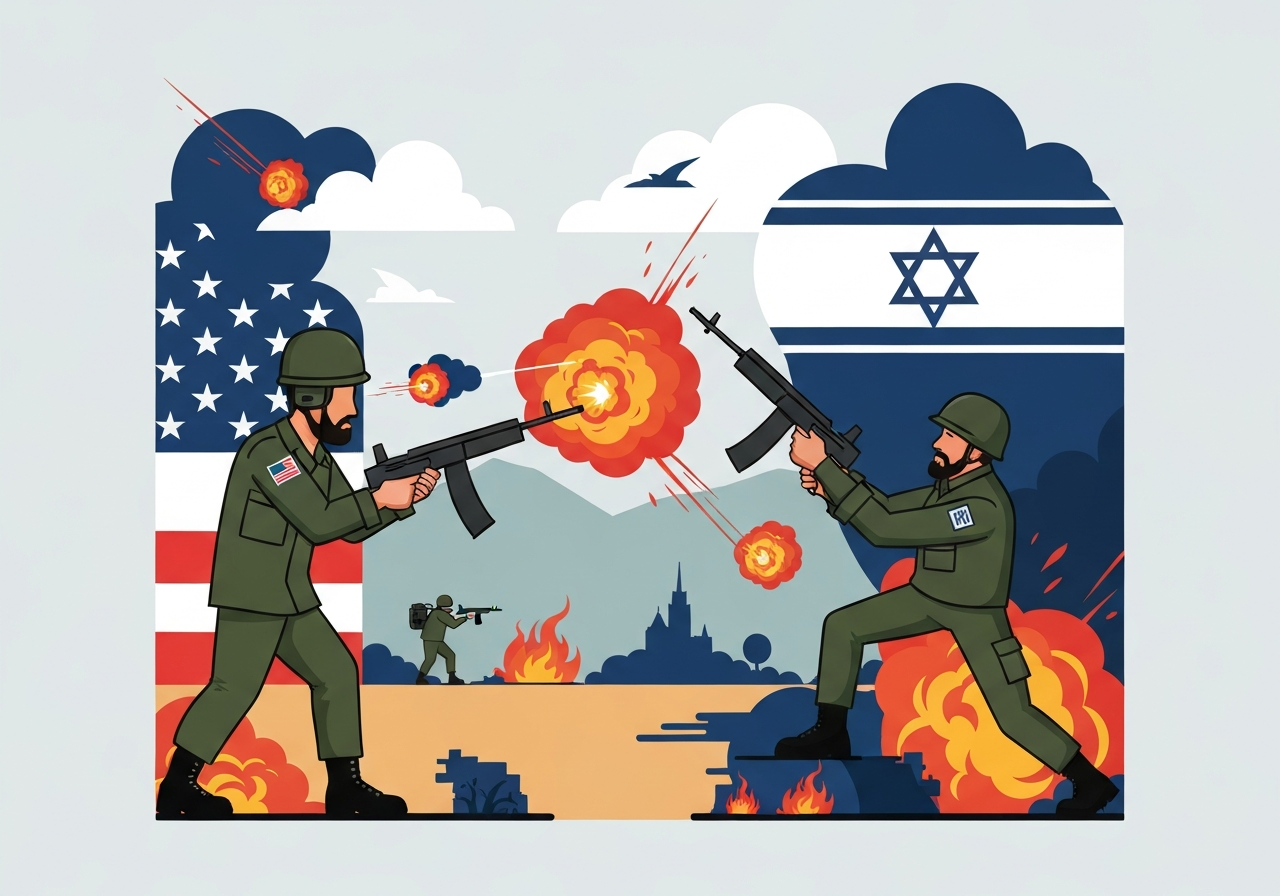
Lead: On Feb. 27–28, 2026, U.S. and Israeli forces carried out coordinated strikes across Iran, including an attack reported near the compound of Supreme Leader Ayatollah Ali Khamenei in Tehran. The strikes prompted immediate retaliatory launches by Iran’s Islamic Revolutionary Guard Corps toward Israel and raised alarms across the Gulf as airspace closures and sirens spread from Kuwait to Jordan. U.S. President Donald Trump publicly urged Iranians to “take over your government,” framing the operation as a bid to pressure or halt Tehran’s nuclear advances. The exchanges have set off regional military alerts and widespread diplomatic warnings.
Key Takeaways
- Strikes occurred Feb. 27–28, 2026, with explosions reported in Tehran and other Iranian cities; one early strike targeted the area around Ayatollah Ali Khamenei’s compound (Khamenei, age 86).
- Washington characterized the operation as “major combat operations” aimed in part at constraining Iran’s nuclear and related programs; President Trump said the U.S. assembled an extensive naval and air force presence beforehand.
- Iran’s Revolutionary Guard said it launched a “first wave” of drones and missiles at Israel in retaliation; Israeli authorities reported incoming fire and activated national defenses.
- Bahrain reported a missile strike on the U.S. Navy’s 5th Fleet headquarters; Kuwait, Qatar and other Gulf states reported explosions or sounded civil defense alerts; Iraq and the UAE closed airspace.
- U.S. embassies in Qatar, the UAE and Israel ordered staff to shelter in place; several Israeli hospitals shifted patients and procedures to underground spaces as a precaution.
- Iran maintains it has not enriched uranium since June but has prevented some international inspectors from accessing certain sites; satellite imagery has shown renewed activity at facilities previously struck in a 12-day conflict.
- Iran’s self-declared limit on ballistic missiles is 2,000 km (1,240 miles), putting much of the Middle East and parts of eastern Europe within range.
Background
For years, tensions between Tehran and Washington — and between Iran and Israel — have revolved around Iran’s nuclear program, its ballistic missile capabilities and its support for proxy groups across the region. Diplomatic efforts to limit Iran’s enrichment and delivery systems have repeatedly stalled; in recent months, U.S. warships and strike aircraft moved into the region amid sharp rhetoric from both sides. That buildup coincided with escalating domestic unrest inside Iran, which U.S. officials said they were seeking to exploit to press Tehran to make concessions.
Past Israeli and U.S. strikes on Iranian-linked sites have focused on nuclear-related facilities, command-and-control centers and proxy infrastructure. Iran has repeatedly pledged to respond to direct attacks; the Islamic Revolutionary Guard Corps (IRGC) has invested heavily in missile and drone forces intended to project power against regional adversaries. Gulf states and U.S. partners have grown increasingly anxious about spillover effects, including threats to shipping in the Red Sea and to military bases hosting U.S. forces.
Main Event
The first reported explosions were heard in downtown Tehran near the complex linked to Supreme Leader Ayatollah Ali Khamenei; authorities sealed roads in the area and state broadcasters acknowledged blasts without immediately detailing casualties. Iranian media and witnesses described subsequent detonations across the capital and other regions as the strikes widened. Officials and participants in the operations have not publicly released a full target list, but one U.S.-briefed source said targets included military, intelligence and government-symbolic sites.
President Trump released a social-media video asserting that U.S. forces had begun major combat operations and warning Iranians to take cover during strikes. In that message, he also urged Iranians to seize control of their government after the campaign — language that U.S. officials framed as a call for domestic political change in Tehran rather than a narrow military objective. Prime Minister Benjamin Netanyahu said the joint action sought to remove an “existential threat” posed by Iran.
Within hours, Iran’s IRGC reported launching a first wave of drones and missiles toward Israel; Israeli defenses engaged incoming threats and authorities reported explosions and interception operations. Bahrain declared a missile hit near the U.S. Navy’s 5th Fleet headquarters, while witnesses in Kuwait and Qatar reported alarms and blasts. Several regional airspaces were temporarily closed as militaries tracked incoming and outgoing missiles and assessed damage.
Analysis & Implications
The strikes mark a major escalation between Iran and a U.S.-Israeli coalition and risk broadening into a wider regional conflict. Even if the initial campaign aims to degrade specific capabilities — such as facilities tied to uranium processing or command centers — the public call for regime change raises the political stakes and could harden Iranian domestic resolve rather than prompt an immediate collapse of central authority. Tehran’s ability to retaliate through missiles, drones and proxies gives Iran multiple asymmetric options to impose costs on U.S. forces and allied states.
Economically and logistically, the region faces near-term disruptions: shipping lanes in the Red Sea and Gulf routes could be targeted by Iran-aligned groups or the Houthi movement backed by Tehran, threatening commercial traffic and energy supplies. Insurance and freight costs could spike quickly if attacks on maritime routes intensify. For global markets, any protracted confrontation would increase oil-price volatility and complicate already-fragile supply chains.
Diplomatically, allies will be pressured to choose how openly to support further operations, complicating NATO and Arab partner relationships with Washington and Tel Aviv. Countries that had sought to mediate nuclear discussions or de-escalate tensions will face tough choices about sanctions, basing rights and diplomatic recognition of post-conflict arrangements. The long-term effect on Iran’s nuclear trajectory is uncertain: strikes can set back infrastructure but may also accelerate clandestine activity or harden Iran’s technical resolve.
Comparison & Data
| Item | Detail |
|---|---|
| Iran missile range | 2,000 km (1,240 miles) — regional coverage includes most Middle East and parts of eastern Europe |
| Reported strike dates | Feb. 27–28, 2026 |
| Target types (reported) | Military installations, intelligence sites, government-symbolic locations |
The 2,000 km range commonly cited by Iranian statements places capitals such as Riyadh, Baghdad, Jerusalem and parts of southeastern Europe within reach, shaping how neighboring states calibrate civil defenses and asset deployments. Historical comparisons to the prior 12-day war show satellite-detected reconstruction activity at some sites, suggesting efforts to assess or recover materials after earlier damage.
Reactions & Quotes
International and domestic reactions were immediate and intense, spanning official condemnations to calls for restraint.
“For 47 years, the Iranian regime has chanted ‘Death to America’… When we are finished, take over your government. It will be yours to take.”
U.S. President (video statement)
President Trump framed the operation as a culmination of long-standing grievances and directly appealed to Iranians to act politically after the strikes, language that some analysts say blurs military objectives with regime-change rhetoric.
“Our joint operation will create the conditions for the brave Iranian people to take their fate into their own hands.”
Israeli Prime Minister
Prime Minister Netanyahu tied the military action to Israel’s national security argument, describing the campaign as necessary to eliminate what his government calls an existential threat.
“The time has come to defend the homeland and confront the enemy’s military assault.”
Iran Foreign Ministry (statement on X)
Tehran’s foreign ministry emphasized a readiness to defend the country and promised response, language that preceded IRGC reports of retaliatory launches.
Unconfirmed
- Whether Supreme Leader Ayatollah Ali Khamenei was present at the struck compound at the time of the initial explosions remains unverified.
- Full casualty and damage assessments for strikes across Iran and the subsequent Iranian response are not yet independently confirmed.
- Claims that the U.S. and Israel intend immediate regime change in Tehran are based on political statements and have not been accompanied by a formal, public transition plan.
Bottom Line
The Feb. 27–28 strikes represent a significant escalation that intermixes military targeting with public political messaging aimed at Iran’s leadership and populace. While the operations may temporarily disrupt specific Iranian capabilities, the broader consequences — retaliation, regional destabilization, and economic disruption — are likely to unfold over weeks to months rather than be resolved quickly.
For policymakers and regional actors, the immediate priorities will be preventing escalation to full-scale war, protecting civilian infrastructure and shipping, and securing diplomatic channels to manage humanitarian and security fallout. Independent verification of targets, casualties and strategic intent will be essential for governments and analysts seeking to assess whether this episode reshapes the long-term trajectory of Iran’s nuclear and regional policies.