
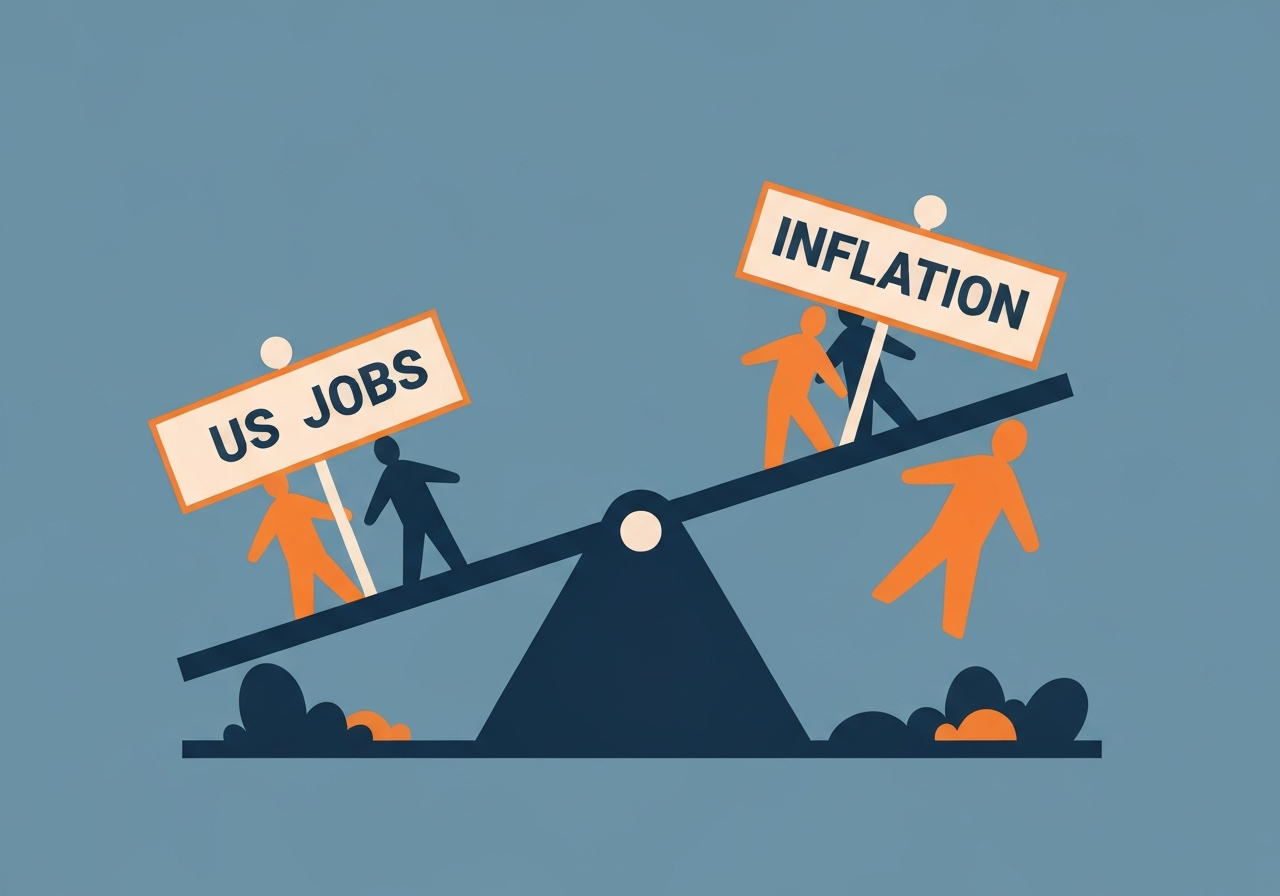
Investors and policymakers face a compact, consequential week as two major U.S. economic releases arrive within days of each other. The January jobs report is scheduled for Wednesday and the Consumer Price Index (CPI) for Friday, a timing shift caused by a recent partial government shutdown that delayed both releases. The back-to-back cadence compresses the information flow that markets and the Federal Reserve normally get over two weeks into a single session. Traders and officials say the paired readings could sharpen volatility and complicate policy interpretation.
Key Takeaways
- The January jobs report is due Wednesday and the CPI is set for Friday, following delays tied to a partial government shutdown that pushed both releases later than usual.
- Normally the employment report appears on a Friday and CPI is published the following week; this week’s schedule is compressed, concentrating two headline data points into three trading days.
- Market participants expect heightened intraday volatility as the jobs and inflation figures arrive in quick succession, increasing the chance of rapid repricing of Treasury yields and equities.
- The Federal Reserve has emphasized data-dependence; these sequential releases raise the odds that policy expectations could swing in response to mixed signals on labor and prices.
- Economic firms and analysts will be scrutinizing payrolls, the unemployment rate, average hourly earnings, and the CPI’s core and headline readings for signs of persistent inflation or labor-market cooling.
- Operationally, some market desks and statistical aggregators noted logistical strain from processing two headline releases in a compressed window.
Background
The two reports are among the most closely watched monthly economic indicators. Employment data provide a direct read on labor-market strength—payroll gains, jobless rates, and wage trends—while CPI captures month-to-month changes in consumer prices. Policymakers at the Federal Reserve and market strategists lean on both to judge whether inflation is cooling toward the Fed’s objective or remaining stubbornly above target.
In early February 2026 a partial federal government shutdown disrupted the Bureau of Labor Statistics’ usual release calendar, prompting the agency to shift publication dates by a few days. That left the normally spaced releases unusually adjacent: payrolls typically appear on a Friday with CPI the following week. The compressed schedule leaves less time for analysts to digest one report before the next arrives.
Main Event
On Wednesday the Bureau of Labor Statistics will publish the January employment snapshot, including nonfarm payrolls, the unemployment rate, and average hourly earnings. These components will be assessed for signs of labor-market resilience or cooling; payroll additions and wage growth are especially scrutinized as inputs to core inflation dynamics. Market consensus will form around payrolls and wage momentum ahead of Friday’s price data.
Friday’s CPI release will report headline and core inflation for January. Core CPI—excluding food and energy—often draws the most attention for monetary policy because it filters volatile categories. Analysts will compare month-to-month and 12-month changes and examine whether shelter, services, and goods components signal persistent inflationary pressure.
Because the releases are so near each other, initial market moves after Wednesday’s payrolls could be amplified or tempered by Friday’s CPI reading. If payrolls come in stronger than expected but CPI slows, markets may split the difference; if both surprise in the same direction, moves in Treasuries, swaps and equities could be rapid and pronounced.
Analysis & Implications
The compressed timing raises interpretive challenges for the Federal Reserve. Historically, policymakers have treated employment and inflation as joint inputs; when both point in the same direction, the signal for policy is clearer. This week the Fed will have to weigh nearly contemporaneous signals that may not allow for a calm, sequential readjustment of expectations.
For markets, the risk is heightened volatility and whipsaw trading. Algorithmic strategies and short-term traders may amplify moves as they react to payrolls and then to CPI. Longer-horizon investors will focus on whether the combined data alter the path of expected policy rates implied by futures and swaps markets.
Economically, a stronger payrolls print paired with elevated CPI could increase the likelihood of a slower easing cycle, keeping borrowing costs higher for longer. Conversely, weaker employment and easing inflation could embolden bets on rate cuts. The tight sequencing means one release could materially change how the other is interpreted, complicating forecast updates and risk positioning.
Comparison & Data
| Item | Normal Schedule | This Week |
|---|---|---|
| Employment report | Friday of release week | Wednesday (delayed) |
| Consumer Price Index (CPI) | Following week (after jobs) | Friday (same week) |
| Cause | Regular BLS calendar | Partial government shutdown delayed releases |
Compressing the schedule concentrates headline information that markets normally digest over multiple sessions. Analysts say the closer timing reduces the market’s ability to anchor expectations between releases, increasing the short-run impact of surprises. Historical episodes of back-to-back major releases show elevated intraday volatility and quicker policy-sensitive repricing.
Reactions & Quotes
“Investors are braced for a ‘double whammy’ of jobs and inflation data this week,”
Bloomberg (news report)
“The Consumer Price Index measures the average change over time in the prices paid by urban consumers for a market basket of consumer goods and services,”
Bureau of Labor Statistics (official)
Unconfirmed
- Whether the compressed schedule will materially change the Fed’s near-term policy path remains unconfirmed until both releases are published and markets fully react.
- Estimates of the magnitude of market volatility this week are preliminary; actual intraday moves will depend on the size and direction of any surprises in payrolls and CPI.
- Reports of specific component surprises (for example, shelter or wage subcomponents) are not confirmed until the BLS publishes full underlying tables.
Bottom Line
This week’s unusually tight sequence of the January jobs report and Friday’s CPI compresses two of the most important economic signals into a short window, increasing the potential for rapid market moves and complicating policy interpretation for the Federal Reserve. Analysts and traders should prepare for elevated volatility and for the possibility that one release will substantially alter the market’s read of the other.
For readers tracking the economic outlook, focus on payrolls, wage trends, and core CPI components; those figures will be central to assessing whether inflation is trending toward the Fed’s 2% objective or remains an upside risk. Reliable, primary-source releases from the Bureau of Labor Statistics will be the definitive references as events unfold.
Sources
- Bloomberg — media report on the schedule and market context (news)
- Bureau of Labor Statistics — CPI page (official statistics)
- Bureau of Labor Statistics — Employment Situation (official release schedule and methodology)
- Federal Reserve — policy framework and statements (official)