
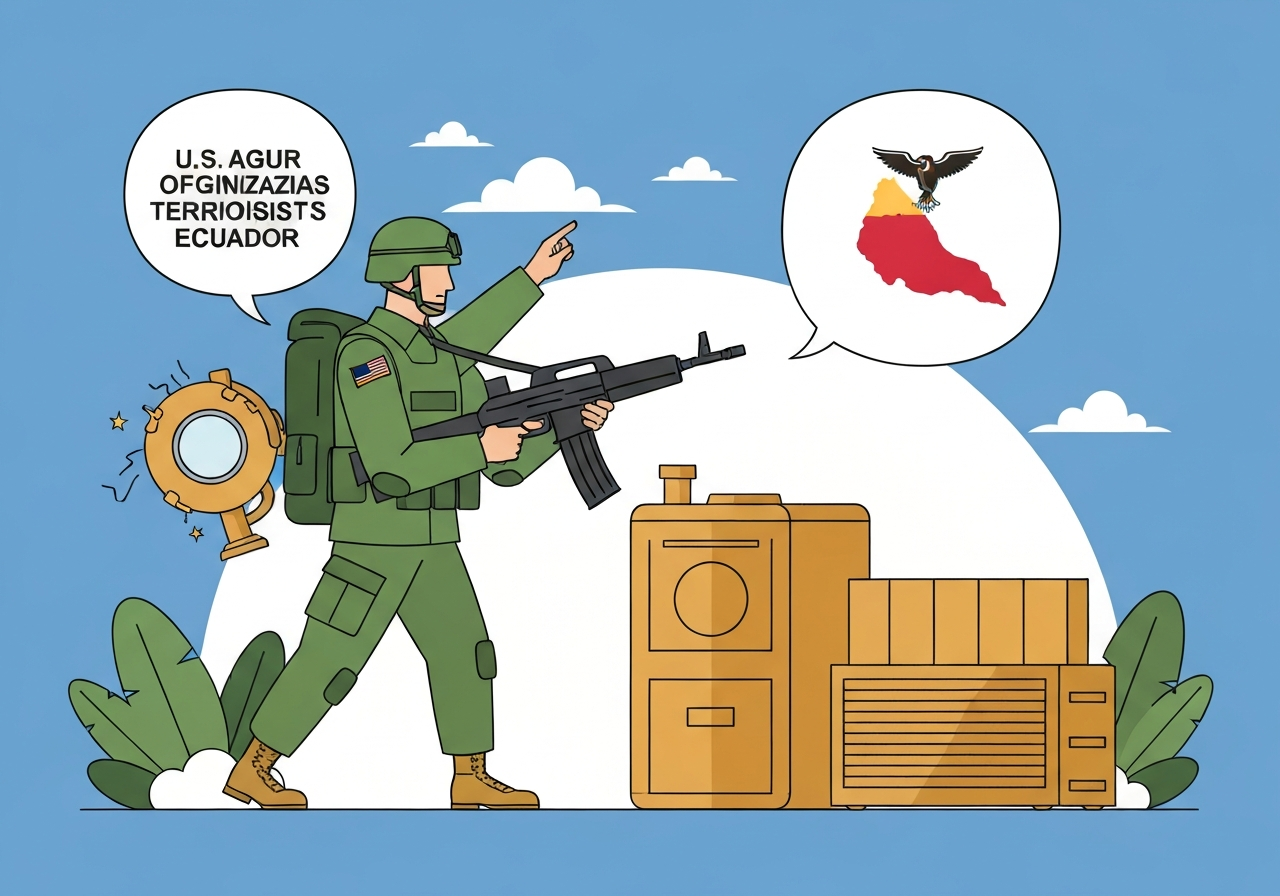
On March 3, 2026, the United States and Ecuador announced coordinated military actions inside Ecuador against groups labeled as “designated terrorist organizations,” according to U.S. officials and a military statement. The operations—publicly framed as targeting drug shipment facilities and other drug-linked sites—involve U.S. Special Forces advising Ecuadorian commandos, with Americans providing planning, intelligence and logistics support. A 30-second video released by U.S. Southern Command showed a helicopter lift and troop movements; U.S. and Ecuadorian officials described that clip as the first of a series of raids. The Pentagon said the move represents a significant expansion of U.S. military activity tied to anti-narcotics efforts in the region.
Key Takeaways
- The joint operations were publicly disclosed on March 3, 2026, and the U.S. Southern Command released a 30-second video of an early raid sequence.
- U.S. Special Forces are advising and supporting Ecuadorian commandos across the country; U.S. personnel are reported to be providing intelligence and logistics but not leading ground assaults.
- The raids are described as targeting suspected drug shipment facilities and other drug-related sites; officials have not disclosed the number of raids or confirmed their outcomes.
- The action appears to broaden previous U.S. measures, including unilateral strikes against boats in the Caribbean Sea and Eastern Pacific cited by the Trump administration as anti-drug operations.
- U.S. Southern Command called the operations an example of regional partnership against “narco-terrorism,” but provided few operational details in its public release.
Background
Ecuador has faced a sharp rise in organized criminal violence in recent years as transnational trafficking networks expanded along Pacific and Andean corridors. Coastal ports and jungle transit routes have become contested spaces where criminal groups and trafficking cells operate with increasing sophistication. Washington has repeatedly framed parts of its regional security effort as targeting “narco-terrorism,” an umbrella term used to describe criminal groups that resort to terror tactics or hijack local institutions to further drug trafficking.
Under the prior U.S. administration, Washington carried out unilateral strikes against vessels in the Caribbean Sea and the Eastern Pacific that were accused of carrying narcotics, marking a more assertive maritime posture. Those strikes and broader U.S. engagement in the region drew debate over the legal basis and operational transparency of such actions. Ecuador, which has cooperated with U.S. counternarcotics programs in the past, now appears to be extending that cooperation to land-based raids with U.S. advisory support.
Main Event
The Pentagon and Ecuadorian officials reported that U.S. Special Forces have been embedded as advisers to Ecuadorian commando units conducting raids across multiple sites inside Ecuador. According to a U.S. official who spoke on condition of anonymity, Americans are assisting in planning, providing intelligence analysis and arranging logistics support, but are not believed to be actively executing the entry teams on the ground.
U.S. Southern Command released a short video showing a helicopter takeoff and troop movement at dawn or dusk; U.S. officials said the clip depicted the first of what could be multiple operations. Some planned raids will reportedly include U.S. advisers positioned nearby; others will be carried out solely by Ecuadorian forces. Officials have not released the locations targeted, the identities of the organizations under strike, or whether particular missions met their objectives.
U.S. and Ecuadorian spokespeople framed the effort as an intensification of cooperation to disrupt drug shipments and the networks that facilitate them. The Pentagon emphasized partnership and regional security in its public statement, while withholding operational specifics that might reveal tactics, targets or the scale of U.S. involvement.
Analysis & Implications
Legally and politically, the U.S. expansion of advisory roles inside Ecuador raises questions about sovereignty, domestic political optics, and the legal frameworks governing foreign forces supporting partner militaries. Although the United States says it is serving in an advisory capacity, critics and regional observers may scrutinize the degree of U.S. presence and whether it effectively constitutes direct intervention. Ecuadorian political leaders will need to balance national authority and public acceptance against security imperatives to confront heavily armed trafficking groups.
Strategically, the operation signals continuity in U.S. policy emphasizing kinetic and advisory measures against drug trafficking since earlier maritime strikes. Partnering with host-nation forces can enhance actionable targeting information and local legitimacy, but it also transfers reputational and operational risks to the partner government when raids are contested or produce civilian harm. The lack of detail in public statements increases the risk of political backlash if communities perceive foreign involvement as overreach.
Regionally, neighbors and multilateral institutions will watch how Ecuador frames legal authority for these operations and whether similar models of advisory support spread to other Andean states. If effective at disrupting shipment hubs, such operations could degrade trafficking flows temporarily; however, criminal networks often adapt by shifting routes or methods. Long-term success typically depends on parallel efforts in governance, judicial capacity and economic alternatives in affected communities.
Comparison & Data
| Operation Type | Geographic Focus | Typical U.S. Role |
|---|---|---|
| Maritime strikes (recent years) | Caribbean Sea, Eastern Pacific | U.S. naval and air strikes; unilateral targeting of vessels |
| Current joint raids (March 2026) | Across Ecuador (land-based) | U.S. Special Forces advising, intelligence and logistics support |
The table contrasts the recent maritime campaign—characterized by U.S. unilateral strikes at sea—with the March 2026 operation, which is described publicly as advisory support for Ecuadorian commando raids on land. Publicly available details remain limited, so this comparison focuses on declared roles rather than unaudited operational footprints.
Reactions & Quotes
U.S. Southern Command issued a brief public statement highlighting partnership and shared goals but provided few tactical details. The statement framed the operations as part of a broader effort to combat trafficking networks deemed to use terror tactics in the region.
The operations are a powerful example of the commitment of partners in Latin America and the Caribbean to combat the scourge of narco-terrorism.
U.S. Southern Command (military statement)
U.S. officials speaking on background described the American role as advisory. Their accounts stressed planning, intelligence-sharing and logistics, while denying that U.S. troops were conducting the actual raids—a distinction intended to clarify the scope of U.S. engagement.
We are advising and supporting Ecuadorian forces with intelligence and logistics; Ecuadorian troops are leading the on-the-ground entries.
U.S. official (anonymous)
Unconfirmed
- Exact number and locations of raids conducted on March 3, 2026, remain undisclosed by officials.
- Specific identities of the targeted groups described as “designated terrorist organizations” have not been publicly confirmed.
- There is no public confirmation of casualties, arrests, or the tactical success of the initial operations.
Bottom Line
The March 3, 2026 announcement marks a notable deepening of U.S. military engagement in Ecuador, shifting some focus from maritime strikes to land-based advisory support for partner commando raids. While U.S. officials emphasize a supporting role, the distinction between advising and participating will be scrutinized by domestic audiences, regional governments, and rights groups—especially if operational details remain opaque or if operations produce unintended harm.
For lasting impact against trafficking networks, short-term raids must be integrated with judicial, governance and economic measures that address the roots of illicit economies. Observers should watch for further disclosures about targets, legal authorizations, and oversight measures that clarify how U.S. involvement is bounded and reviewed.
Sources
- The New York Times — U.S. newspaper (report, March 3, 2026)