
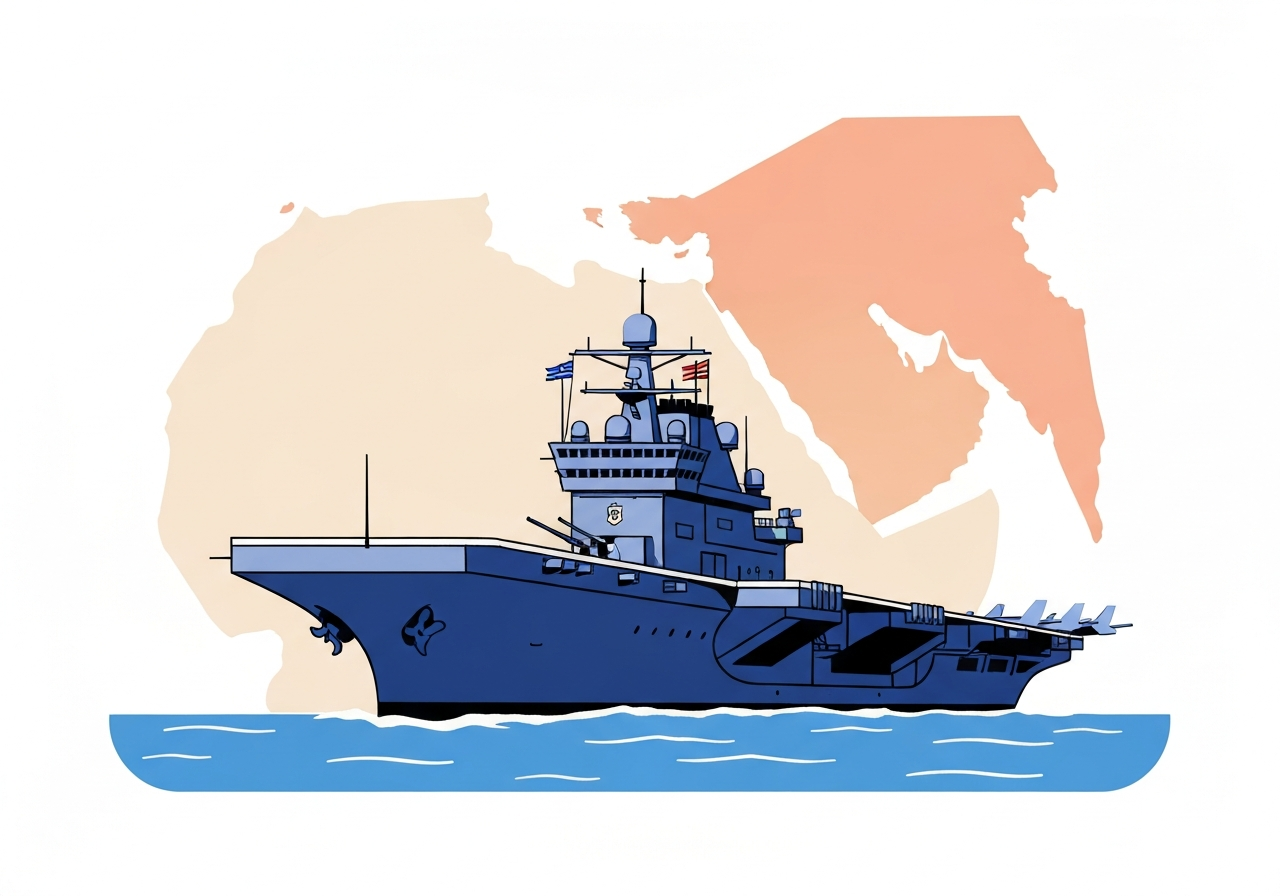
U.S. officials told The Associated Press on Friday that the Navy will deploy the aircraft carrier USS Gerald R. Ford to the Middle East to join the USS Abraham Lincoln and its escort ships, a move meant to reinforce American military presence amid heightened tensions with Iran. The decision follows indirect U.S.-Iran contacts in Oman and Qatar and comes as President Donald Trump presses Tehran over its nuclear program. Gulf Arab states have warned that any strike risks expanding into a wider regional war while Iranians at home begin 40-day mourning rituals after a deadly government crackdown on protests last month. The White House did not immediately comment on the reported deployment.
Key Takeaways
- The USS Gerald R. Ford is being ordered to the Middle East to back up the USS Abraham Lincoln, creating two carrier strike groups in the region.
- The Abraham Lincoln and its accompanying guided-missile destroyers are currently operating in the Arabian Sea.
- The Ford deployed in late June 2025; the crew will have been away for about eight months in two weeks, raising concerns about an unusually long deployment.
- President Trump has signaled urgency for a deal with Iran, saying negotiations “should happen quickly” and warning failure could be “very traumatic.”
- Indirect U.S.-Iran exchanges occurred this week in Oman and Qatar, but substantive new talks have not materialized publicly.
- Gulf Arab governments cautioned that any military attack on Iran could escalate into a broader regional conflict, given the ongoing Israel–Hamas war in Gaza.
- Iran is marking 40-day mourning ceremonies for those killed in last month’s nationwide protest crackdown, increasing domestic pressure on Tehran.
Background
U.S.-Iran relations have oscillated between negotiation and confrontation since the U.S. withdrew from the 2015 nuclear accord; the current administration has combined diplomatic overtures with visible military pressure. The reported Ford deployment follows a pattern of rapid carrier movements this year: the Gerald R. Ford was redirected from the Mediterranean to the Caribbean in October for a Venezuela-related strike force and later sailed toward other theaters as geopolitical priorities shifted. President Trump has publicly pushed for a quick resolution with Tehran while also threatening harsher measures if diplomacy fails, creating a dual-track of incentives and pressure.
Regionally, Gulf Arab states remain wary of unilateral military action that could widen conflicts across the Middle East, particularly as the Israel–Hamas war continues to reverberate through the area. Israel has urged the U.S. to press Iran to curb ballistic missiles and limit support for proxy groups such as Hamas and Hezbollah as part of any broader agreement. At the same time, Iran faces significant domestic unrest after a monthslong wave of protests and a forceful government response; families are now holding traditional 40-day mourning ceremonies that can reinvigorate public grievance.
Main Event
The deployment, disclosed to AP by a person familiar with the plans who spoke on the condition of anonymity, will bring the Ford into a theater where the Abraham Lincoln and its escorts are already operating. The move will effectively place two carrier strike groups and their supporting warships within reach of Iranian waters and strategic choke points like the Arabian Sea and Strait of Hormuz. U.S. military officials routinely rotate ships and carrier strike groups, but the timing and concentration of forces reflect heightened focus on Iran amid stalled public progress in diplomacy.
The Ford left on its current deployment in late June 2025; based on the reported timeline, the crew will reach roughly eight months at sea within a fortnight. Navy deployments vary, but that duration is longer than typical carrier patrol cycles and could mean extended time away from home port for sailors and air wings. How long the Ford will remain in the Middle East was not disclosed, and Pentagon officials did not issue an immediate confirmation to news inquiries.
The reported deployment followed comments by President Trump this week indicating both a readiness to negotiate and a warning to Tehran about consequences if a deal is not reached. Israeli Prime Minister Benjamin Netanyahu spoke with Trump as well, pressing for a U.S. stance that would address Iran’s missile program and regional support for armed groups. Gulf partners, mindful of spillover risks, have privately and publicly urged restraint while emphasizing deterrence.
Analysis & Implications
Sending a second carrier to the Middle East increases U.S. visible firepower and can serve multiple strategic aims: deterrence, reassurance to regional allies, and leverage in parallel diplomacy. Carrier strike groups provide a highly mobile, layered capability—airpower, missile defense, and command-and-control—that can be used to signal intent without immediately escalating to kinetic action. However, concentrated naval presence also raises the chance of miscalculation: closer proximity of forces to Iranian assets and proxies increases interaction points where incidents can spiral.
For Tehran, the added U.S. naval posture is likely to be portrayed domestically as coercion, strengthening hard-line narratives even as the government copes with internal unrest. The 40-day mourning rituals could amplify public anger and constrain Iranian leaders’ willingness to appear conciliatory, complicating diplomatic openings. Conversely, Iran might calculate that demonstrating resilience at home and limited asymmetric responses abroad better preserves deterrence than direct military escalation.
Operationally, extended carrier deployments strain maintenance cycles, air wing readiness, and crews’ morale. A Ford crew approaching eight months at sea will press Navy logistics and personnel policies; prolonged patrols can necessitate adjustments in rotation plans, carrier strike group sustainment, and allied burden-sharing. Politically, the deployment signals to partners—particularly Israel and Gulf states—that Washington is prepared to back its demands on Iran with force posture, while leaving diplomatic channels open.
Comparison & Data
| Asset | Location (reported) | Deployment start | Notes |
|---|---|---|---|
| USS Gerald R. Ford (CVN‑78) | En route to Middle East | Late June 2025 | Crew will reach ~8 months deployed in two weeks |
| USS Abraham Lincoln (CVN‑72) | Arabian Sea | Previously deployed | Accompanied by guided‑missile destroyers |
The table summarizes carrier presence as reported. Placing two carriers in the same theater is less common than single-carrier rotations and increases the number of deployable combat sorties and continuous on-station air patrols. Analysts will watch supply chains, sortie rates, and port calls for signs of how long the Navy intends to sustain this force posture.
Reactions & Quotes
Officials and regional leaders framed the deployment as both a deterrent and a potential accelerant, reflecting the delicate balance of military signaling and diplomacy.
“It should happen quickly. They should agree very quickly.”
Donald Trump, U.S. President
“Any attack could spiral into another regional conflict.”
Gulf Arab officials (statement to media)
Unconfirmed
- Exact length of the Ford’s stay in the Middle East remains undisclosed; official timelines have not been released.
- Whether the deployment is primarily deterrent posturing or prepares forces for potential kinetic options has not been publicly confirmed.
- Reports of indirect exchanges in Oman and Qatar did not produce publicly verifiable progress toward a negotiated settlement.
Bottom Line
Deploying the USS Gerald R. Ford alongside the Abraham Lincoln signals a stepped-up U.S. military posture aimed at pressuring Iran while supporting allied deterrence. The move increases U.S. operational options and reinforces messages to Tehran that Washington is prepared to use forceful leverage if diplomacy stalls.
At the same time, concentrated carrier presence elevates the risk of inadvertent escalation, particularly as Iran deals with internal unrest and regional partners fear spillover from the Israel–Hamas war. Watch for official Pentagon confirmations, carrier rotation notices, and any change in Iran’s public stance or asymmetric responses as immediate indicators of whether this posture will de‑escalate or entrench the standoff.
Sources
- Associated Press — news agency report (primary reporting)