
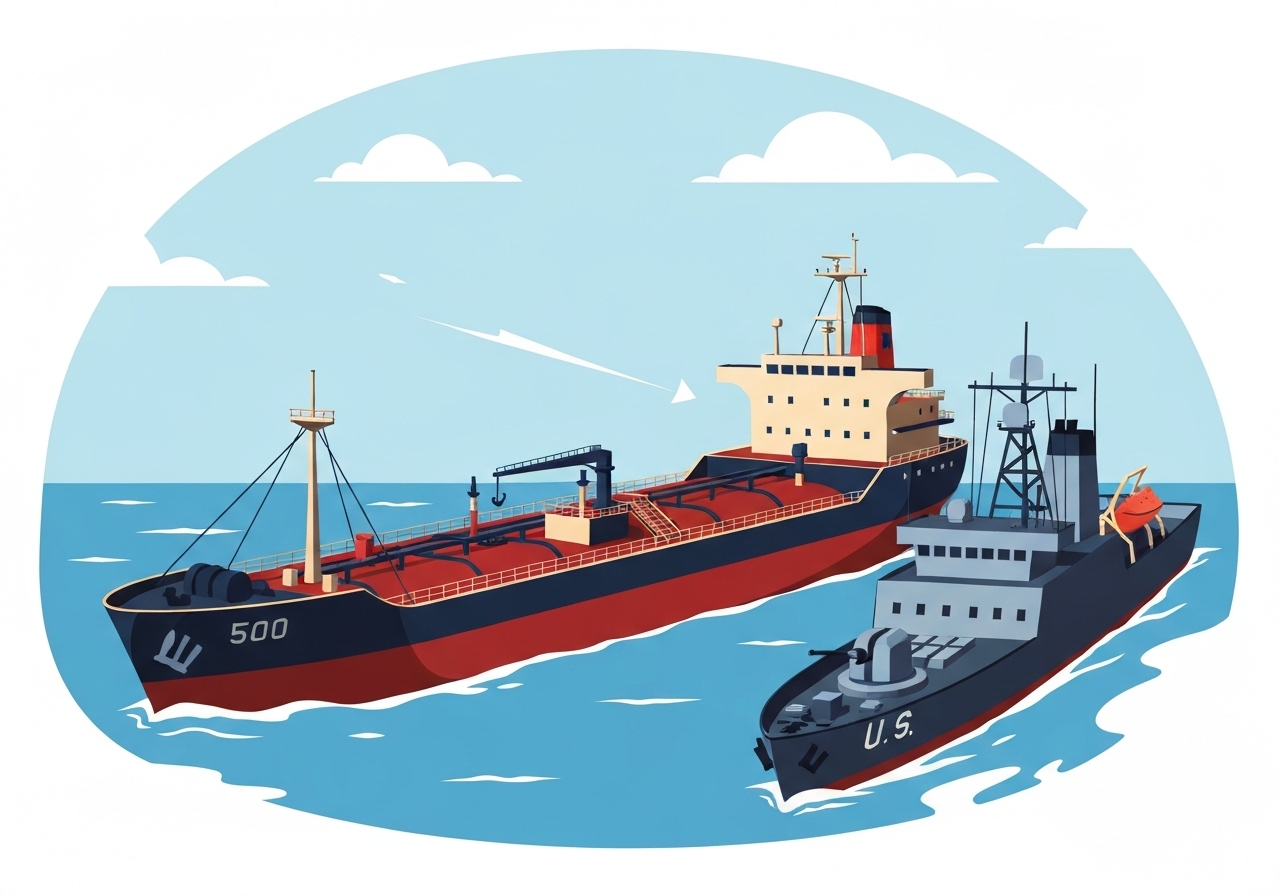
— President Donald Trump announced that U.S. forces seized a large oil tanker off the coast of Venezuela as tensions with President Nicolás Maduro’s government escalated. The administration says the vessel carried roughly 2 million barrels of heavy crude, about half reportedly tied to a Cuban state importer, and that the operation was conducted under U.S. law-enforcement authority. The Coast Guard, supported by the Navy and deployed from the aircraft carrier USS Gerald R. Ford, boarded the ship by helicopter in a high-profile interdiction. Venezuelan officials condemned the action as theft and piracy, while U.S. lawmakers and legal experts raised questions about the move’s scope and legality.
Key takeaways
- The seizure occurred on Dec. 10, 2025, and involved a tanker identified by U.S. officials as the Skipper, formerly known as M/T Adisa.
- U.S. officials say the ship departed Venezuela around Dec. 2 with ~2 million barrels of heavy crude; documents indicate roughly half was linked to a Cuban state-run oil importer.
- The operation was led by the U.S. Coast Guard with Navy support; personnel fast-roped from helicopters launched from USS Gerald R. Ford.
- The Adisa/Skipper was previously sanctioned by the U.S. in 2022 for ties to a shadow tanker network accused of serving Iran’s Islamic Revolutionary Guard Corps and Hezbollah.
- Venezuela called the seizure an act of piracy; President Maduro framed it as proof the U.S. seeks his country’s natural resources.
- Congressional critics say the action undermines the administration’s stated anti-narcotics rationale for its regional military campaign, which has included strikes that officials say killed 87 people in 22 known strikes since early September.
- The White House has not released full operational details; Defense and Coast Guard officials have referred questions to central command channels and to the White House.
Background
Venezuela holds the world’s largest proven oil reserves and exports oil that remains central to the government’s revenue through state-owned Petróleos de Venezuela S.A. (PDVSA). Production has fallen from historical highs, but the country still produces roughly 1 million barrels per day; oil transactions have increasingly relied on intermediaries and shadow logistics to evade sanctions imposed in recent years.
Sanctions and pressure campaigns against the Maduro government, expanded in 2019 and reinforced in subsequent administrations, prompted Venezuela to work through complex networks of shell companies, intermediaries and so-called ghost tankers. In 2022 the U.S. Treasury sanctioned vessels including the M/T Adisa, citing a network that allegedly smuggled crude on behalf of Iran’s Islamic Revolutionary Guard Corps and Lebanon’s Hezbollah.
Main event
According to U.S. officials who spoke on condition of anonymity, Coast Guard teams transported by helicopter from the carrier USS Gerald R. Ford boarded the tanker during a daytime operation. Video shared by Attorney General Pam Bondi shows personnel fast-roping to the vessel and moving through its superstructure with weapons drawn.
The U.S. official named the vessel as the Skipper, saying it left Venezuela around Dec. 2 carrying about 2 million barrels of heavy crude. Internal PDVSA documents reviewed by reporters indicate roughly half the cargo was associated with a Cuban state-run oil importer; those documents were shared on condition of anonymity.
President Trump told reporters at the White House the tanker was seized “for a very good reason” and when asked about the oil’s fate replied, “Well, we keep it, I guess.” The Coast Guard characterized the action as conducted under U.S. law-enforcement authority, while Venezuelan officials condemned the move as theft and international piracy.
The operation follows an expanded U.S. military presence in the Caribbean, including the deployment of USS Gerald R. Ford and a campaign of strikes against vessels the U.S. says were involved in narcotics trafficking. U.S. officials have described the strikes as targeting drug-smuggling boats; critics counter that some strikes appear to have caused civilian casualties and raise legal questions.
Analysis & implications
Seizing a civilian merchant vessel on the high seas is rare and legally complex. The U.S. says it acted under domestic law-enforcement authority, but the operation touches on international maritime law, the law of the sea, and contested questions about extraterritorial enforcement. If upheld, the action could set a precedent for more assertive interdictions of sanctioned shipping networks.
Economically, interdictions aimed at PDVSA-linked cargoes can squeeze a vital revenue stream for the Maduro government, but they also risk wider market disruption. A single cargo of 2 million barrels represents roughly two days of current Venezuelan production at about 1 million barrels per day; repeated interdictions could hinder Venezuela’s ability to trade and deepen shortages domestically.
Politically, the move escalates tensions with Caracas and with countries that receive Venezuelan oil, including Cuba. Maduro’s framing—calling the seizure proof the U.S. targets Venezuela’s natural resources—will likely reinforce domestic narratives of foreign aggression and could rally nationalist support at home.
Diplomatically, the seizure complicates U.S. relations in the region. Allies and partners will weigh support for sanctions enforcement against the risk of being drawn into disputes over maritime seizures and potential retaliation. In Congress, critics on both sides raised constitutional and oversight concerns, and calls for unedited strike footage and fuller briefings intensified.
Comparison & data
| Item | Figure | Context |
|---|---|---|
| Seized cargo | ~2,000,000 barrels | Estimated amount aboard the Skipper; documents tie ~50% to a Cuban importer |
| Venezuelan daily production | ~1,000,000 barrels/day | Approximate current national output |
| Strikes since early Sept. | 22 strikes, 87+ dead | U.S. strikes on suspected smuggling boats, number of fatalities reported by officials |
The table above places the seized cargo in perspective: the tanker carried roughly two days’ worth of Venezuelan output at current rates. The casualty figures from the boat-strike campaign—reported as at least 87 dead across 22 strikes—underscore both the intensity of the U.S. interdiction campaign and the human-cost concerns raised by critics and lawmakers.
Reactions & quotes
Administration spokespeople framed the operation as lawful enforcement against a vessel linked to illicit networks, while Venezuelan officials denounced it sharply. Congressional response split largely along partisan and oversight lines, with some Democrats and legal scholars questioning the operation’s motives and legality.
“We’ve just seized a tanker on the coast of Venezuela, a large tanker, very large,”
President Donald Trump
Trump announced the seizure at the White House and said the seizure was justified without providing full operational details. His comment that the oil might be kept drew immediate pushback and raised questions about property rights and disposition of seized cargo under U.S. law.
“For multiple years, the oil tanker has been sanctioned by the United States due to its involvement in an illicit oil shipping network supporting foreign terrorist organizations,”
Attorney General Pam Bondi
Bondi posted video of the boarding and emphasized prior sanctions on the vessel’s previous identity. Her statement links the operation to longstanding U.S. sanctions policy targeting networks allegedly serving sanctioned foreign actors.
“This shows that their whole cover story — that this is about interdicting drugs — is a big lie,”
Sen. Chris Van Hollen (D-Md.)
Sen. Van Hollen, a member of the Senate Foreign Relations Committee, said the seizure undermines the administration’s stated anti-narcotics rationale and suggested the action indicates a push toward regime change by force. His comment reflects growing Congressional scrutiny of the strike campaign.
Unconfirmed
- Full legal basis for retaining the oil and the disposition plan for the 2 million barrels has not been publicly released.
- The precise evidence linking the Skipper’s cargo to terrorist organizations or to the full chain of custody has not been made public by U.S. authorities.
- Independent verification of the PDVSA documents cited by reporters and the exact ownership trail for roughly half the cargo tied to a Cuban importer remains limited.
Bottom line
The seizure marks a sharp escalation in U.S. enforcement against maritime networks tied to Venezuela and sanctioned entities. It demonstrates a willingness to use naval and Coast Guard forces in law-enforcement style boardings, but it also raises complex legal, diplomatic and economic questions that the administration has not fully answered.
Watch for immediate diplomatic fallout from Caracas and reactions from regional partners, increased Congressional oversight and potential legal challenges over property and jurisdiction. The episode could alter the calculus for both Venezuelan trade routes and U.S. enforcement tactics if similar interdictions become more frequent.