
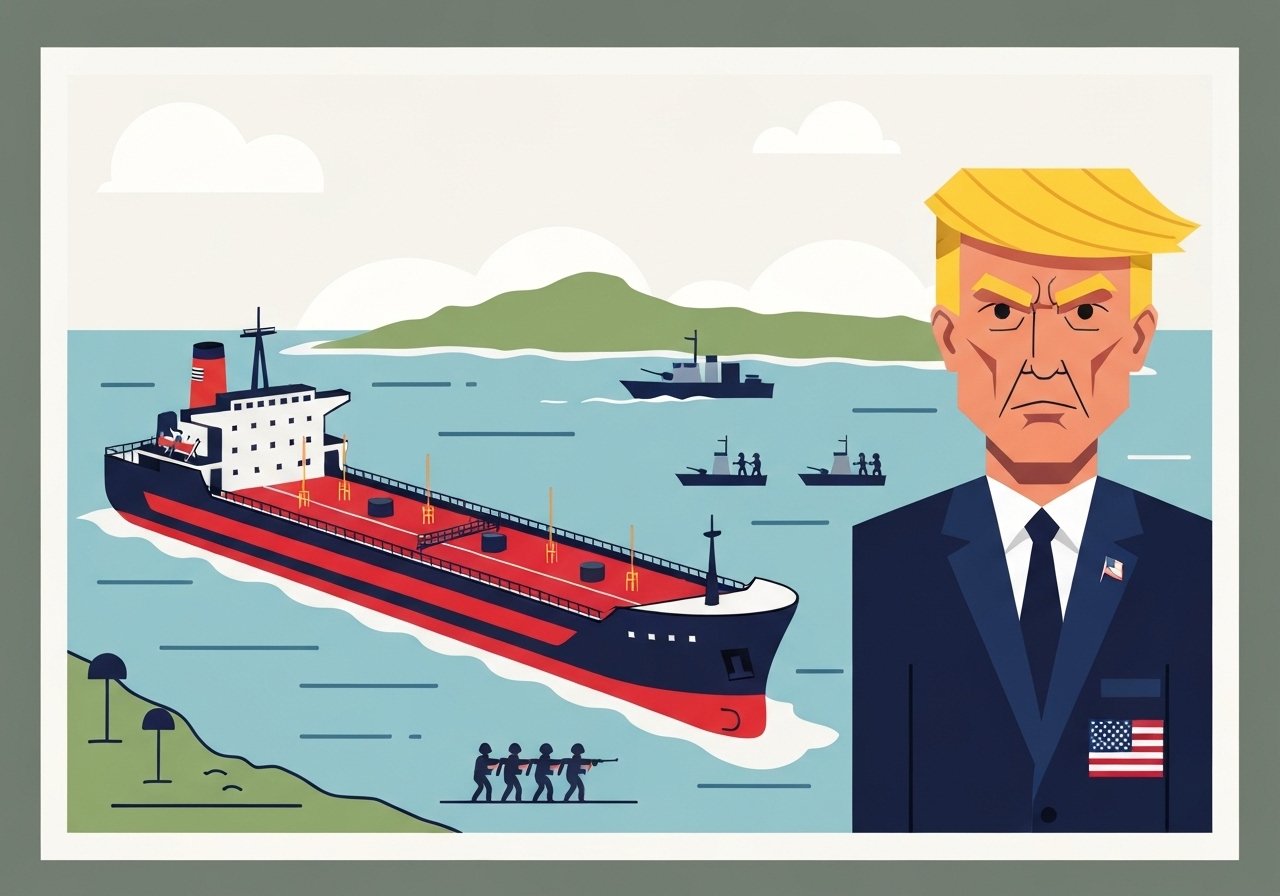
US forces seized a large oil tanker off the coast of Venezuela on Wednesday, President Donald Trump told reporters, marking an abrupt escalation in a months-long campaign of military pressure in the Caribbean. The White House event and subsequent comments by the president added fresh controversy to Washington’s stated counter-narcotics operations, while Venezuelan officials accused the US of targeting the country’s oil wealth. The operation—reported by news agencies to have been led by the US Coast Guard—comes amid a deployment of roughly 15,000 US personnel to the region and renewed scrutiny of legal and diplomatic justifications.
Key Takeaways
- The US announced the seizure of a large tanker off Venezuela on Wednesday; President Trump called it “the largest one ever seized,” without providing full operational details.
- Roughly 15,000 US military personnel are currently deployed in the Caribbean, according to US statements included in coverage of the incident.
- Since early September, US forces have carried out more than 20 strikes at sea against vessels alleged to be carrying drugs, with reports of over 80 people killed in those actions.
- The US administration cites counter-narcotics objectives; Venezuela and some regional voices say the move risks appearing aimed at seizing oil reserves.
- US company Chevron operates in Venezuela under a Treasury license that exempts it from broad oil sanctions, a complicating factor in the energy and sanctions landscape.
- News agency reports indicated the US Coast Guard led the tanker operation; the White House has said additional information and imagery will be released later.
- Oil futures reacted to the news, briefly spiking and raising questions about short-term fuel prices and market sensitivity to geopolitical moves in the region.
Background
Over recent months the Trump administration has publicly framed a military build-up in the Caribbean as part of a stepped-up campaign against drug trafficking into the United States, especially fentanyl and cocaine. That deployment—described by officials as non-international armed conflict with transnational traffickers—has included aircraft carriers, guided-missile destroyers and amphibious ships.
Venezuela’s government, led by President Nicolás Maduro, rejects that framing and has repeatedly accused the US of using counter-narcotics operations as a pretext to exert political pressure or gain access to Venezuela’s sizable oil reserves. The country’s oil sector remains subject to wide-ranging sanctions, although some firms, notably Chevron, operate under specific US permissions to work with Venezuela’s state oil company, PDVSA.
Main Event
President Trump first told reporters at a White House event on Wednesday afternoon that a large tanker had been seized near Venezuela and promised further details and images. Later exchanges with the press included the president saying the vessel was taken “for a very good reason” and, when asked about the oil aboard, saying: “Well, we keep it, I guess.”
News agency reporting cited anonymous US officials saying the Coast Guard led the operation; the White House has not yet published a formal operational summary explaining legal grounds, the vessel’s flag, ownership or planned disposition of the cargo. Journalists and analysts immediately flagged questions about maritime jurisdiction, the legal basis for seizure on the high seas and whether the action falls within established counter-narcotics authorities.
The seizure followed weeks of maritime strikes and interdictions attributed by US authorities to narcotics interdiction efforts. US officials have described strikes on boats in international waters since early September that the administration says disrupted shipments and targeted organized criminal networks; legal experts have publicly questioned the lawfulness of some strikes.
Analysis & Implications
Legally, the seizure raises immediate questions: Was the tanker in territorial waters or on the high seas? Under what authority did the US act? International maritime law allows for interdiction in certain circumstances, but large-scale seizures of commercial tankers are rare and can carry significant diplomatic fallout if the legal basis is unclear or contested.
Politically, the action plays into two overlapping narratives. For the Trump administration, high-profile interdictions underline a hardline approach to drugs and migration that resonates domestically. For the Maduro government and sympathetic regional actors, the move can be cast as economic coercion—confirming long-held suspicions that the US seeks access to Venezuelan energy assets.
Economically, the seizure briefly pushed oil futures higher, highlighting how security incidents in Venezuela—home to some of the world’s largest proven oil reserves—can quickly affect markets. Any sustained escalation, or disruption to Venezuelan exports, would carry broader implications for regional fuel prices and supply chains.
Comparison & Data
| Metric | Figure |
|---|---|
| US personnel deployed in Caribbean | ~15,000 |
| US maritime strikes since early September | >20 |
| Reported fatalities linked to strikes | >80 |
| Reported operation leader | US Coast Guard (agency report) |
These figures sketch the scale of US activity in the region and the intensity of recent maritime operations. Analysts note the combination of personnel numbers and repeated strikes suggests a sustained campaign rather than sporadic interdictions.
Reactions & Quotes
“As you probably know, we’ve just seized a tanker on the coast of Venezuela… the largest one ever seized actually,”
Donald Trump, US President (remarks to reporters)
Trump’s comments framed the action as decisive and noteworthy, but his office has not yet released a full accounting of the legal rationale or operational details.
“The US is trying to grab Venezuela’s oil reserves,”
Venezuelan government statement (paraphrase)
Venezuelan officials immediately characterised the seizure as evidence of economic aggression; similar themes were expressed by some Caracas residents and regional critics who view US moves with suspicion.
“The operation was led by the US Coast Guard,”
News agency report citing US officials
Agency reporting provided a preliminary attribution of command to the Coast Guard but relied on anonymous sources; independent confirmation and official documentation remain pending.
Unconfirmed
- Whether the seized tanker was flying a Venezuelan flag has not been publicly confirmed by US officials or independently verified.
- No official public document has yet detailed the legal authority invoked for the seizure, leaving questions about jurisdiction and justification unresolved.
- It is unconfirmed whether the seizure signals the start of a broader naval blockade or a limited interdiction tied strictly to counter-narcotics operations.
Bottom Line
The tanker seizure marked a clear intensification in US actions around Venezuela and will test legal, diplomatic and market responses in the coming days. Absent a full public accounting from Washington, the operation will fuel competing narratives: a US claim of law enforcement and a Venezuelan claim of economic aggression.
Watch for official documents describing the legal basis for the operation, shipping and flag-state records for the tanker, and responses from regional governments and international bodies. Those elements will determine whether this remains a high-profile interdiction or evolves into a broader confrontation with lasting political and economic consequences.