
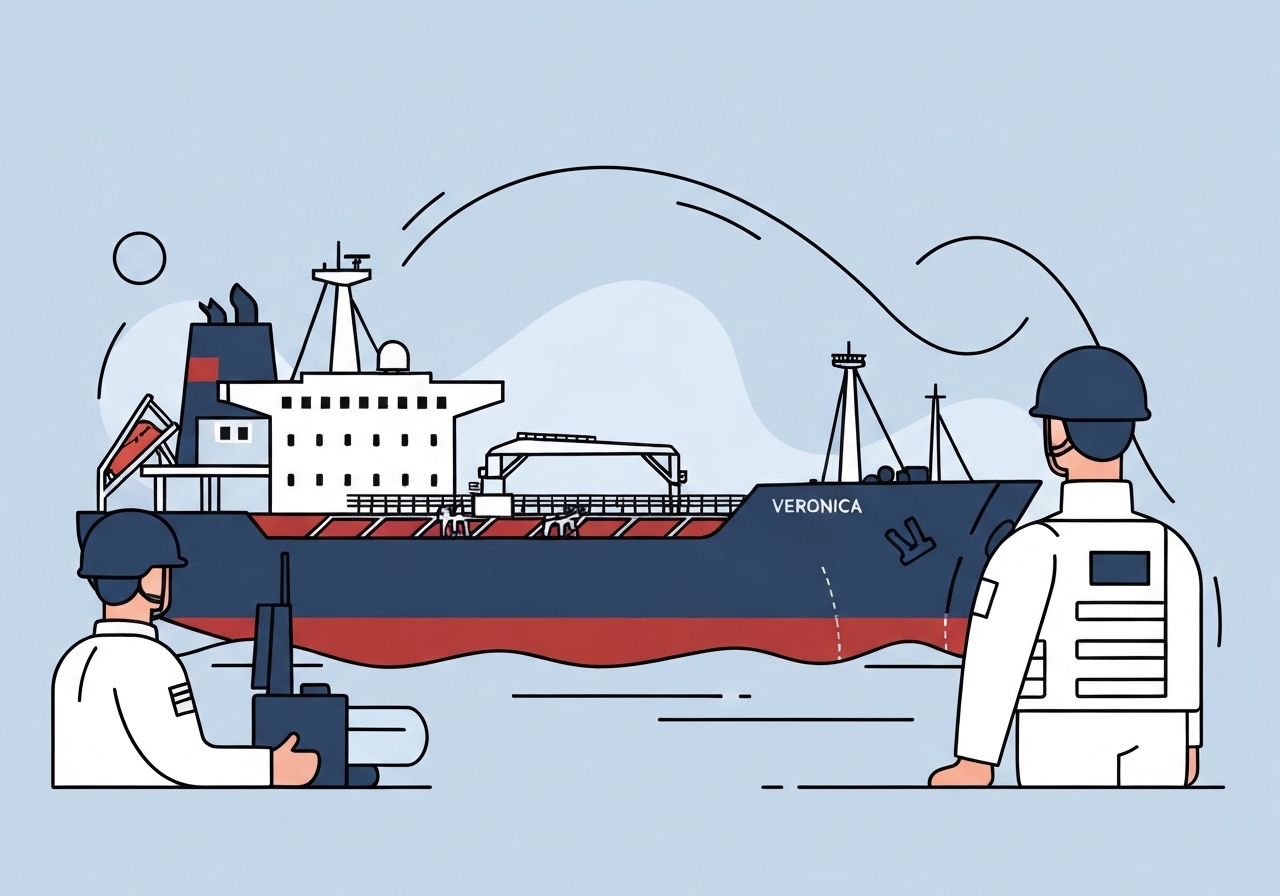
Lead: US military forces boarded and seized the crude oil tanker Veronica in a pre-dawn operation this week as part of President Donald Trump’s campaign to restrict Venezuelan oil exports. The action, announced by US Southern Command and confirmed by Homeland Security Secretary Kristi Noem, was carried out with the Coast Guard and Justice Department and described as compliant with international law. Officials said the Veronica — an 815 ft (249 m) vessel listed in maritime records as flying a Guyanese flag — was taken without incident and is the sixth such interdiction since the capture of Venezuelan president Nicolás Maduro earlier this month. The seizure precedes a scheduled White House meeting between Trump and opposition figure María Corina Machado to discuss Venezuela’s future.
Key Takeaways
- US forces boarded and seized the crude oil tanker Veronica in a pre-dawn action announced by US Southern Command; the vessel is recorded at 815 ft (249 m) in length.
- Homeland Security Secretary Kristi Noem publicly credited the Coast Guard and said the operation complied with international law and targeted vessels breaching a US-established quarantine.
- Maritime tracking showed Veronica’s last public position 12 days earlier off Venezuela; shipping documents cited by Reuters indicate it left Venezuelan waters empty in early January.
- This is the sixth known US military boarding or seizure of a foreign-flagged tanker tied to Venezuela since Maduro’s capture; the first prominent action was the Russian-flagged Marinera on 7 January.
- Southern Command said the action was launched from the aircraft carrier USS Gerald R Ford, repeating that the interdictions are part of Operation Southern Spear.
- US officials say Venezuela has used false-flag registrations or cancelled registrations to disguise shipments, a claim cited in recent interdictions.
- President Trump has announced agreements to secure up to 50 million barrels of Venezuelan crude for US use and issued an order to place Venezuelan oil revenues in US-controlled accounts.
Background
Since early January, the US has intensified naval and maritime interdictions aimed at limiting Venezuela’s ability to move oil products internationally following President Nicolás Maduro’s capture and transfer to the United States. The US strategy combines sanctions, targeted seizures and, according to official posts, a naval quarantine meant to block sanctioned vessels from carrying Venezuelan crude. The campaign has included air strikes on Caracas that Venezuelan officials say killed more than 100 people; those casualty figures have been repeatedly cited by Venezuelan authorities in their responses.
Washington contends Venezuela and affiliated operators use a mix of flag-of-convenience registries and false-flag tactics to obfuscate shipments; US authorities say some vessels had registrations cancelled before interception. The naval interdictions have been coordinated across several US agencies — Southern Command, the Coast Guard, the Department of Homeland Security and the Justice Department — and in at least one case involved assistance from allied militaries. The cumulative effect, US officials say, is to deny Maduro’s government the revenue and logistics to sustain oil exports.
Main Event
US Southern Command announced that marines and sailors launched from USS Gerald R Ford and boarded the Motor/Tanker Veronica in a pre-dawn helicopter insertion, taking control of the vessel without reported resistance. The command published short black-and-white aerial footage that appears to show service members descending onto the tanker’s deck. The post framed the action as another successful phase of Operation Southern Spear and called Veronica part of a fleet operating in defiance of the quarantine on sanctioned vessels in the Caribbean.
Homeland Security Secretary Kristi Noem issued a separate statement praising the Coast Guard and describing the operation as flawlessly executed and consistent with international law. Southern Command’s social-media messaging did not disclose the precise location of the boarding; commercial vessel-tracking records show the ship’s last publicly logged position 12 days earlier off the Venezuelan coast. Reuters reported, citing PDVSA documents and monitoring service tankertrackers.com, that the vessel departed Venezuelan waters empty in early January and had not recently returned.
Officials characterized Veronica as one of several tankers tied to Venezuela that have been intercepted in recent weeks; the US says those ships were operating with opaque registrations or under flags that conceal their links. Earlier in the month, US forces pursued and boarded the Russian-flagged Marinera on 7 January after a multi-week chase across the Atlantic that Western officials say involved a Russian submarine shadowing the vessel. Britain’s Ministry of Defence confirmed assistance in that operation.
Analysis & Implications
The Veronica seizure underscores a stepped-up US effort to choke off Venezuela’s oil revenue streams and control the physical distribution of crude and refined products. By combining carrier-based launch platforms with Coast Guard legal authorities and Justice Department asset controls, the administration is attempting to impose both kinetic and legal restrictions on shipping networks associated with Caracas. If sustained, the campaign could disrupt regional bunkering and ship-to-ship transfer practices that have been used to evade sanctions.
The move also carries diplomatic risk. Intercepting foreign-flagged vessels raises questions about freedom of navigation, flag-state jurisdiction and potential escalation with states whose flagged ships are affected. The boarding of the Russian-flagged Marinera and reports of a Russian submarine’s involvement already injected a military-diplomatic dimension into the maritime operations. Allies’ cooperation — as in the Marinera case — will be politically and operationally important to avoid broader confrontation.
Domestically, the operation reinforces the Trump administration’s public narrative of taking direct control of Venezuela’s assets and post-capture governance. Announcements about securing up to 50 million barrels of crude for the US market and placing revenues into US-controlled accounts indicate a strategy that combines geopolitics with commodity management. However, rerouting crude, prosecuting legal claims and managing storage and refining logistics present complex operational and legal challenges through 2026 and beyond.
Comparison & Data
| Vessel | Flag (reported) | Seizure / Boarding date | Launch platform |
|---|---|---|---|
| Marinera | Russian | 7 January 2026 | Multinational pursuit (US forces; UK MOD assisted) |
| Veronica | Guyanese (maritime records) | Mid January 2026 (pre-dawn) | USS Gerald R Ford, marines/coast guard |
| Olina | Not publicly confirmed | Recent Friday (mid-January 2026) | USS Gerald R Ford |
| Other interdictions | Various | Multiple (early–mid January 2026) | Carrier-based and Coast Guard operations |
This table summarizes publicly reported interdictions with verifiable details. Officials say six boardings/seizures have occurred since early January; names and flags for all interdicted vessels have not been publicly disclosed. The data show a pattern of carrier-launch and Coast Guard coordination, with tracking and shipping records used by independent monitors to confirm last-known positions and cargo status.
Reactions & Quotes
US military posts and administration officials framed the action as lawful enforcement of sanctions and a tactical success in a broader campaign to restrict Venezuelan oil revenue. The public messaging emphasizes interagency coordination and operational readiness while avoiding disclosure of operational specifics such as exact location.
“[Forces] launched from USS Gerald R Ford (CVN 78) and apprehended Motor/Tanker Veronica without incident,”
US Southern Command (official social-media post)
Venezuelan government representatives and allied diplomats have denounced the interdictions and the capture of President Maduro, characterizing US actions as illegitimate and consequential for regional stability. Venezuelan officials have also released casualty figures from the air strikes on Caracas, which they say exceeded 100 killed.
“Heroic Coast Guard men and women once again ensured a flawlessly executed operation, in accordance with international law,”
Kristi Noem, Homeland Security Secretary (public statement)
Internationally, defence and maritime authorities are watching for precedent-setting legal outcomes about custody of seized vessels and disposition of cargo or proceeds. Allies that have cooperated publicly underscore the diplomatic balancing act the US faces as it seeks enforcement without widening the conflict.
Unconfirmed
- The precise geographic coordinates and legal jurisdiction where Veronica was boarded have not been publicly disclosed by US authorities.
- Independent verification of cargo status at the moment of boarding is incomplete; public tracking noted the ship left Venezuela empty in early January but does not confirm later movements.
- Numbers cited by Venezuelan officials for casualties from air strikes on Caracas exceed 100; those figures have not been independently verified in open-source reporting.
Bottom Line
The seizure of Veronica marks a further escalation in the US campaign to exert control over Venezuelan oil flows and revenues following the capture of Nicolás Maduro. Operationally, the interdictions demonstrate the US combining carrier strike-group capabilities with Coast Guard legal authority to interdict ships at sea, a model that can be replicated but carries legal and diplomatic complexity.
Strategically, Washington’s focus on physically securing barrels and revenues is intended to limit Maduro-era networks and redirect resources, but it will require sustained logistics, legal adjudication and international cooperation to manage seized cargoes and associated claims. For readers, the key signals to watch are further details on where seizures occur, legal filings over vessel ownership and how allies respond to continued carrier-based interdictions.
Sources
- The Guardian (news)
- Reuters (news; reporting cited PDVSA documents and tanker monitoring services)
- US Southern Command (official military statements)
- MarineTraffic (maritime tracking service)
- tankertrackers.com (commercial vessel-monitoring service)
- PDVSA (Venezuelan state oil company; documents cited by reporting)