
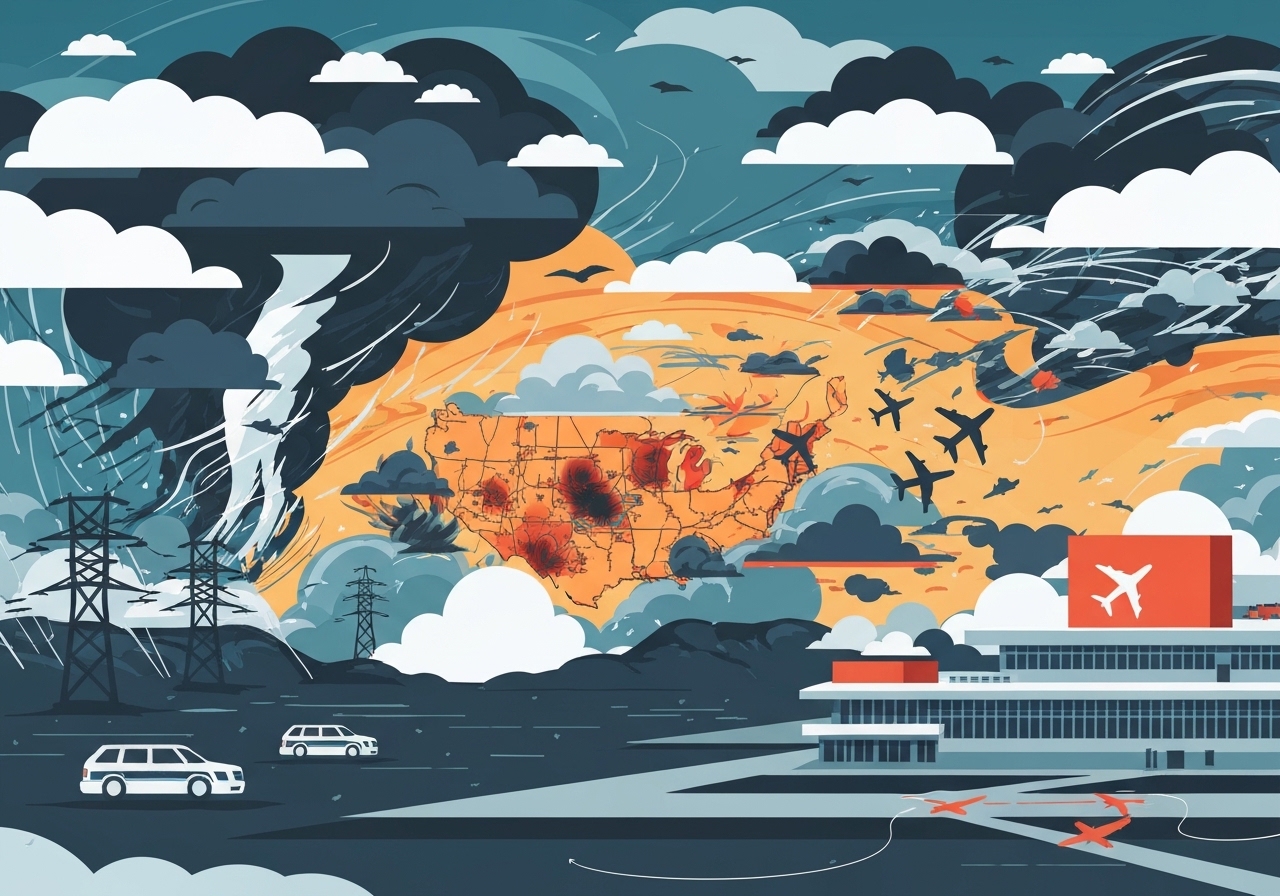
On Jan. 24, 2026, a broad winter storm moving from the southern Rocky Mountains to New England began straining regional power systems and disrupting travel across major population centers. Utilities and emergency managers reported outages and grid stress in multiple states while heavy snow and ice threatened corridors including Texas, New York and Boston. By mid‑afternoon Eastern Time, about 134,000 homes and businesses were without electricity and FlightAware recorded nearly 13,000 canceled flights through Monday. The developing situation prompted grid alerts and widespread operational responses from utilities, airports and federal weather services.
Key Takeaways
- As of 3:15 p.m. ET on Jan. 24, approximately 134,000 customers lacked power nationwide, per PowerOutage.US.
- Texas accounted for roughly 60,000 of those outages, making it one of the hardest‑hit states at that time.
- FlightAware reported nearly 13,000 canceled flights into and within the U.S. through Monday, indicating major air‑traffic disruption.
- Storm impacts span from the southern Rockies to New England, bringing a mix of heavy snow, ice and sleet across densely populated corridors.
- Grid operators issued emergency notices in affected regions as utilities took load‑mitigation and repair measures to prevent wider system failures.
- Transportation disruptions and outages are concentrated in key economic hubs — notably Houston‑area Texas, New York City, and Greater Boston.
Background
Large winter systems that span a wide latitudinal range—here from the southern Rockies through the Northeast—can produce varied hazards simultaneously: heavy wet snow, sleet, freezing rain and strong winds. Those mixed precipitation types increase the risk to power infrastructure because ice accretion and tree failures can damage lines and distribution equipment. The U.S. electric grid operates as a patchwork of balancing authorities and utilities, and extreme weather often exposes weak points in transmission and local distribution networks.
In recent winters, U.S. utilities have faced increasing pressure from more frequent severe weather and aging infrastructure, prompting both investment and emergency planning. Airports and airlines typically begin to preemptively cancel flights once meteorological models indicate sustained hazards across multiple hubs, but the breadth of this storm led to cancellations spanning several days. State and federal weather agencies issued warnings in advance, urging travel avoidance in the highest‑impact windows.
Main Event
The storm intensified on Jan. 24 as a cold airmass collided with moisture from the southern branch of the jet stream, producing broad bands of heavy precipitation across the central and eastern U.S. Utility outage trackers showed rapid increases in reported customers without service during the afternoon. In Texas, crews reported numerous localized outages tied to ice accumulation and wind‑related tree damage.
In the Northeast, sustained heavy snow and wind created hazardous travel conditions and prompted preemptive service reductions at some airports. Airlines and air‑traffic managers logged cancellations and delayed operations as deicing demands rose and runway conditions deteriorated. FlightAware’s tally of nearly 13,000 canceled flights through Monday reflected both domestic disruptions and knock‑on effects at international gateways.
Grid operators in affected regions declared emergency conditions or elevated operating notices to mobilize additional resources and coordinate load‑relief actions. Utilities staged repair crews and prioritized service restoration to critical facilities, while some local officials opened warming centers for residents without heat or power. Weather forecasts through Monday maintained the potential for additional accumulations in several metropolitan corridors.
Analysis & Implications
Short term, the immediate concerns are public safety, restoration of electric service, and stabilizing transportation networks. Outages affecting tens of thousands of customers strain utility crews and supply chains for replacement equipment; restoring service in areas hit by ice or downed trees can take days. For airports and carriers, concentrated cancellations erode scheduling buffers and raise the prospect of extended disruptions if the storm persists or if subsequent waves arrive.
Economically, outages and travel stoppages can temporarily curtail commerce in impacted metro areas, hitting retail, services and commuting patterns. Extended power loss also poses risks to healthcare facilities and cold‑sensitive supply chains. While major bulk‑power failures remained avoided in initial reports, repeated incidents of weather‑driven outages amplify calls for grid hardening, vegetation management and winterization investments across both transmission and distribution systems.
Politically and operationally, large multi‑state weather events test interagency coordination — from municipal emergency managers to regional grid operators and the federal government. Lessons from previous storms encourage prepositioning crews and mutual‑aid agreements, but the scale and geographic spread of this system raise questions about resource allocation when several regions need help simultaneously.
Comparison & Data
| Metric | Jan. 24 snapshot |
|---|---|
| Customers without power (U.S.) | ~134,000 |
| Customers without power (Texas) | ~60,000 |
| Flights canceled (through Mon.) | ~13,000 |
The table above summarizes the principal measurable impacts reported midday on Jan. 24, 2026. Those figures are evolving: outage trackers update as utilities report restorations and new interruptions, while flight cancellation totals change as carriers adjust schedules. Comparing to prior large winter storms, the outage counts are significant but below historic system‑wide collapses; nevertheless the simultaneous travel disruption marks a major short‑term economic and logistical burden.
Reactions & Quotes
Officials and operators responded quickly to the unfolding impacts, emphasizing safety and resource deployment. Utility statements highlighted ongoing repair work and coordination with regional operators, while transportation agencies cautioned travelers to expect delays.
“Crews are working around the clock to restore service where lines are down or equipment is damaged; safety remains our top priority,”
Local utility statement (official)
This statement accompanied operational notes about staged crews and planned restorations prioritized for hospitals and critical infrastructure. Airport managers likewise alerted passengers to verify flights before travel and to anticipate prolonged delays.
“We are monitoring conditions and have adjusted operations; customers should check with their airline before coming to the airport,”
Airport authority advisory (official)
Analysts emphasized the systemic strain: winter weather of this breadth tends to cascade across sectors, with grid stress, supply chain interruptions and compounded travel impacts. Experts urged residents in affected areas to prepare for multi‑day restoration timelines in places with heavy ice damage.
“When you see mixed precipitation across such a wide area, distribution systems and tree‑related failures become the main driver of extended outages,”
Energy infrastructure analyst (industry)
Unconfirmed
- Reports of isolated distribution‑substation damage in certain counties have not yet been fully verified by utility field teams.
- Some social‑media posts claiming multi‑day regional blackouts in metropolitan centers were not corroborated by official outage maps as of the latest updates.
Bottom Line
The Jan. 24, 2026 winter storm is a wide‑ranging system producing a mix of snow, ice and wind that has already caused significant localized outages and major flight cancellations. Immediate priorities are safe restoration of power, clearing transport routes, and minimizing risks to vulnerable populations. Utility mobilization and prepositioned resources have reduced the risk of larger grid collapse so far, but the situation remains dynamic.
Over the coming days, closely following official outage maps, airline notices and local advisories will be essential for residents and travelers. The event also reinforces longer‑term imperatives: investing in grid resilience, updating winterization practices and strengthening mutual‑aid frameworks to cope with multi‑region weather emergencies.
Sources
- Bloomberg (news)
- PowerOutage.US (real‑time outage tracker)
- FlightAware (airline tracking & cancellations)