
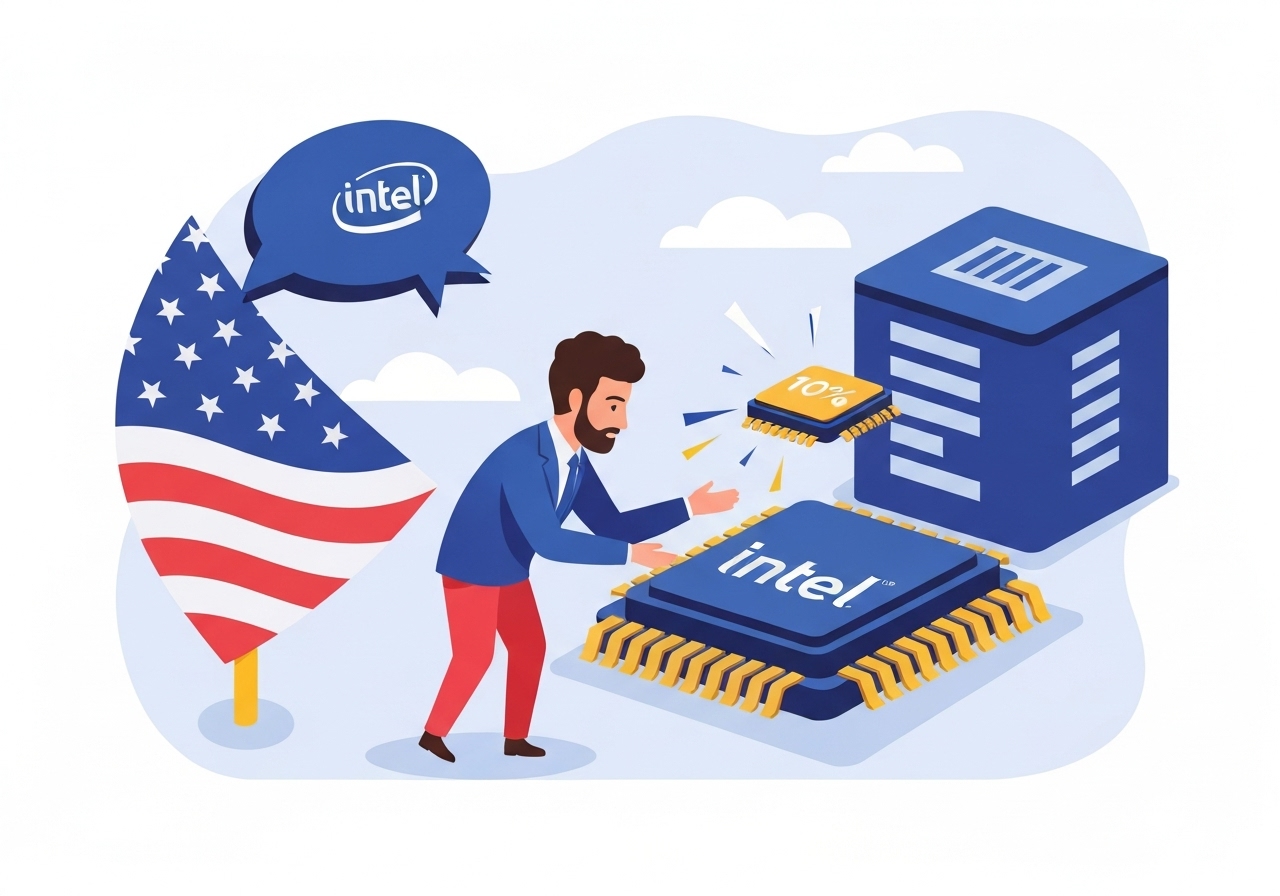
— The U.S. federal government has become Intel’s largest single shareholder after converting federal semiconductor grants into roughly a 10% equity stake, a move aimed at strengthening domestic production of advanced AI chips amid competition with China and concerns over supply-chain risks.
Key Takeaways
- The Trump administration converted federal CHIPS-era grants and other support into about a 10% ownership stake in Intel.
- The investment aims to accelerate U.S. high-end chip fabrication to reduce reliance on overseas foundries such as TSMC.
- Intel remains the only major U.S. company with substantial domestic chipmaking capacity.
- Experts warn government equity can bring political pressure and potential politicization of corporate decisions.
- The move is motivated by both economic competition with China and national-security concerns over supply-chain disruptions.
- Washington’s stake does not include voting or formal governance rights, according to officials.
Verified Facts
The federal government converted previously awarded grants under semiconductor-support programs into an ownership position of about 10% in Intel on or before September 6, 2025. That stake makes the U.S. the company’s largest single shareholder, though officials say it does not grant direct board seats or explicit voting control.
Intel, founded in 1968 and headquartered in Santa Clara, California, designs and manufactures microprocessors used in devices from laptops to data-center accelerators and automotive systems. The company’s leadership in advanced manufacturing has slipped over the past decade, with Taiwan Semiconductor Manufacturing Co. (TSMC) and Samsung taking the lead in bleeding-edge nodes.
Policymakers point to two primary drivers for the move: the strategic importance of onshore chip production for national security and the race to supply specialized processors for artificial intelligence workloads. The CHIPS and Science Act provided large grants and incentives to expand U.S. semiconductor capacity; the recent transaction converts part of that support into equity.
Experts from academic and policy centers — including Dartmouth, Georgetown’s Center for Security and Emerging Technology, and the University of Illinois — told reporters that bolstering Intel could be the clearest path for the United States to cultivate domestic advanced fabrication, since many leading chip designers (e.g., Nvidia, AMD) rely on foreign foundries for manufacturing.
Context & Impact
Strategically, the U.S. stake in Intel seeks to reduce exposure to potential foreign supply shocks. Observers cite geopolitical risks around Taiwan — where much of the world’s advanced foundry capacity is concentrated — as a key motivation for onshoring critical parts of the semiconductor supply chain.
Economically, converting grants to equity signals a long-term commitment beyond one-time subsidies and may make it easier for Washington to justify ongoing support for capital-intensive facilities. However, turning public funds into ownership also raises questions about how and when the government might divest.
- Potential industrial benefits: more domestic fabs, skilled jobs, and resilience for defense supply chains.
- Potential downsides: politicization of business decisions, perceived favoritism, and investor concerns about state involvement.
Analysts also note that while Intel has manufacturing capacity in the U.S., regaining full leadership in the most advanced process nodes will require sustained capital investment and time. Competing nations and firms continue to subsidize chipmaking aggressively.
“We are grateful for the confidence the administration has shown in Intel,”
Lip-Bu Tan, Intel CEO
Official Statements
Intel issued a brief statement thanking the administration for its confidence. Government spokespeople described the transaction as a strategic investment to secure domestic capacity for advanced chips used in AI and critical systems.
Unconfirmed
- Whether and how the government might seek to influence specific operational decisions at Intel in future procurement or board deliberations.
- The precise timetable for any eventual divestment or the terms that would govern a future sale of the federal stake.
- Detailed operational targets Intel must meet as part of the conversion (if any) beyond previously announced grant conditions.
Bottom Line
The federal equity stake in Intel represents a rare peacetime example of the U.S. government taking ownership in a major private company, driven by strategic concerns about AI leadership and supply-chain resilience. The step could accelerate domestic chipmaking but carries risks of politicization and long-term governance complications that policymakers and industry will need to manage.